
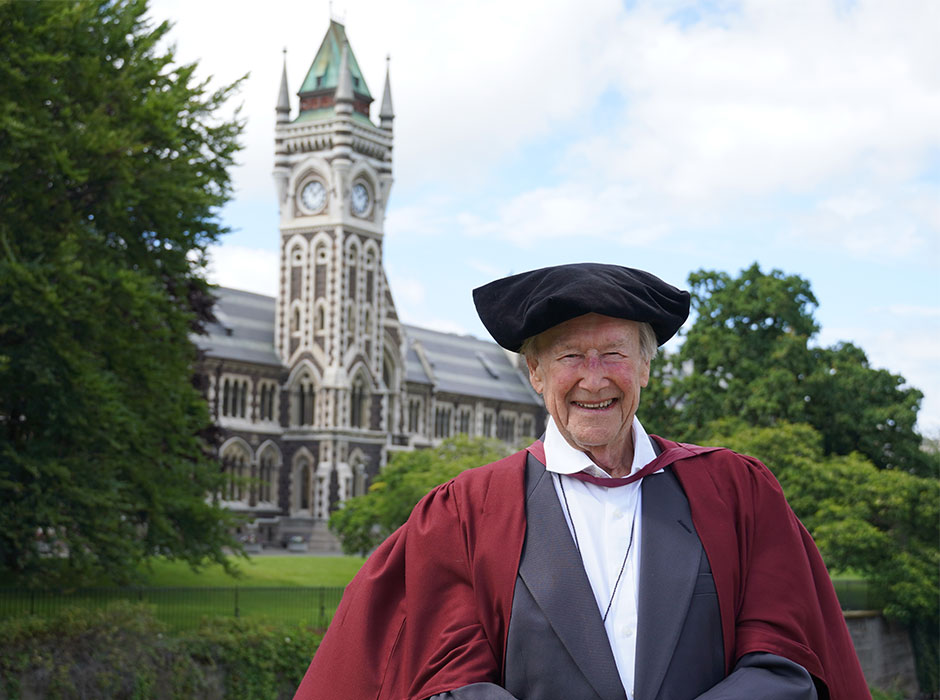
Peter Duncan (88) is believed to be the oldest person to complete a PhD at Otago.
Having dedicated his life to education, it is little wonder Peter Duncan took on PhD studies in his 80s.
When he graduates today with a Doctor of Philosophy in Education, the 88-year-old will become what is believed to be the oldest person to complete a PhD at Otago.
From construction of the Roxburgh Dam, working in the office of former Prime Minister David Lange, to guiding US educational leaders, Peter’s career has been full of opportunities and challenges.
He “thoroughly enjoyed” the more than three years he spent immersed in his PhD study and the opportunity it gave him to reflect on all he has learnt.
“Younger scholars look upward and outward to the world they may hope to change, I tended to look more inward at times, drawing upon my almost now 70 years of experience since first entering teacher’s college and university,” he says.
His PhD, Teachers’ Reflections of Changed Beliefs and Practices, follows the impact of early literacy development on teachers and how that shaped their pupils and careers through the following decades.
Peter’s family is in awe of his accomplishment.
Fourteen of them will be gathering from Wānaka, Canterbury, Canberra, Hawaii, and Arizona to celebrate in Dunedin.
“My own family, and my now extended family for the past 25 years, have been so supportive about my study – I’ve had nothing but encouragement from them.
“All acknowledge the importance of learning and education. It was they who chose to make my graduation a real family affair and I am privileged to have them be part of the celebration,” he says.
Where it started
Born and raised in Dunedin, Peter’s tertiary education started at Dunedin Teachers College and the University of Otago in 1956.
“My maths teacher in my final high school year had me present on a reasonably complex topic to the class, he thought he saw potential and suggested teachers’ college. Throughout the years of my involvement in education, especially teacher education, I have never regretted my choice of career,” he says.
While he admits to university life being “somewhat bewildering” for a 19-year-old, he embraced the Teachers College programme.
“Teachers College began to reveal my strengths through the strengths of the faculty – they were open to ideas yet somewhat formal about teaching and learning with expectations that as a teacher you carried an ethical responsibility to treat your students with respect and in turn, they would respect you.”
After his probationary year at Roxburgh Hydro School in 1958, he was invited back to College as a third-year art student.
Peter completed a BA at Otago, received an Advanced Diploma of Teaching, and later completed two Master’s Degrees at Victoria University.
After working as a school advisor in Otago, he was appointed as a Lecturer, Senior Lecturer, and finally the Chair of Professional Studies at Wellington College of Education.
He then moved to the Department of Education where he was eventually appointed as the Director of Teacher Education, before working with the Ministers of Education, Rt. Hon Lange on the Tomorrow’s Schools legislation and Hon. Lockwood Smith on the implementation of the Tomorrow’s Schools changes.
Peter’s career in New Zealand ended with a position in the newly formed Ministry of Education as the manager of Curriculum and Assessment.
But he didn’t stop there.
He spent the next six years living in the US, later working in a partnership consultancy that supported principals and district educational leaders seeking to improve literacy learning. The teacher development programme was based on the rationale underlying New Zealand early literacy teaching and the unique Ready to Read books.
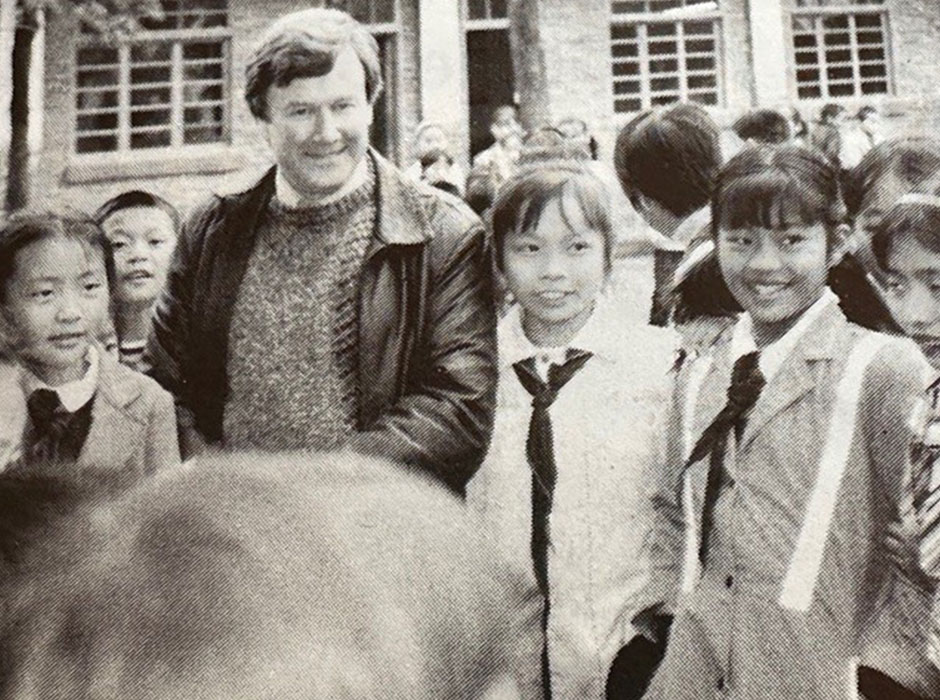
When working for the Department of Education, Peter attended a 1987 UNESCO National Conference on Innovations in Teaching Methods and Practices in China. Here he is visiting Huangtu Village School, Sichuan Province. Photo: Supplied
Coming full circle
“My literacy learning experiences in the United States evoked questions I have wrestled with for most of my career – how and why teachers can change from the traditional whole class presentational teaching of ‘one approach suits all’, to being able to manage the learning of each student’s individual progress along their continuum of learning.”
To help him find the answers, he began his PhD in the aftermath of the Covid-19 pandemic by distance from Wānaka, his local home now for over 25 years.
“Otago was my choice for my advanced degree mainly because my primary supervisor, College Dean (later Emeritus) Professor Jeffery Smith was an American trained educator. As it turned out, he was the perfect choice.”
While he missed the campus banter, making new friends, and enrichment from colleagues, Peter says his northern summer families had provided encouragement and quiet places to work, as well as breaks to refresh his thinking.
His thesis examines the role of mentorship and the place of reflecting on one’s teaching experiences on the job.
“The most complex human question of all in this is how to accept and try to change one’s teaching practices based on the evidence of improving students’ literacy outcomes.
“I concluded that the most important components of teacher change relate to developing a continuing deeper understanding of subject knowledge, a broad experience using different approaches to instruction about those things each student needs to learn, and a repertoire of classroom practices that create a flexible environment for learning using whole class, small interchangeable groups, and individual instruction.
“We can trust highly skilled teachers to know where their students are on their own continuums of learning, where they need to be, and what the teacher needs to do to get them there. They are the only ones who know these things. In this approach how a teacher uses time is critical to their effectiveness.”
When asked if further study was in his future, the response was a firm: “No. Despite the nagging questions of a forever curious.”
He hopes, however, that the example he has set inspires others.
“Age need not be a factor. If you are wishing to do something, just put your mind to it and do it. You can do it!”