
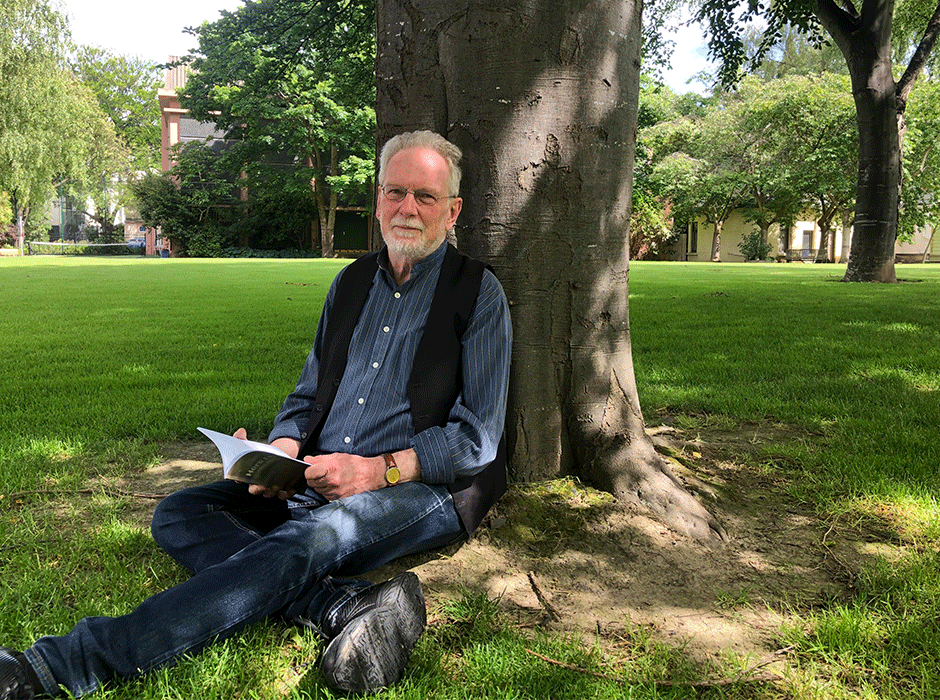
Associate Professor Paul Tankard says the fantasy genre can encourage readers to look at the world differently, and inspire hope. Paul teaches the ENGL233 Fantasy and the Imagination paper during Summer School and says tauira taking the class will read some "terrific books".
Have you ever thought that maybe the world is not quite as it seems?
Tauira taking the ENGL233 Fantasy and the Imagination Summer School paper could find themselves seeing the world in a new light. They will also get a chance to read some “terrific books”, Associate Professor Paul Tankard says.
Writers of realism are attempting to reflect back to the reader a vision of what society was like at the time of writing, Paul says.
“Fantasy writers have got a different agenda, and that is aiming to open imaginative doors and to imply that the world is not quite what it seems.
“I think that’s something worth knowing, particularly these days where everything is so technological, and we tend to think the world is a lot more ordered and mechanistic.
“People in the past have thought that there are other dimensions with which the dimensions we live in are connected, and fantasy writers illustrate that, that there might be other worlds just around the corner.
“The suggestion that that might be the case, I think, is hopeful to young people.”
The course has a strong historical component that is intended to broaden the students’ sense of what fantasy constitutes. Fantasy writers in the past were writing fantasy for a range of complicated and interesting reasons, he says.
“That’s what I find fascinating about it - when it hasn’t been mainstream, I think it broadens people’s horizons far more.
“Until recently, fantasy has been written in opposition to mainstream realism, and it always had a point to make in terms of reshaping your consciousness.
“That’s why we call the paper ‘Fantasy and the imagination’, it’s about how the imagination works, and what people do with the imagination. A lot of writers of fantasy in the past have been very interesting people who chose to write that way – against the grain.”
Incorporating a variety of texts from within the fantasy genre onto the course reading list was important to him to “expand students’ horizons”.
The course reading list includes books from more than 300 years of fantasy:
The Fairy Tales of Charles Perrault, 1697,
At the Back of the North Wind, George MacDonald, 1871,
The Lord of the Rings (all three volumes), J.R.R. Tolkien, 1954-1955,
A Wizard of Earthsea, Ursula Le Guin, 1968,
And J K Rowling’s Harry Potter and the Philosopher’s Stone, 1997, and Harry Potter and the Goblet of Fire, 2000.
Paul says the thing about the Lord of the Rings that delighted him when he first read it age 17 was the sense that it would “provide imaginative opportunities to think about the world differently”.
“To conceive of the possibility of hope in a world that seemed very much without it. I think that’s one of the things you get out of the fantasy texts that I enjoy most of all.
“Even things like fairy tales, that are not perhaps particularly profound, give us that sense of wonder and that sort of childlike delight in things, which I don’t think people should lose.
“People who are still able to find delight in things are more happy within themselves, and able to contribute more usefully to shaping the world around them, than people who think life runs on an entirely predictable track.”
The paper has been offered at both a 200 and a 300 level at Summer School for about 15 years, with no prerequisites.
-Kōrero by Koren Allpress, Communications Advisor
ENGL223 Fantasy and the Imagination
An examination of fantasy literature, from Charles Perrault to Harry Potter, and the interaction between the literary and the visual, by way of illustrations, dust jackets, stage-plays, videogames, TV and movies.
View