
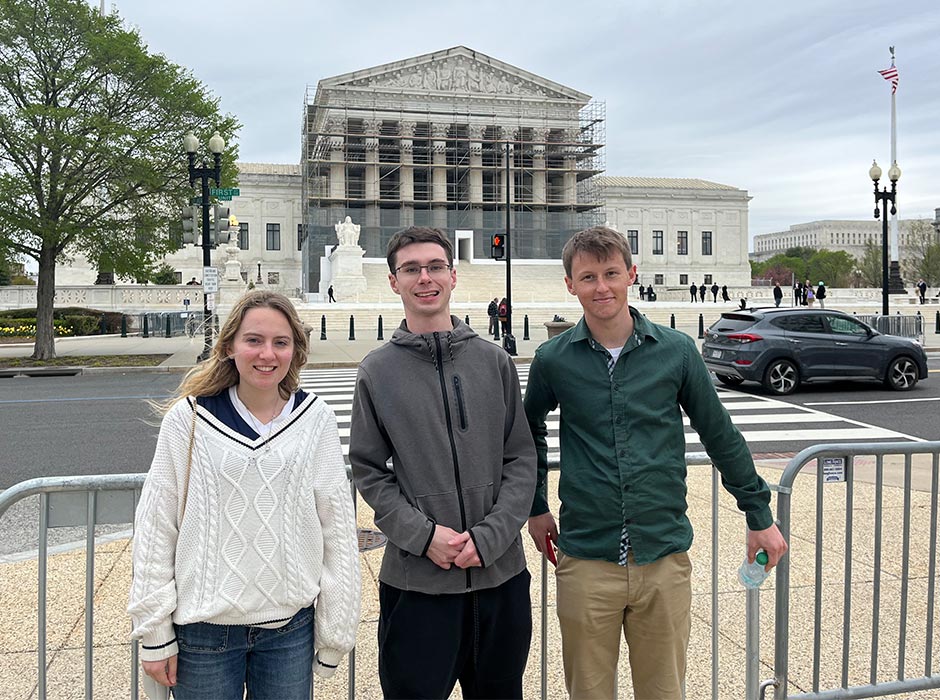
Representing Otago at the Jessup international moot court in Washington DC are researcher Annabel Rhodes and oralists Samuel Blackwood and Oliver Thorns. The Jessup is the world's largest moot court competition and includes participants from around 700 law schools.
The Union of Ambrosia and the Republic of Rovinia have beef, and the world’s finest young legal minds have been called on to resolve it.
This was the set up for 2025’s Jessup – the world's largest moot court competition, which is held annually in Washington DC. It includes participants from around 700 law schools in 100 countries and jurisdictions.
Representing Otago this year were oralists Samuel Blackwood and Oliver Thorns, and researcher Annabel Rhodes, who attended as the team's "Of Counsel". Samuel and Oliver qualified to attend Jessup through winning the Otago Mooting competition and coming second at the National Mooting Competition, while Annabel was selected by the Faculty of Law.
For those unfamiliar with mooting, Samuel describes it as a happy medium between delivering a speech and competitive debating.
“A moot is different from delivering a speech, as you have to be prepared to think on your feet. You need to be ready to answer a barrage of questions that really test your understanding of what you’re talking about, then pivot to the line of argument that seems like it’s actually landing with the judges.
“Then, compared to competitive debating, there’s much more of an onus on you in mooting to genuinely persuade your audience and back up your arguments with sources.”
For the first stage of the Jessup, the Otago team prepared written memorials (submissions) for both the Applicant and Respondent sides of the moot problem, each memorial being about 15,000 words long.
“Preparing the memorials required extensive research into the international legal issues raised by the moot problem, which is written to be very dense in terms of the number of legal issues it raises.”
The second stage of the competition required the team to deliver oral submissions on the moot problem.
So what exactly was the problem?
“The scenario was designed to raise four major issues of international law in a dispute between two fictional States – the Union of Ambrosia and the Republic of Rovinia – after Rovinia's arrest and prosecution of a former Ambrosian Interior Minister for enforced disappearances taking place in Ambrosia, solely involving Ambrosian nationals.
“We delivered oral submissions in four preliminary rounds, twice as Respondent (against the teams from Universidad Católica Andrés Bello in Venezuela and the National Law School of India) and twice as Applicant (against the teams from Peking University and the University of Toronto).”
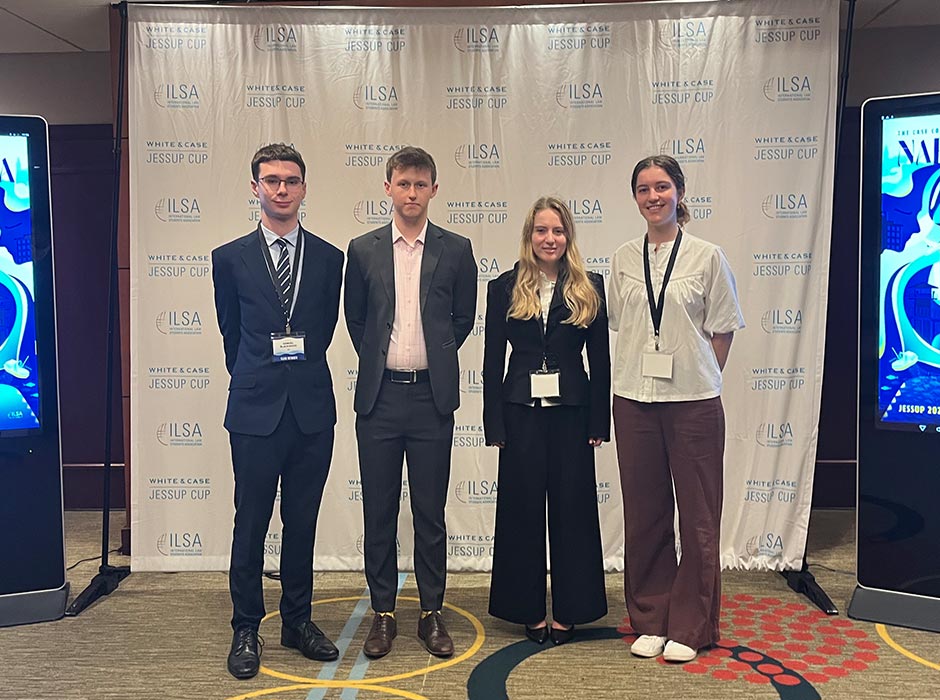
Samuel Blackwood, Oliver Thorn and Annabel Rhodes with their travelling coach Rebecca Bridgman before attending the Jessup’s opening ceremony.
While Samuel has prior experience mooting, this was his first time competing at Jessup.
The experience was highly worthwhile, he says.
“Our advocacy skills and knowledge of public international law have improved significantly – both before we left for Washington and during the International Rounds themselves.
“Our joint highlight was the people we met, who were from all around the world. For example, we met a team from Westminster International University in Tashkent (a university in Uzbekistan) prior to the opening ceremony. We also befriended the team from the University of Toronto after facing them in the final preliminary round.”
The competitors were supported by travelling coach Rebecca Bridgman and Otago law lecturer Henry Benson-Pope, who helped the team prepare ahead of the competition.
“Our students qualifying and competing well with the best law schools from around the world is a reflection on the quality of our students and of the law degree here at Otago,” Henry says.
“Jessup exposes them to the world of international law and the opportunities for them in that space upon completing their degrees. Previous Jessup competitors from Otago have gone on to very successful legal careers both in New Zealand and abroad.”
Henry offers special thanks to former Law Dean Shelley Griffiths for her efforts in helping prepare the team, and to the Alumni of the University of Otago in America and the Vice-Chancellor, whose support ensured they were able to have this experience.
“We were also very lucky that former Otago student and Jessup competitor Rebecca Bridgman agreed to coach the team. Rebecca was part of the Otago Jessup team in 2023 and is also currently a Judge’s Clerk in the Christchurch High Court.”
Samuel graduated with a Bachelor of Laws with Honours (First Class) at the end of 2024 and a Bachelor of Science majoring in economics in 2023.
In the future he’d like to pursue a career involving the intersection between the legal profession and artificial intelligence, he says.
“That intersection was the focus of my LLB (Hons) dissertation. However, I’m also very interested in international dispute resolution – particularly international arbitration.
“Attending the Jessup has definitely fostered my interest in that area.”
- Kōrero by Internal Communications Adviser Laura Hewson
Study Law at Otago
Otago's Faculty of Law is one of New Zealand's premier Law schools. Choose a Bachelor of Laws or take the next step in your legal career with one of our higher degree programmes.
Find out more