

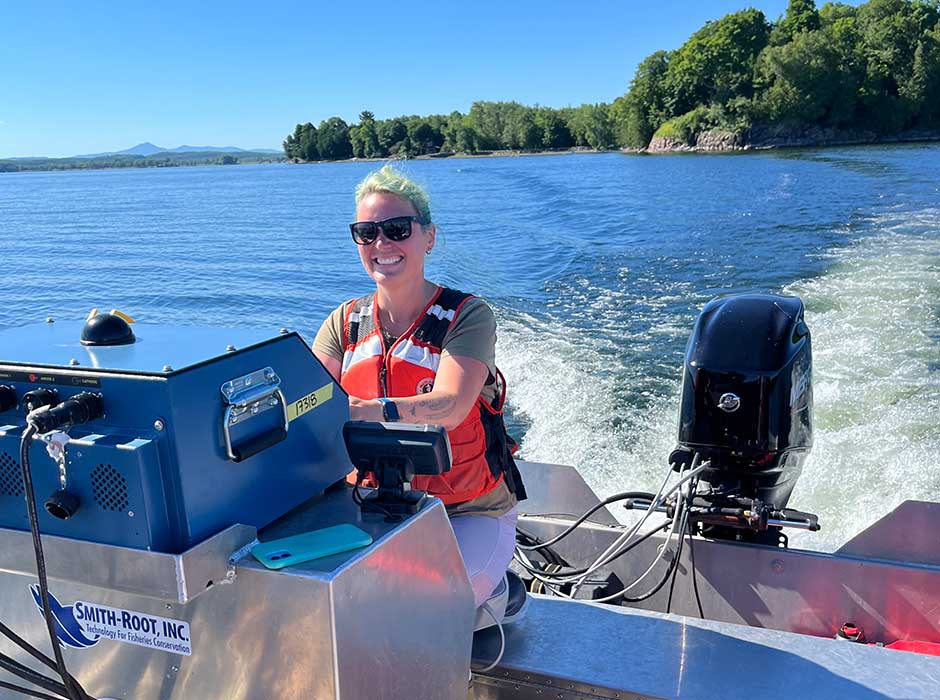
Dr Roe Stuart, a Mana Tūāpapa Future Leader Fellow based in the Department of Zoology, is exploring the hidden depths of New Zealand’s great lakes. The fish fancier defies advice not to take work home with you. “I'm currently building a fishpond in my garden,” they say.
Dr Roe Stuart didn’t find a taniwha in the unexplored depths of New Zealand’s lakes – but they may have found a new species of fish.
“We have four lakes in New Zealand that exceed 400m deep, and the deepest records we had of fish life were 90m,” says Roe, who realised while doing post-doctoral work at Lake Champlain in the USA that no one knew what lurked in Aotearoa's lakes.
“I just wondered what would be down there.”
A depth sounder found Lake Manapōuri and Lake Te Anau to be to be 467m and 430m deep respectively – about the height of Dunedin's Saddle Hill.
Searching for signs of aquatic life in the untraversed waters required 2km of rope, multiple traps set at different depths, and … a breakfast spread?
“We baited the traps with marmite,” Roe says. “I've had quite a few people ask if vegemite also works, but why risk it?”
When the team returned the next day, they pulled up the traps that had been set at different depths – and found fish in all of them.
“There’s fish in here!” Roe exclaims, reliving the moment of discovery. “It's not very often that you get to have that ‘we're the only people that know this’ moment.”
Roe found native bullies and galaxiids – small (about 12cm), iridescent climbing fish that are sometimes caught as whitebait.
“We suspect the galaxiids are kōaro or kōaro-adjacent,” Roe says.
“They're very different from our standard assumption of what a kōaro is, so they're either an adaptation or a new species.”
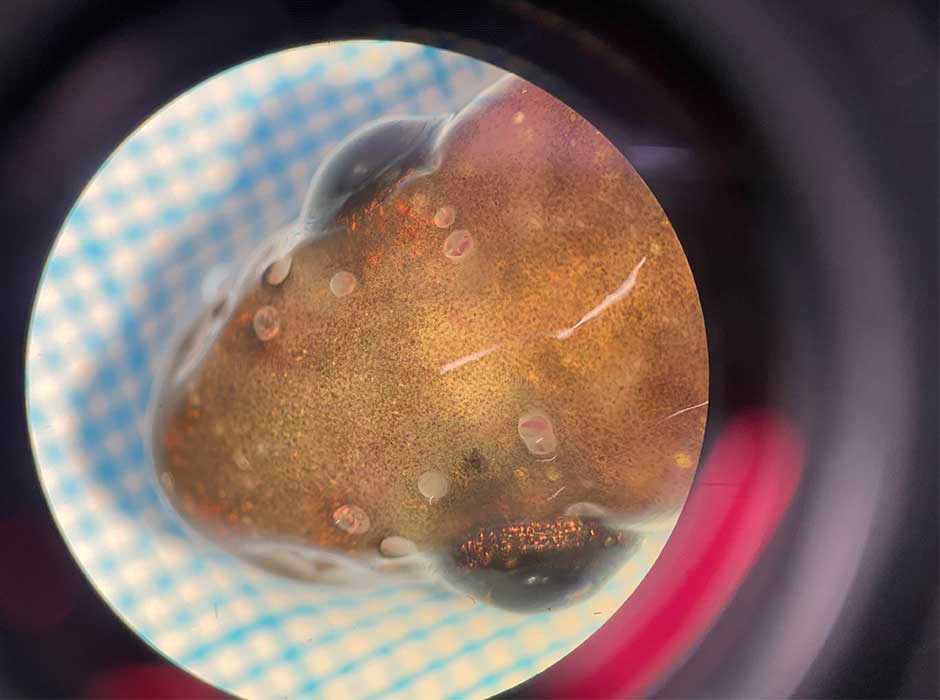
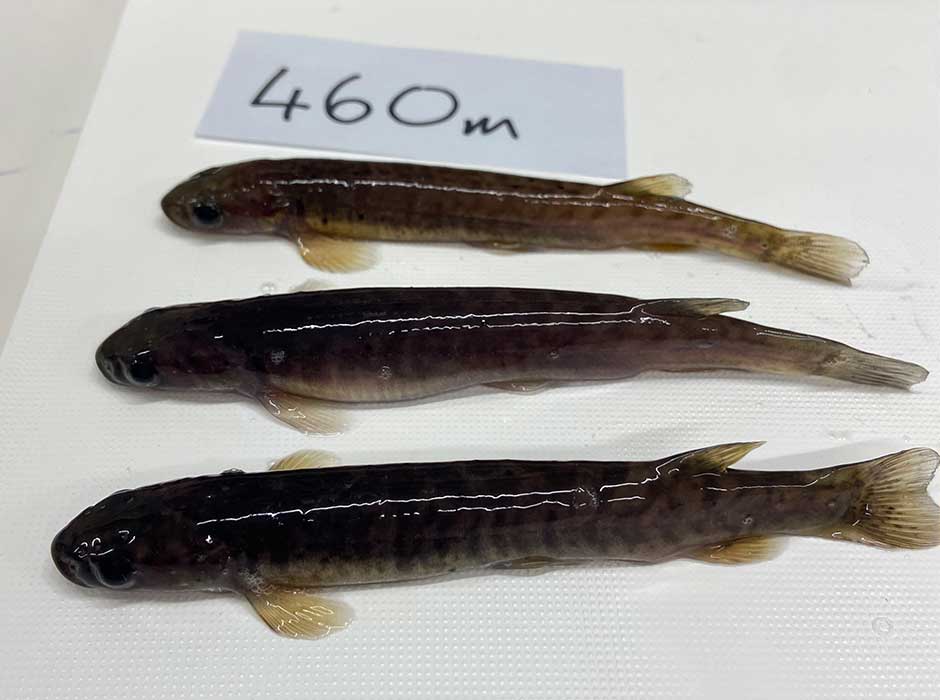
The fish have characteristics that are atypical for kōaro.
“Their eyes are huge compared to regular kōaro, and the other really cool thing about them is that they have these amazingly large sensory pores on the top of their heads. There's no light down at the bottom of the lakes, and the sensory pores likely help them navigate their habitat.”
Genetic testing will determine whether the fish are indeed a new species, but Roe’s thrilled to have found life in the lake depths at all.
“No one’s worked in New Zealand’s deep lakes before, and everyone I talked to was somewhat sceptical I might find anything – so the fact we found fish in both lakes was hugely exciting. It's hard to protect and care about something if you don't know it exists.”
The discovery provides new information and raises fresh questions.
“The fact the lakes have oxygen all the way down is informative in itself,” Roe says.
“It brings in questions about the human impacts on the surface. We don't necessarily think about those really deep basins, so how our impacts transfer is something we should consider for future management of these iconic, deep-water lakes.”
Finding hidden fish is a change of pace for Roe, who’s used to chasing aquatic life around the lab.
“I did a postdoc at the University of Vermont, looking at American eels. They wanted to see if the eels were eating sea lamprey, an invasive species in the inland waters that had got in through canals and were really detrimental.”
As part of the experiments, Roe and the team kept eels and crayfish in their labs.
“Eels are escape artists. I lost one that went down the drain and turned 90 degrees before getting stuck at a T junction,” Roe says.
“I got it out, but it turns out crayfish are as hard to contain as eels. We had crayfish roaming around the lab. After that, all our tanks had lids and tape so they wouldn't get out.”
With Roe’s arms adorned with tattoos depicting eels, zoo plankton and torrent fish, it’s clear they’re passionate about the inconspicuous creatures that inhabit our rivers and lakes.
“Fish are surprisingly charismatic. They're fascinating, they have such complex behaviours, there's so much diversity of fish, and there's still so much we don't know. Someone needs to speak up for them,” Roe says.
“Something calls to me about the overlooked and underappreciated.”
-Kōrero by Kathryn van Beek, Communications Advisor| Kaiarataki Pārokoroko
Department of Zoology
Zoologists study how animals evolved, their behaviour, physiology and ecological interactions, and how to conserve populations in the face of global change.
View