
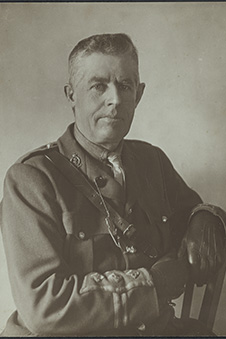
Otago Medical School’s first graduate, Ledingham Christie.*
Medical Markers
Ledingham Christie and Lincoln Nicholls are separated by 119 years and 9,998 other graduates.
Dunedin-born Dr Ledingham Christie was the Otago Medical School’s first graduate. He taught at primary schools in Otago before studying medicine at Otago University, where he was capped with an MB ChB in 1887, followed in 1890 by the first MD to be awarded to a New Zealand medical graduate.
Christie briefly set up in general practice in Outram and Milton, then spent the rest of his career overseas.
He worked as a locum, house surgeon and clinician in England, notably campaigning for nearly two decades to improve life for children of impoverished families in Bristol.
He then served as a medical officer in Borneo, a British Army surgeon during the First World War, locum in Singapore, and head of a private hospital in Malaya.
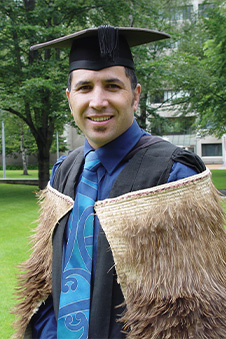
Otago Medical School’s 10,000th graduate, Lincoln Nicholls.*
His widow, Ethel Christie, funded the Medical School’s William Ledingham Christie Prize in applied anatomy and presented a portrait of him to the Medical School Library.
Dr Lincoln Nicholls became the Medical School’s 10,000th graduate when he was capped in December 2006.
Nicholls (Ngāti Raukawa) shares Christie’s teaching and army background. He taught physical education, human biology and te reo Māori in Palmerston North before entering Medical School.
Interviewed on graduating with an MB ChB, Nicholls spoke of his sense of responsibility to uphold the legacy of earlier Māori doctors trained at Otago, and to work in and with Māori communities.
A captain in the Army, he served as a medical officer at the Linton Defence Health Centre in Palmerston North for many years, during which he was deployed to Afghanistan. He then switched to orthopaedics and is currently employed at Wellington Hospital but has plans to work with his wife’s iwi in Whangārei.
A keen multisport athlete, he also aspires to complete his 10th (and final) New Zealand Ironman next year.
*Photo 1: University of Otago Medical Library Historical Collection, MS-1643/011/002, Hocken Collections - Uare Taoka o Hākena.
*Photo 2: University of Otago Division of External Engagement records, MS-5279/343, Hocken Collections - Uare Taoka o Hākena.
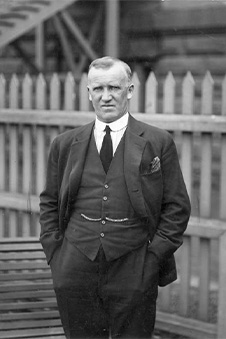
Michael Herbert Watt. New Zealand Free Lance.*
Family Medicine
Michael Watt and his sons and grandsons are among the Otago Medical School’s inter-generational graduates.
Dunedin-born Dr Michael Watt graduated with an MB ChB in 1910, followed by an MD in 1912. He gained clinical experience in Britain as a recipient of the Medical School’s second travelling scholarship, set up in private practice in Ngāruawāhia, and returned to Otago to teach physiology and anatomy.
Recruited to the Department of Public Health, he served as the first district health officer to be born and trained in New Zealand.
He was the first director of the Division of Public Health, and became deputy director-general and then director-general of health in 1930, setting up the New Zealand Medical Research Council in 1937.
Michael Watt’s two sons both studied medicine at Otago. Dr Jim Watt graduated with an MB ChB in 1937. He served in the New Zealand Army
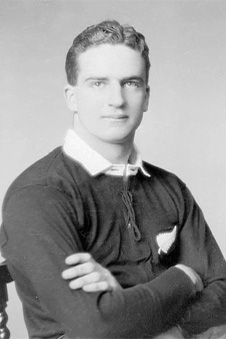
J. M. Watt.*
Medical Corp during the Second Word War, studied child health in England, specialising in paediatrics in Wellington, and became Otago’s and New Zealand’s first professor of paediatrics in 1967.
Michael Watt’s second son, Dr Malcolm Watt, graduated from Otago with an MB ChB in 1940.
He served as a medical officer with the Royal New Zealand Air Force in the Pacific during the Second World War, undertook postgraduate study in England, and worked as a physician and medical officer in the Hutt Valley.
Father Michael and sons Jim and Malcolm all played rugby for New Zealand Universities, and Jim, who was also a talented track athlete, played two tests for the All Blacks in 1936.
Jim Watt’s three sons – Michael (1968), Peter (1969) and Richard (1975) – are also Otago Medical School graduates.
*Michael Watt Photographic prints and negatives. Ref: PAColl-6388-33. Alexander Turnbull Library, Wellington, New Zealand. /records/23087675.
*J.M.Watt Crown Studios Ltd :Negatives and prints. Ref: 1/2-205549-F. Alexander Turnbull Library, Wellington, New Zealand. /records/22842807.
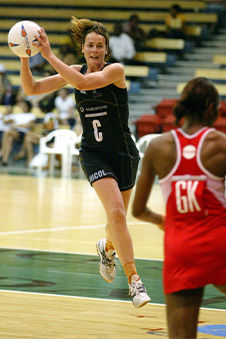
Medical alumna and netball star Lesley Nicol plays her 100th test.*
Sports Medicine
Some Medical School alumni have combined medicine and international sport, including athletes Sir Arthur Porritt and Dr Jack Lovelock; rugby player, Dr Ron Elvidge; and swimmer, Emeritus Professor Dave Gerrard.
World champions Lesley Nicol (Rumball) and David Kirk are among the modern sporting greats who fitted sporting commitments into the demands of the medical course.Dr Nicol completed degrees in physiotherapy in 1998 and medicine in 2002, while juggling a domestic and international netball career.She captained the champion Southern Sting netball team, won a world age-group championships title, and captained the Silver Ferns national team, with which she became the most capped player at the time – on 110 games – and won a World Netball Championships title in 2003. Nicol went on to specialise as a sports and exercise physician in Christchurch, and to raise three children with her husband, fellow Medical School classmate, Dr Chris Rumball.
Dr David Kirk completed an MB ChB in 1984, while pursuing a rugby career that had seen him play for the University Club, Otago and the All Blacks the previous year.
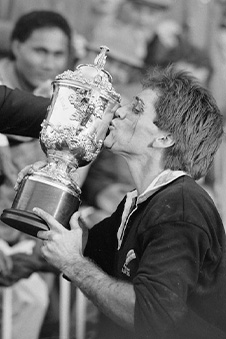
All Black captain David Kirk with the Webb Ellis Cup at Eden Park, Auckland.*
The half-back played 34 matches for the All Blacks, including captaining the national team that won the inaugural Rugby World Cup in 1987.
Kirk then took up a Rhodes Scholarship at Oxford University and became one of the Medical School graduates who opted to pursue a profession outside of medicine, in his case in the corporate world in New Zealand and Australia.
*The 2003 World Championship semi-final match against Jamaica (the team won, and also the final against Australia making them the 2003 World Champions).
*Dominion Post (Newspaper): Photographic negatives and prints of the Evening Post and Dominion newspapers. Ref: EP/1987/2998/22-F. Alexander Turnbull Library, Wellington, New Zealand.
Words and Pictures
Eileen Merriman and John Gillies are among the Medical School graduates who have mixed medicine with the creative arts.
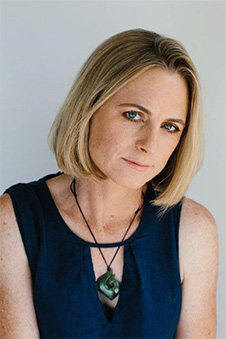
Dr Eileen Merriman.
Dr Eileen Merriman (Thompson) is the clinical director of haematology at Auckland’s North Shore Hospital, a university lecturer, mother of two school-age children, and an acclaimed fiction writer.
Merriman graduated with degrees in medical laboratory science in 1996 and medicine in 2001; she later completed a PhD at Monash University. She has worked in Nelson, Christchurch, Melbourne and Auckland.
While working full-time at North Shore Hospital since 2011, she has become a prolific writer of young adult and adult novels, short stories and flash fiction, for which she has been short-listed or placed in various literary awards.
“I was stressed. As a consultant, the buck stops with you, so there was pressure, and I was going home and mulling over my patients,” Merriman explains. “Then I started to write. It was like a form of meditation. When I wrote, I stopped mulling and stressing.”
Her latest whodunit novel, The Night She Fell, is about the death of a student who fell from her three-storey Dunedin flat.
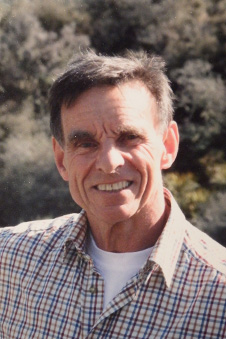
Dr John Gillies.
Dr John Gillies is a retired physician and full-time artist.
Gillies graduated in 1971, underwent specialist training in respiratory medicine, and was the clinical director of respiratory medicine with the former Canterbury District Health Board for nearly 30 years before retiring in 2008.
Gillies developed an interest in painting while still at school, and continued to paint throughout his training at Otago, busy medical career, and helping to raise four children. His paintings have been widely exhibited throughout New Zealand.
Fittingly, he has painted eight of the life-size portraits of Otago Medical School deans that adorn the walls of the Colquhoun and Barnett lectures theatres.
In 1979, Gillies formed the New Zealand Association of Artist Doctors, aimed at fostering visual and performing arts activities among doctors. “It’s one healthy way to provide balance in one’s life and a sense of fellowship,” Gillies says. He is the current vice-president and helps organise the Association’s annual concert and exhibition in Christchurch.
His latest book, Portrait of a War Artist, illuminates his medical student experiences in the Otago University Medical Company during the Vietnam War.