
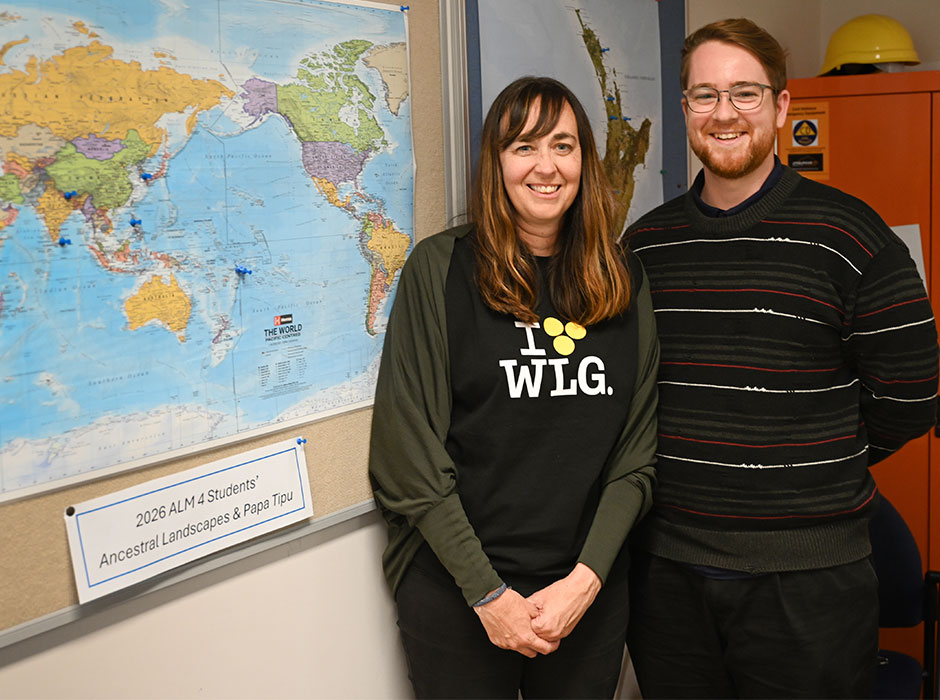
Te Whakapounga Orientation Module Convenor Dr Estelle Jaine and app developer Nathan Hollows helped fourth-year medical students get to know the Pōneke campus with a digital treasure hunt.
Fourth-year medical students kicked off their academic year in Wellington with a digital treasure hunt, using an app to complete a series of serious and not-so-serious challenges as they navigated their way around campus.
The 104 students were divided into small teams to make their way around 12 stations, donning fancy dress to conduct mock consultations in the Department of Primary Health Care, ‘performing’ keyhole surgery using a laparoscopic training unit in the Department of Surgery and Critical Care, and designing an inventive menu for Wellington Hospital’s Te Rourou Health Deli café.
Te Whakapounga Orientation Module Convenor Dr Estelle Jaine says the treasure hunt may seem light hearted, but it has a serious aim – to help students develop a sense of connection and belonging to each other, to the Pōneke campus, and to the staff they will be working with during their three years of advanced learning in medicine training.
Estelle, who also did her clinical training in Wellington, says the students come from a large cohort of med school students in Dunedin and may not have met the others before.
“This is a nice way for them to get to know the other students as well.”
At Estelle’s station outside the Education Unit, students were encouraged to put pins on a New Zealand and a world map to show the places they grew up and connected to.
“Two of the students found they had grown up 15 minutes from each other but hadn’t met before.”
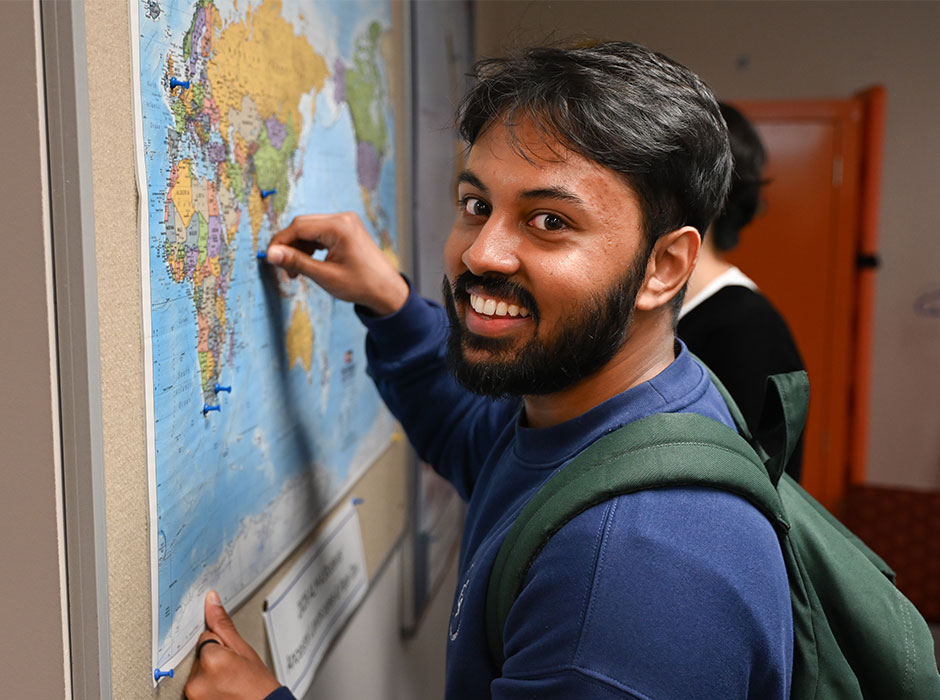
Fourth-year medical student Huthaifa Ibrahim, who grew up in Auckland, puts a pin on Sri Lanka, where he and his family are originally from.
Students also recorded their names on voice memos, providing a practical way for their teachers to ensure their names will be pronounced correctly.
The treasure hunt is based on an app developed by Otago alumnus Nathan Hollows, who was on campus to offer technical support.
Nathan, who has a Master of Science Communication and a Bachelor of Science in Computer Science, wanted to make it easy to create games for place-based learning.
The app is named Rapua, which means ‘to seek, to search, to find’, and is based on a platform he developed in 2024 for Otago’s Faculty of Law to help second-year law students learn about New Zealand law and its relationship with tikanga Māori, Māori land, and the Treaty of Waitangi.
“Place-based learning, especially through bespoke games, can be prohibitively expensive and time-consuming to create. I wanted to change that with Rapua, a platform that makes it easy to create and play games in real-world spaces.”
The treasure hunt stations were designed by Education Unit, teaching and other departmental staff in Wellington and Nathan was able to upload the content into the app. The students followed prompts on their smart-phones to search for important locations around campus, including the library, the IT department – and the coffee machine.
“They shouldn’t get lost after this,” he says.
Orientation activities finished with pizza for afternoon tea and prizes for the most creative teams, best photographs, and for videos of their consultations. The prizes were sponsored by MAS – Medical Assurance Society and the Royal New Zealand College of General Practitioners.
– Kōrero by Cheryl Norrie, Wellington Communications Adviser
University of Otago, Wellington
We teach medicine, radiation therapy, physiotherapy, postgraduate qualifications and papers, and undertake a wide variety of health-based research.
View