
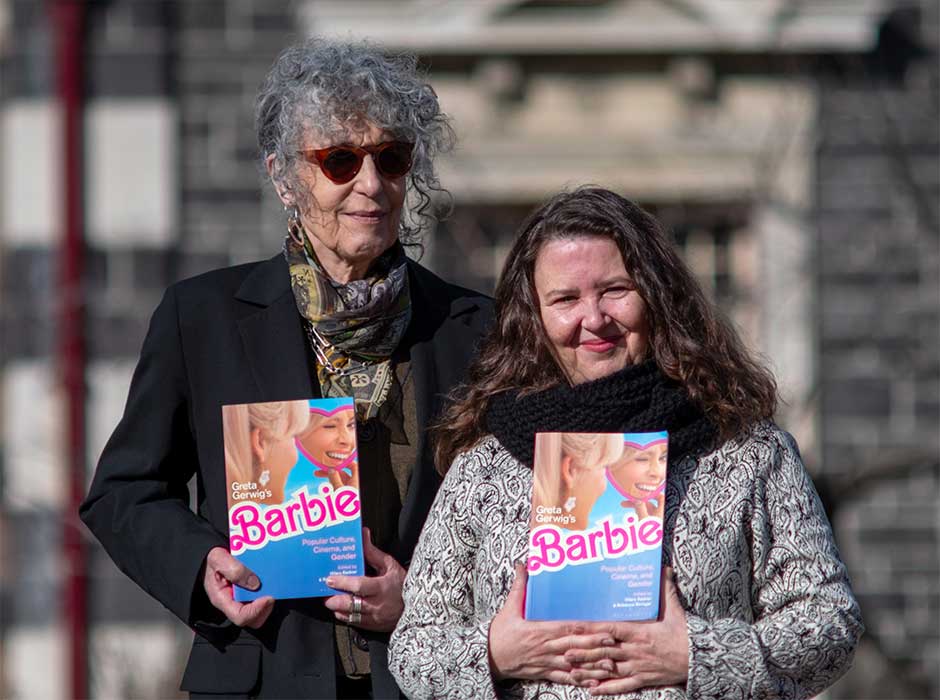
Emeritus Professor Hilary Radner, left, and Associate Professor Rebecca Stringer have co-edited the newly released book 'Greta Gerwig's Barbie: Popular Culture, Cinema, and Gender'.
People may know it as the highest grossing box office film for 2023, or the highest grossing film to have ever been directed or co-directed by a woman.
Some audiences loved it and some loathed it.
But for two Otago academics, Associate Professor Rebecca Stringer and Emeritus Professor Hilary Radner, Greta Gerwig’s Barbie represents so much more than a movie about a doll brought to life.
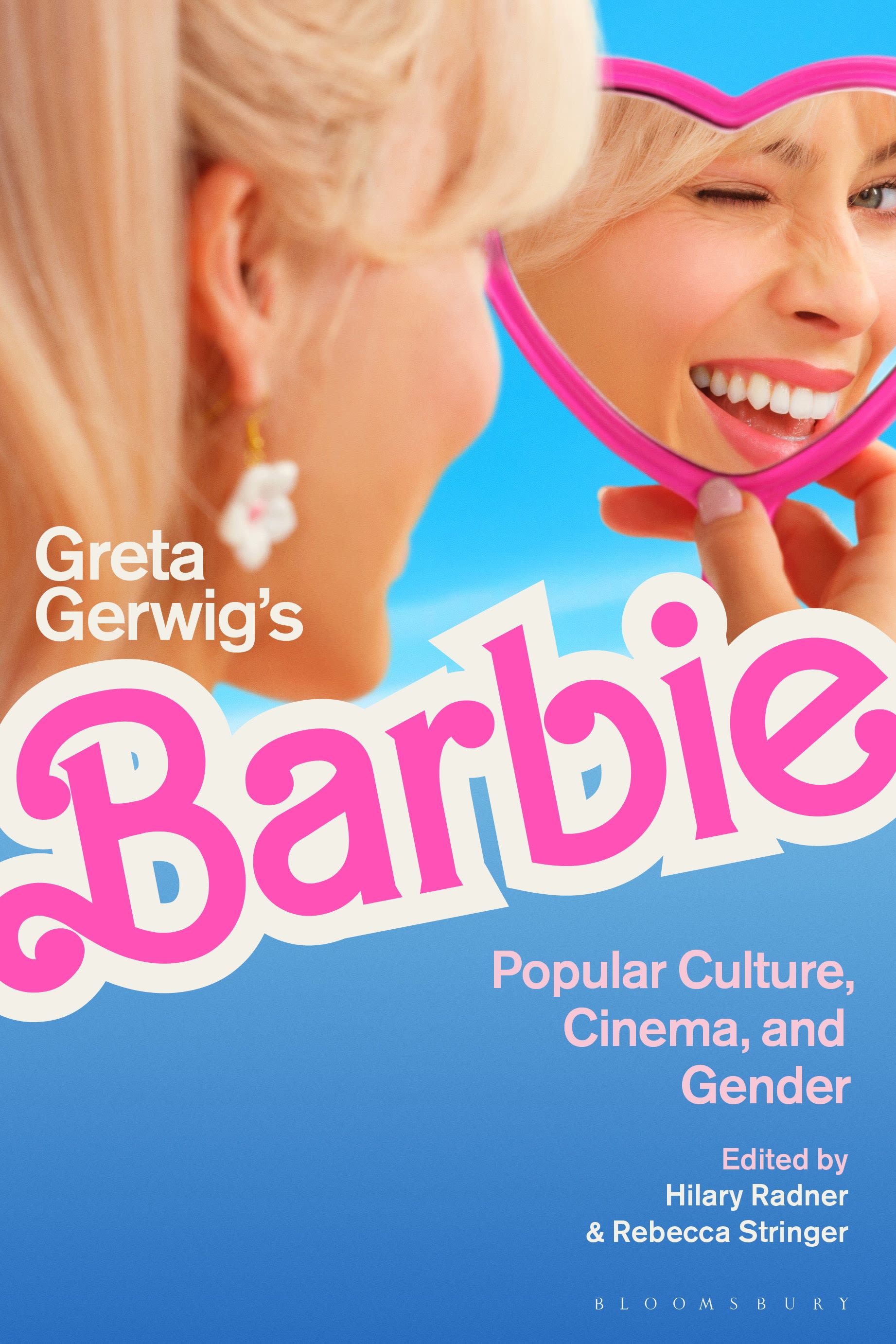
The cover of Greta Gerwig's Barbie: Popular Culture, Cinema and Gender
“When a woman directs a film as successful as Barbie, feminists like us are bound to take notice and want to know more,” Rebecca says.
Hilary, formerly of History and Art History and Theory, and Rebecca, of Sociology, Gender Studies and Criminology, spent two and a half years assembling a selection of essays written by academics to put into their newly released book Greta Gerwig’s Barbie: Popular Culture, Cinema, and Gender.
“For Hilary and me, it’s exciting to have brought together such a talented group of authors, and to be part of the critical reception of a benchmark film,” Rebecca says.
“Barbie swam against the tide towards its recording-breaking success, and knowingly mirrors the themes, contradictions and tensions of its cultural moment.”
The book is divided into four parts.
The chapters within the first part are written by senior scholars and help contextualise Barbie as a cultural moment, while chapters in the second part focus on Greta, situating her as a contemporary auteur director and discussing signature themes of irony and self-fashioning in her films, Rebecca says.
The third part of the book focuses on identity, with chapters offering a queer reading of Barbie, discussions of gender binarism in the film’s soundtrack, audience reception, and Ken’s post-millennial masculinity.
And the chapters in the final part of the book on polemics of Barbie address the ambiguities of contemporary feminism, the intersectional politics of gender, race and class, Barbie as advertising, and the ecological concerns haunting Barbie’s kitsch aesthetic.

Associate Professor Rebecca Stringer was excited to come across a copy of the book in a Waterstones bookstore in London, UK.
Hilary explains that she based the structure and choice of authors on her long experience teaching in cinema and visual culture, starting with three commissioned chapters from three very senior scholars in the field: Tom Schatz on the film industry; Patricia White on Greta Gerwig and the controversial history of representations of American Girlhood, going back to 19th century writer Louisa May Alcott; and Pamela Church Gibson on film, fashion and consumption.
“These authors highlighted thematics of the film that would animate the subsequent sections of the book: from gender and identity to the larger political and ideological debates generated by the film on topics ranging from neo-liberal feminism to ecological policies,” Hilary says.
Hilary also sought to diversify the authorial line up by inviting authors from outside the Anglophone world. As a result the book features a chapter by a scholar from France and a chapter from a scholar in Turkey.
Including authors that spanned generations was also important to her, and she was able to achieve this by including Thomas Schatz and Alex Dickie. Tom, who wrote the lead article on the “Barbenheimer Phenomenon”, was Hilary’s PhD supervisor, while Alex, who contributed a chapter on Gerwig as a contemporary auteur, completed an Honours degree and Master of Arts at the University of Otago under Hilary’s supervision.
Hilary says her interest in the film was triggered by an invitation to contribute to a Forum on the “Barbenheimer” phenomenon – the advertising lead-up and simultaneous release of Barbie and Oppenheimer, expressed in the portmanteau term “Barbenheimer”– for the Australasian Journal of American Studies (AJAS).
Hilary has written three monographs - Shopping Around: Feminine Culture and the Pursuit of Pleasure (1995), Neo-Feminist Cinema (2011) and The New Woman’s Film (2017), and has a long-standing interest in the relations between popular narratives, gender and feminism, in particular as manifested in the woman’s film, which was the basis for this invitation from AJAS.
Hilary has had a long-standing interest in Greta, having previously written a chapter on one of her earlier films Francis Ha (Noah Baumbach, 2012) that saw Greta co-screenwriting and playing the lead. She says a book of essays seemed the “appropriate vehicle to explore the complicated nexus of influences that created this film, from the toy conglomerate Mattel (a major financer) to the indie film duo Noah Baumbach and Greta Gerwig who wrote the screenplay”.
Rebecca says she did some media on Barbie when the movie premiered and was delighted when Hilary asked her to come in on the project as chapter contributor and co-editor.
It’s not the first time the pair have collaborated on a project – their first edited volume, Feminism at the Movies (2012), was really successful, and the Barbie movie provided the perfect occasion to collaborate again.
“We do have a vague hope that Greta might see the book She has a long-standing interest in literary criticism,” Hilary comments.
The book was released in the northern hemisphere in May, and the southern hemisphere on June 25, 2026. Greta Gerwig’s Barbie: Popular Culture, Cinema and Gender is in stock at the University Book Shop, Dunedin. It is also available online through Bloomsbury Australia and online book retailers such Fishpond NZ and The Nile NZ.
-Kōrero by Koren Allpress, internal communications adivser
Sociology, Gender Studies and Criminology
Explore the contemporary world in a challenging and exciting interdisciplinary environment.
View