
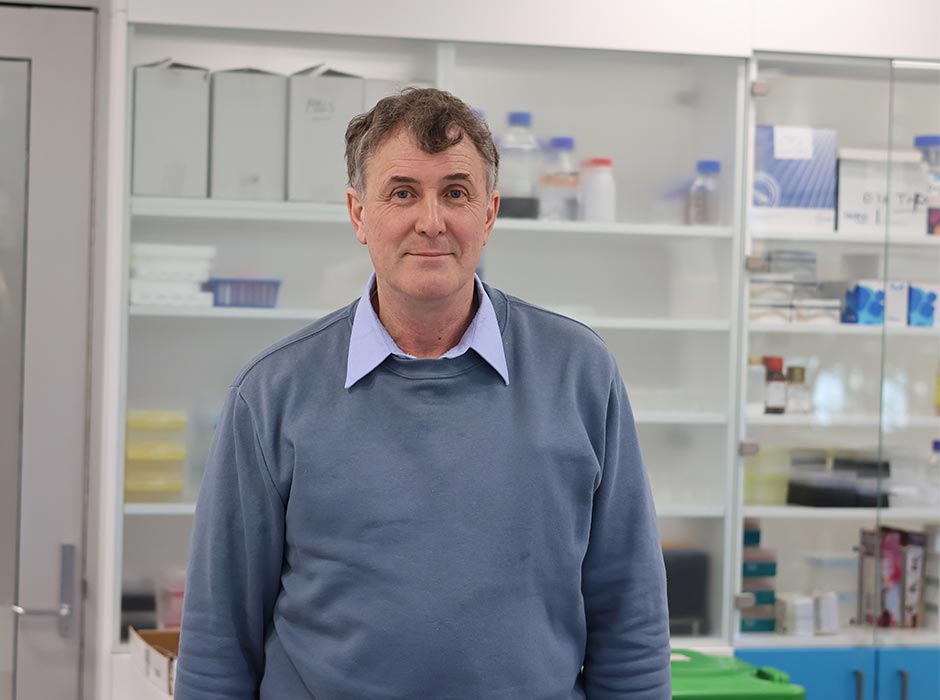
Department of Botany Associate Professor David Burritt, pictured here plotting the murder of convolvulus and woolly nightshade, is working with a Waikato team to develop glyphosate-free weedkillers from marine compounds.
Though the brown-thumbed among us might disagree, Associate Professor David Burritt claims that “when you want to kill a plant, you need a plant scientist”.
But the Otago botanist doesn’t only want to kill one plant, he wants to destroy plants at scale – and his contributions to the development of next-generation, glyphosate-free weedkillers were recently profiled by Farmers Weekly NZ.
David’s working with University of Waikato researchers to employ marine compounds from seaweed in the battle against convolvulus, woolly nightshade, and other C4 weeds that cause problems for crops.
“We’re bioprospecting New Zealand marine organisms to produce a natural product. We’re looking at molecules that might be able to replace herbicides, and seaweeds produce lot of bioactive molecules,” David says.
“The problem with a lot of the current herbicides is that many of the highly selective ones have been taken off the market because they’ve been shown to be toxic to us and to the environment. People are looking to next-generation weedkillers, and we’re getting some quite cool results with seaweeds. There’s a huge amount of scope there.”
“I always tell my students there’s absolutely no magic in modern agricultural science, it’s hard science and hard work.”
The project team, led by the University of Waikato’s Professor of Coastal Science Dr Chris Battershill, is now partnering with Ngāti Pūkenga to trial compounds from sustainably sourced seaweed. The formulations disrupt the photosynthesis of C4 plants but are unlikely to affect mammals or invertebrates, and David hopes they will contribute to a safer environment while making life easier for farmers.
“I always tell my students there’s absolutely no magic in modern agricultural science, it’s hard science and hard work,” David says.
“What people don’t realise with the food chain is that going from soil and water to what we eat involves a huge amount of work. People seem to think modern agriculture is like growing fruit and veges in your garden at home, but it’s absolutely not. Farming’s not about having a little lifestyle block. It’s hundreds of thousands of acres. It’s a different scale.”
Though the project team’s working with seaweed, David’s involvement in the project began with another plant – kiwifruit.
“Chris’s daughter Zoe Battershill, who’s one of my students, is working on kiwifruit as part of her PhD. It was through her that I got to know Chris, and his team brought me on as a plant scientist,” David says.
Kiwifruit and seaweed exploration are just two adventures in a varied cross-disciplinary career that’s seen David take tools from ecology and molecular biology and apply them to everything from pasture and grasses, to bioactives for humans, to sustainable plant production.
“When I was at university, biotechnology was really new, and I had an excellent lecturer who was pushing how useful it would be for the future. It’s basically a discipline where you use modern tools – molecular or computer-based techniques, or biological systems – to solve a technological or industry problem. It includes genetic engineering, but it’s much more than that.”
David would love to see more students follow him into the field he finds rewarding and endlessly fascinating.
“Why bother with plants that grow slowly and often have thorns? Because plants are fascinating. There’s such wonderful diversity out there, and it’s really important that we preserve it,” he says.
“There’s got to be a balance between the natural world and managed farming systems, and a good understanding of plant biology is absolutely essential if you want to be a farmer and grow plants in the field. If you’ve got 30,000 acres and a problem, you need to know if it’s a pollutant, a fungal disease or an insect attack.”
But like the cobbler who never fixes their own shoes or the builder with the unfinished kitchen, David doesn’t apply his considerable knowledge to his own garden – which, given his current passion for killing plants, might be for the best.
“I don’t have time to grow fruit and vegetables … but I do get really excited if I see a new lichen or moss growing on my concrete retaining walls.”
– Kōrero by Kathryn van Beek, Communications Advisor | Kaiarataki Pārokoroko
Department of Botany
The Department of Botany at Otago is the only university department in New Zealand specialising in the science of plants, and one of only a few in Australasia.
Study Botany