
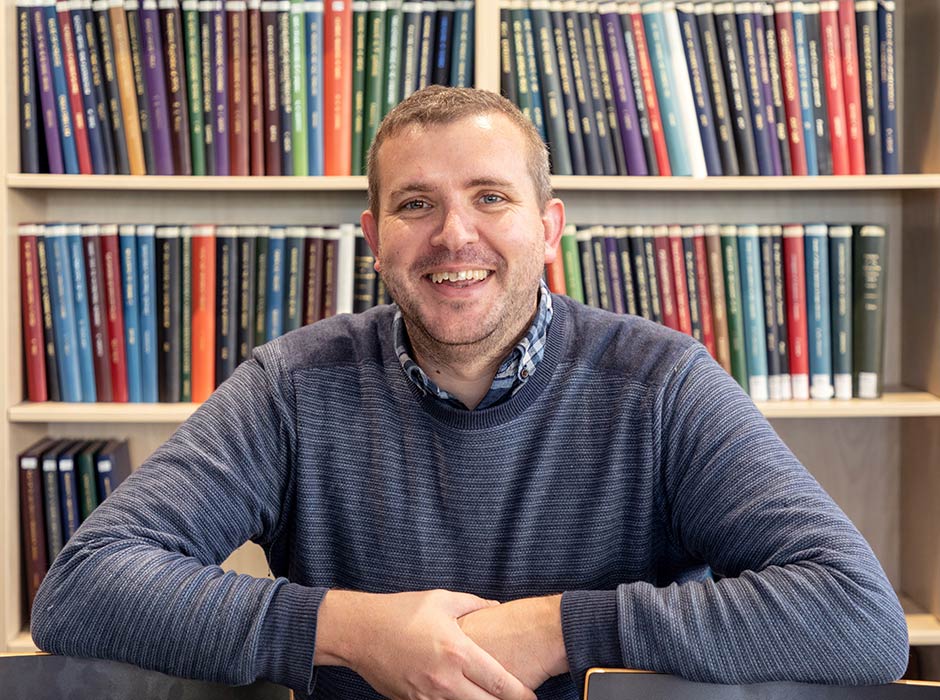
Faculty of Biomedical Sciences researcher Dr Nathan Kenny is using the latest genomics tools to improve the resilience of green-lipped mussels to climate change.
Facing climate change pressures from warming seas to toxic blooms, Aotearoa New Zealand’s half-billion-dollar mussel industry and cherished taonga are under threat. Dr Nathan Kenny's team is now using revolutionary genomics to pinpoint and help breed resilience into the species.
They’re a taonga and seafood staple that filter our coasts, feed communities, and power a half-billion-dollar industry.
But, increasingly, Aotearoa green-lipped mussels (kuku or kūtai) are literally feeling the heat of a changing marine environment.
For Dr Nathan Kenny (Te Ātiawa and Ngāi Tahu), these pressures, ranging from warming seas and ocean acidification to algal blooms and pathogens, underscore the urgency of understanding how this cherished species is responding.
Nathan, an evolutionary genomics scientist at Otago’s Faculty of Biomedical Sciences, says wild and farmed mussels are particularly vulnerable to damaging marine heatwave events.
During these episodes, which are projected to grow longer, stronger, and more frequent under climate change scenarios, mussels sitting in sun-exposed, near-shore habitats can’t retreat to cooler waters as fish species can.
Research has also shown that higher temperatures weaken their physiology, making them susceptible to pathogens and leaving them skinnier, with less flesh for consumers.
At the same time, mussels have been observed to tolerate a wide temperature range across New Zealand, meaning there is resilience for breeders to harness.
“If we want a resilient industry, then we need to understand how resilience is encoded in their genomes.”
Decoding kuku
Over a career that has taken him from the University of Oxford to the Chinese University of Hong Kong and London’s Natural History Museum, Nathan’s research has long focused on using genomics to explore how unusual organisms survive in hostile environments.
Recent leaps have transformed his field, making the once expensive and lengthy process of genomic research something that can be done at a fraction of the cost and time.
Advanced genomic protocols, previously only feasible for high-value livestock like cattle and sheep, can now be applied economically to species such as kuku.
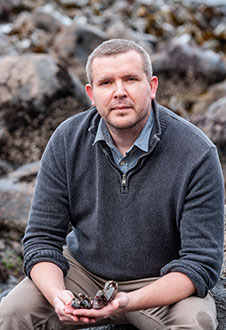
Dr Nathan Kenny
Nathan’s Otago team recently completed the first high-quality genome for the species, providing a crucial blueprint to pinpoint those genetic traits that help the mussels withstand environmental stressors.
He says the task came with its own unique challenges: mollusc DNA is notoriously hard to extract, often clogged with long chain polysaccharides.
Compounding the challenge, the animals’ genomes resist neat assembly.
“They’ve got very variable genomes, and that might mean that different populations are quite distinct,” Nathan says.
This variability - potentially linked to the concept of a core genome that all mussels share, and an accessory genome that only certain individuals or populations possess - underpins their interesting biology but complicates the sequencing process.
Nathan says the trick was to start with sperm samples: “You up-end them over a cup, collect the sperm, and you can get really good DNA.”
The resulting genome, about a third the size of our own but far more variable, is a foundation for precise breeding.
“People have bred animals for thousands of years without genomes,” he says. “But once you know what you’re doing, you can be far more precise.”
That precision matters. Nathan’s working hypothesis suggests that early in development, larvae that survive better tend to develop their shell a little bit quicker.
Identifying the genes behind that resilience could allow selective breeding of tougher mussel strains as ocean waters warm.
But Nathan adds that there’s much more to the picture than temperature.
In one recent research programme, Dr Hannah Greenhough investigated how harmful algal blooms, often triggered by nutrient runoff, interact with warming seas and oxygen depletion.
“Climate change is causing harmful algal bloom events to increase in frequency and duration, and it’s also becoming more common for blooms to coincide with marine heatwaves,” Hannah says.
At the same time, climate change could enable the range expansion of species of toxic microalgae that have previously not been observed in New Zealand, posing further risks to both marine ecosystems and food safety, she says.
Nathan says temperature spikes can co-occur with harmful algal blooms and deoxygenation of the water column.
“These become additive problems that can be much worse than just one of them on their own.”
PhD student Mary Hawkes is applying single-cell sequencing to mussel embryos, teasing apart which genes switch on in different tissues in the first 48 hours of life.
“Single cell sequencing is the new frontier,” Mary says.
“In the past we would never have been able to get such detailed information about such an understudied species so quickly.”
Nathan says: “You can work out what genes are turned on in the cells that go on to make the shell.”
This highlights how this novel technique provides a powerful way to pinpoint resilience pathways, he says.
Honours student Daisy Power, meanwhile, has been studying microRNAs: tiny regulators that fine-tune which genes are expressed.
She has uncovered both novel and canonical or conserved microRNAs active under climate stress, offering another layer of insight into how mussels adapt.
“Characterising microRNAs in a species where they hadn’t been studied before was challenging at times, as there wasn’t always a clear roadmap to follow,” Daisy says.
“But that also made it exciting, there is so much potential for discovery.”
Nathan says that microRNAs act as an “extra control” on what’s being turned on and off.
Together, these strands illustrate the programme’s breadth: from field observations of mortality events to molecular signatures inside single cells.
Collaborative science
Nathan stresses that this is not just lab work. His group partners closely with iwi, especially Te Ātiawa in the Marlborough Sounds, and with the Cawthron Institute in Nelson.
That collaboration matters because climate impacts are already biting. Marine heatwaves recently killed salmon in the Sounds, while mussel farmers are trialling deeper longlines and new sites around Stewart Island.
“Choices need to be made about how you respond: whether you move offshore, mechanise, or rethink locations altogether,” Nathan says.
While mussels are the flagship, Nathan’s curiosity ranges across the seafloor. He has sequenced Antarctic sponges, studied blue sea stars, and is involved in projects on pāua, kina, and salmon, among other species.
“Green-lipped mussels remain a good model, but the broader question is how broadcast-spawning invertebrates - which produce larvae and send them into the sea hoping they survive - will cope,” he says.
“They all face the same pressures, even if they’re not charismatic or farmed.”
So how far can genomics take us?
Nathan is cautiously optimistic about how the technology can assist in protecting and sustaining mussel stocks, even if climate change is moving faster than natural selection.
In the near term, breeding programmes guided by genomics may buffer the industry and protect taonga species.
“If they had 500 or 1000 years, they’d probably be able adapt on their own,” he says.
“With climate change, we’re unfortunately having to put our finger on the scales a little bit.”