
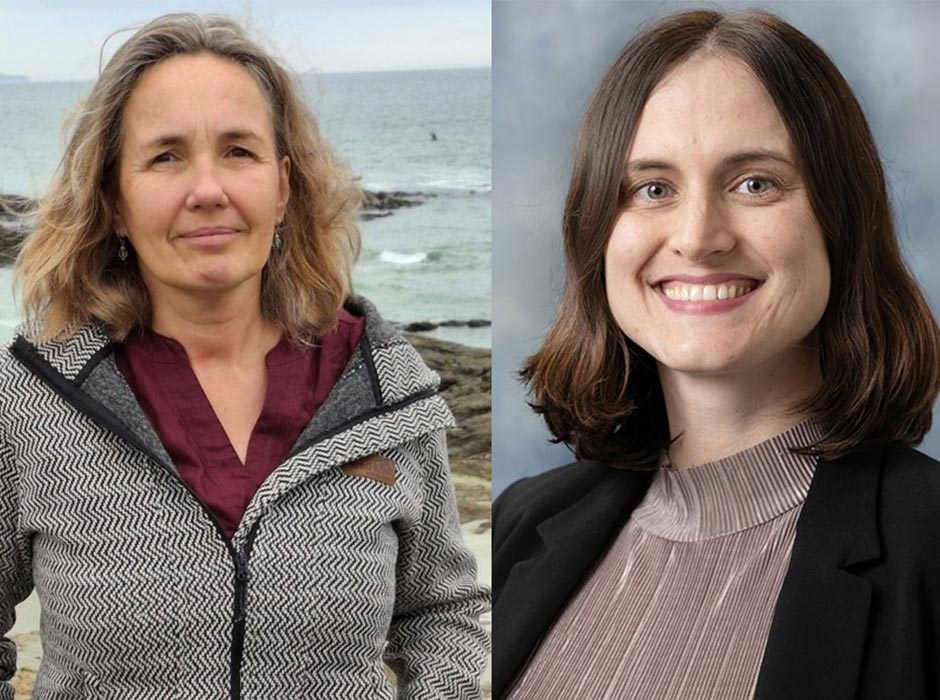
The UORG triumphant: (from left) Associate Professor Viktoria Kahui and Dr Maddie Judge.
There’s plenty of environmental heart and innovative thinking in the latest two Division of Commerce projects to receive University of Otago Research Grant funding.
One new study will examine the conservation value people hold for our nation’s pakake/sea lion population. The other will assess how public opinion can be best nudged towards embracing sustainable and socially just food systems.
Associate Professor Viktoria Kahui, a specialist in environmental economics, was awarded $20,000 for a project that will examine the potential of anthropomorphism as an effective conservation tool to protect Aotearoa’s pakake.
Titled ‘Sharing the beach with sea lion ‘Mum’ and her descendants: does naming increase Willingness to Pay for conservation?’, Viktoria’s research was inspired by a whiskered matriarch who birthed a pup on a farm near the Otago coast in 1993.
Pakake had previously been driven away from our shores due to human settlement and choosing to have their families on the subantarctic islands. ‘Mum’ changed that by becoming the first pakake to give birth on mainland New Zealand in over 200 years. She subsequently gave birth to 10 more pups, helping to re-establish the species in Aotearoa. There’s even a statue of her at St Clair Beach in Dunedin.
“Communities have largely been supportive of sharing the beach with the growing cohort of Mum’s descendants, and we want to conduct a nationwide survey to see if naming pakake increases people’s Willingness to Pay (WTP) for conservation,” Viktoria says.
“In this case, WTP is about the value people put on sea lions being able to return to our coastline. If you can identify the economic value people place on this, you can then argue a better allocation of resources at a governmental level – such as the Department of Conservation (DOC) – for sea lion protection.”
Along with colleagues from the Department of Economics (Professor Stephen Knowles and Dr Neha Agarwal), Viktoria will seek to determine if naming might prove a useful, low-cost tool to support the re-emergence of wildlife populations at the edge of natural and urban habitats.
She says the idea for the project came to her during a DOC presentation.
“One of the rangers put up a slide that showed the whakapapa of a sea lion and her descendants and included their names. I was stunned because I’d never seen that done for animals. It really piqued my interest.”
Viktoria says there are many examples of this internationally – such as ‘Fat Albert’, the heaviest polar bear in Alaska, ‘Cecil the Lion’, who made international headlines for being killed in Zimbabwe by an American trophy hunter, and ‘Otis the Brown Bear’, four-time winner of an Alaskan competition called Fat Bear Week.
“Increasingly, naming is a way to ascribe personality or value to wildlife animals in an anthropomorphic way, which can be seen as an effective tool to foster empathy and stimulate pro-conservation behaviour.”
Pro-conservation behaviour is also in the sights of Dr Maddie Judge (Department of Marketing). She was awarded $31,394 for a two-year research project titled ‘Investigating the role of moralisation and collective action in accelerating sustainable and just food system transitions.’
Maddie will turn her research gaze towards the central role food systems play in societal issues such as climate change, biodiversity loss and public health challenges. Her initial focus will be on the issue of a sustainable protein transition – a systemic shift away from producing and consuming high levels of animal-based protein towards more plant-based and alternative proteins.
As a researcher in social and environmental psychology, Maddie is interested in how social psychological processes can accelerate or hinder transitions towards more sustainable futures. She sees great potential in the power of moral innovators to inspire social tipping points and compel others to take action.
“Integrating social psychology with sustainability transitions theory, this research will examine how morally motivated minorities can collectively influence public opinion and contribute to wider social and institutional change in food systems over time.
“Addressing the climate crisis and related sustainability challenges will require transformative changes to existing societal systems. Current approaches to social change often focus either on individual-level behaviour change or on systems-level change, with relatively less attention paid to how collective social processes connect these levels.
“The findings will provide evidence-based guidance for policymakers, advocates, and practitioners who seek to support public engagement and accelerate sustainable and just food system transitions.”
– Kōrero by Claire Finlayson, Communications Adviser (Otago Business School)
Study Business at Otago
The Otago Business School programmes include a variety of subjects to prepare you for a career in business, or help you take your career further.
More about Business