
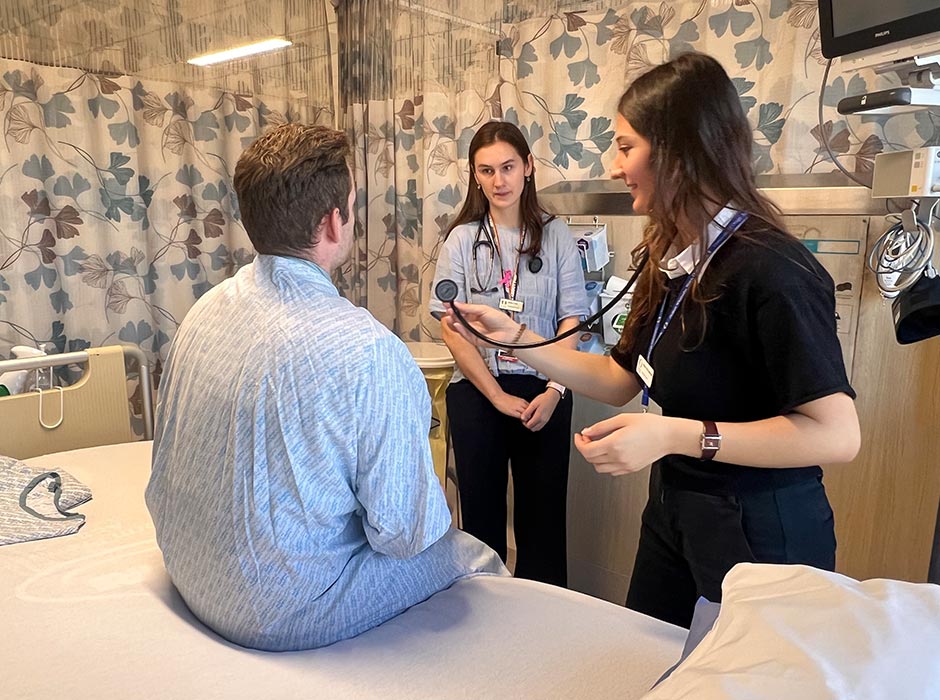
Fourth year medical student Molly McCullough examines a patient, observed by her Trainee Intern "coach" Jaime Kate Cave.
Feedback from a peer-to-peer teaching programme at the University of Otago Faculty of Medicine – Christchurch Ōtautahi, shows it not only helps junior medical students strengthen their patient examination skills, but helps senior students improve their teaching confidence as well.
The three-year-old Near-peer Programme – rolled out solely at the Christchurch medical school campus - pairs senior fifth and sixth year (Trainee Intern) students with their fourth-year colleagues for weekly coaching sessions focused on improving bedside examination skills.
Two new surveys reflecting student participant group feedback show strong support for the initiative, with 72 per cent of students stating the experience met or exceeded their expectations.
Campus Dean and Near-peer Programme Coordinator, Professor Lutz Beckert, says peer-teaching has been historically embedded in medical education and is increasingly recognised internationally as a core professional competency, with graduate doctors now expected to not only care for patients but also teach students and colleagues.

Professor Lutz Beckert
“Medicine is inherently a teaching profession. Therefore, learning how to teach effectively is an essential skill for all future doctors in Aotearoa,” Lutz says.
“Near-peer coaching allows students to develop vital skills in a relaxed, low-pressure and supportive environment, while reinforcing their own clinical knowledge.”
Ninety mentors and 125 mentees participated in the programme in 2025. Each week, voluntary senior ‘student-coaches’ are paired with fourth-year ‘student learners’. The coach identifies a suitable hospital patient requiring assessment in areas such as cardiovascular, respiratory, neurological, abdominal, or musculoskeletal medicine, then supervises the learner conducting a clinical examination. Sessions generally last 15–20 minutes, followed by structured, yet informal, feedback from the coach.
Fourth-year students reported increased confidence in approaching patients and performing clinical examinations, with many feeling the sessions helped fill gaps in their knowledge while providing valuable hands-on practice in advance of formal exams and OSCE assessments.
Senior students reported benefits too, with the teaching experience helping consolidate their own learning and improving their confidence in supervising others. They also reported the programme had improved their own understanding of how students learn and taught them how to communicate clinical reasoning more effectively.
Lutz says the dual benefits reported by student participants reinforce the programme’s value.
“We have since submitted the data as an abstract with the title: Near-peer bedside teaching: learning twice and belonging once.
“The results suggest structured peer teaching may be an important complement to traditional clinical supervision, strengthening future doctors' confidence, competence, and commitment to work-based teaching and supervision.”
Several senior students also described the satisfaction of watching their junior colleagues grow in self-confidence.
One commented: “It was incredibly rewarding to guide someone through concepts I once found challenging and see their confidence grow over time.”
Another added: “It was beneficial being able to pass on small nuggets of knowledge I didn’t think I had.”
Feedback also highlighted a collegial and social benefit, with both sets of students enjoying the chance to connect across year groups.
As one student put it: “It’s rewarding to pass on the knowledge we’ve gained from house officers, registrars and consultants to more junior students. It feels like being part of the continuum of medicine.”
The programme evaluation also identified some areas for improvement, stating that scheduling sessions could be challenging when timetables don’t align, and that finding suitable patients for some examination systems could occasionally be difficult. Others suggested the need for some brief training in clinical teaching methods.
“Overall, there is strong enthusiasm for the Near-peer Programme,” Lutz says.
“These findings suggest that engagement in peer teaching depends on relational continuity, structured preparation, and shared commitment. Designing programmes with these elements may enhance sustainability and educational value.”
Lutz says the next step is exploring ways to provide formal guidance in teaching skills so that student-coaches can further develop their abilities as clinical educators.
- Kōrero by Lorelei Mason