
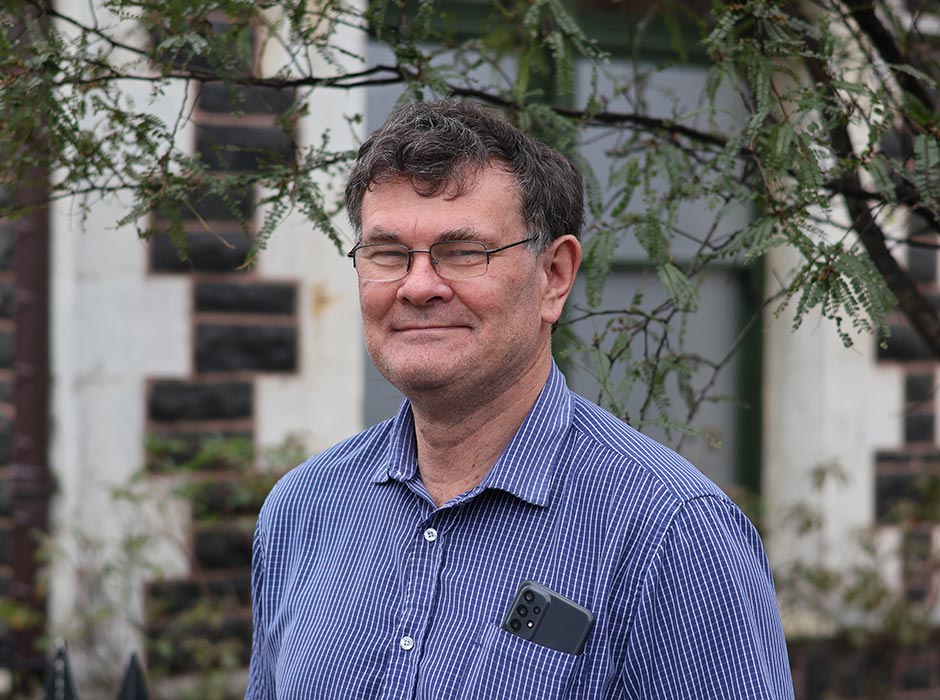
Department of Neuroscience Senior Research Fellow Dr Bruce Mockett is developing a treatment that could slow the progression of neurodegenerative diseases.
In the future, slowing the progression of neurodegenerative diseases such as frontotemporal dementia (FTD) and Alzheimer's disease (AD) could be as simple as getting a flu shot from your GP.
With the help of a Neurological Foundation of New Zealand project grant of $299,321, Department of Neuroscience Senior Research Fellow Dr Bruce Mockett hopes to enable a protective protein to work its magic on brain health.
The sAPPalpha protein, which is naturally produced by the brain, helps maintain neural health and repair brain cells, and could be used as a therapeutic to slow the progression of diseases of the brain.
“What we’ve shown in studies using mouse models of Alzheimer’s disease is that sAPPalpha improved the function of brain cells and helped recover some of their memory deficits,” Bruce says.
“It potentially cleans up plaques in the brain made up of a toxic protein called amyloid, and builds resistance against other challenges to brain health, all of which leads us to think sAPPalpha may be useful to protect against a range of brain diseases.”
But getting additional sAPPalpha isn’t as simple as drinking a protein shake. Instead, Bruce is working on a gene therapy that could encourage the brain to produce more of the plaque-busting protein, but this time to treat FTD, another devastating neurological disease.
“A question that quickly arose is how you get the gene into the human brain because it has a protective shield called the blood-brain barrier,” Bruce says.
With protein shakes ruled out, Bruce and his team are looking at another delivery mechanism: viruses that can cross the human blood-brain barrier to deliver a therapeutic gene.
“Gene transfer by viruses is a known evolutionary mechanism,” Bruce says.
“Viruses are important and, in this case, very useful. Just about every disease you could imagine could be treated with a protein therapeutic, so viral vectors are very useful for getting genes encoding various proteins into the brain.”
Bruce says the scientific community is “frantically trying to develop” these vectors, with his team trialling the promising new AAV9 virus developed by Harvard researcher Ben Deverman.
“The virus delivers the gene to the brain, and the gene makes the protein. You would likely only need the treatment – an injection into the arm – once.”
The Neurological Foundation grant will enable Bruce and his team to demonstrate that they can deliver the gene to the brain, and that it will promote brain health.
“We’ve taken the pure science at the lab bench to what is now a pre-clinical trial, with a view to clinical trials in the near future,” Bruce says.
“If the research is successful, it will bring hope to people that there is a new effective therapeutic for treating dementia. This could provide resilience against the progression of the disease.”
Hope would be a welcome relief from what is currently a bleak diagnosis.
“The individual suffers from loss of brain function, total dependence on other people, and ultimately, death,” Bruce says.
“There’s an enormous cost to carers, and the economic cost is huge. The current estimated cost for New Zealand is $6B a year for Alzheimer's disease alone, and it’s projected to be $15B by 2050.”
When it comes to staving off dementia, Bruce says age, lifestyle and genetics all play a part.
“Alzheimer's is a disease of the elderly, really. Age is a risk factor; once you’re over 65, the risk progressively increases. Forty per cent of dementia cases are estimated to be driven by lifestyle. Smoking increases risk, whereas physical exercise, social engagement and getting enough sleep are all beneficial.”
Groups who are genetically predisposed towards dementia could be treated in the early stages of the disease.
“People with Down’s Syndrome often get Alzheimer's in their early 40s. They have an extra chromosome that produces additional amyloid protein. Because they’re likely to develop the disease, that’s a group you could treat early on,” Bruce says.
Alongside now-Emeritus Distinguished Professor of Psychology Cliff Abraham, Bruce has been working on treatment options for neurodegenerative diseases since 1999.
It was a bit of a swerve for someone who initially wanted to be a vet.
“I started training as a vet, and then moved into a PhD in neurophysiology, and as that progressed, opportunities came along,” Bruce says.
But as there are “plenty of human treatments that have shifted over to the animal realm”, Bruce’s career could yet go full circle.
“Like humans, otherwise healthy animals often show cognitive decline in older age. Cliff had a student who administered sAPPalpha to aged rats and was able to show it improved brain function and memory. Many of us will have observed cognitive decline in dogs as they age. Who knows what might be possible in the future.”
But in the meantime, as he progresses towards clinical trials, Bruce is focused on providing relief for dementia sufferers and their carers.
- Kōrero by Kathryn van Beek, Communications Advisor | Kaiarataki Pārokoroko
Study Neuroscience at Otago
Ever wondered what makes you you? Neuroscience is where curiosity about the brain turns into real discovery.
Explore Neuroscience