
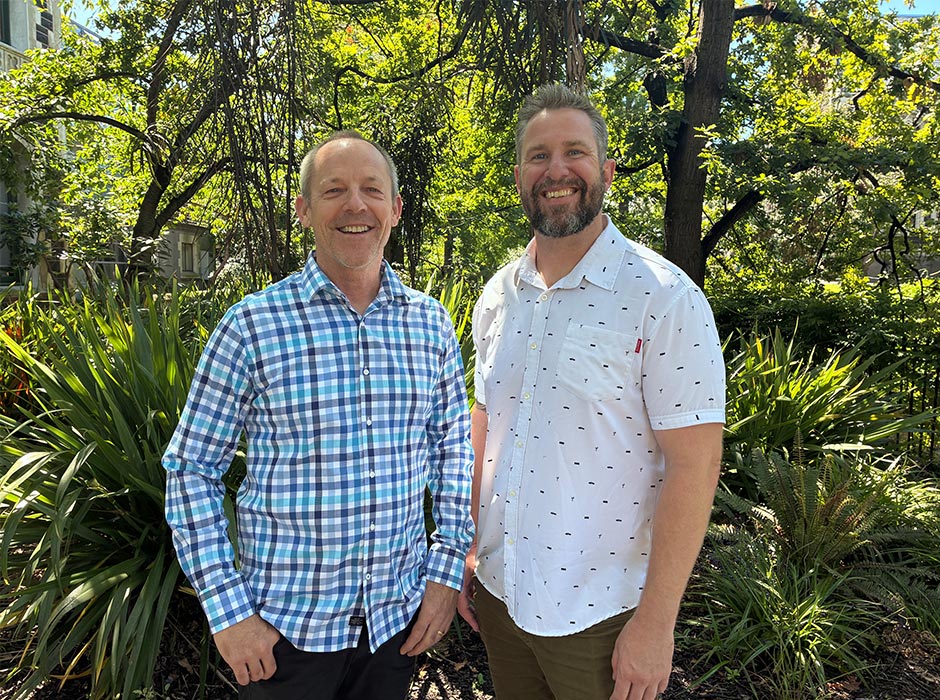
Professor Nicolas Cullen (left) and PhD student Phil Elder, both with Te Iho Whenua - School of Geography, are developing a mapping system to support safer decision making for New Zealand mountain visitors.
The number of mountain visitors, including tourists, is rapidly growing in New Zealand. Te Iho Whenua - School of Geography Professor Nicolas Cullen says that alongside this increase in visitors, information on snow conditions and avalanche danger is becoming increasingly dynamic and uncertain due to climate change.
“This combination is increasing the risk of potential harm from avalanches, including fatalities,” Nicolas says.
Until now, the lack of detailed topographic mapping in the Southern Alps has limited the ability to generate high-quality, computer-generated maps of avalanche terrain.
Nicolas is the Primary Investigator on a project, funded from a University of Otago Research Grant, that is developing a mapping system intended to be a key tool in managing avalanche risks in Aotearoa mountains.
Avalanche risk is a complex interaction between snowpack, weather, terrain and people, where terrain is the only factor that remains constant over time.
“The project is based on the hypothesis that ‘when unstable snow is the problem, terrain is the solution’. This hypothesis is supported by professional mountain and ski guides who have long considered terrain assessment and route selection to be critical in avalanche prevention,” Nicolas says.
The NZ Avalanche Advisory provides widely recognised guidance on snow conditions and avalanche hazards across 13 alpine forecasting regions. As these regions cover large geographic areas, detailed topographic mapping tools will further support users by helping identify smaller pockets of terrain and therefore allow users to refine backcountry travel decisions.
Recently, in what Nicolas describes as a “game-changing opportunity”, detailed topographic data have been collected using lidar (light detection and ranging), with funding from the Provincial Growth Fund.
The project team is using these data to develop a high-resolution terrain classification system – “NZ-mATES” (New Zealand mountain Avalanche Terrain Exposure Scale).
School of Geography PhD student, Philip Elder, is leading the development of this mapping system.
“This NZ-mATES system will simplify the detailed topographic data of complex terrain into easy-to-understand categories, helping both recreational and professional users stay safe and informed while travelling through our mountain ranges,” Philip says.
The system uses high-resolution elevation data and complex geometric calculations to analyse the slope and curvature of mountains and their features, the potential for trapping and holding wind-blown snow, and many other characteristics.
It then uses this information to identify locations where an avalanche might start, travel and dissipate, and calculates risk accordingly.
Once developed, the mapping products will be made available to the Mountain Safety Council and Department of Conservation who will consider integrating them into public-facing platforms to support safer decision making for New Zealand mountain visitors.
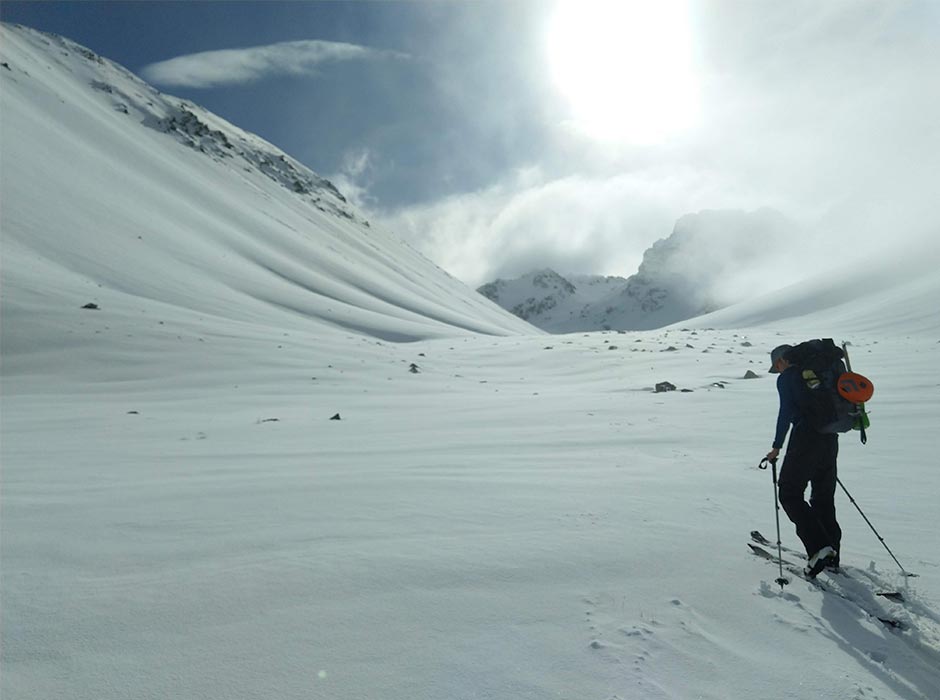
Risk of avalanche harm in New Zealand is increasing as the number of mountain visitors grows and information on snow conditions and avalanche danger becomes increasingly dynamic and uncertain. Photo of Aubrey Miller ski touring provided by the project.
Alongside Nicolas and Philip, this project brings together a team of Associate Investigators including Aubrey Miller and Associate Professor Pascal Sirguey from Otago’s School of Surveying Te Kura Kairūri, researchers from Earth Sciences NZ, Antarctica New Zealand, the WSL Institute for Snow and Avalanche Research (Switzerland), the Mountain Safety Council, the Department of Conservation, Otago Polytechnic and the Chugach National Forest Avalanche Centre (Alaska).
– Nā Antonia Wallace, Kaiarataki Pārokoroko – Communications Advisor
School of Geography
The School of Geography offers programmes in: Environmental Management, Human Geography, International Development Planning, Physical Geography and Planning. It also incorporates the Centre for Sustainability, an inter-disciplinary research centre.
Visit the School of Geography