
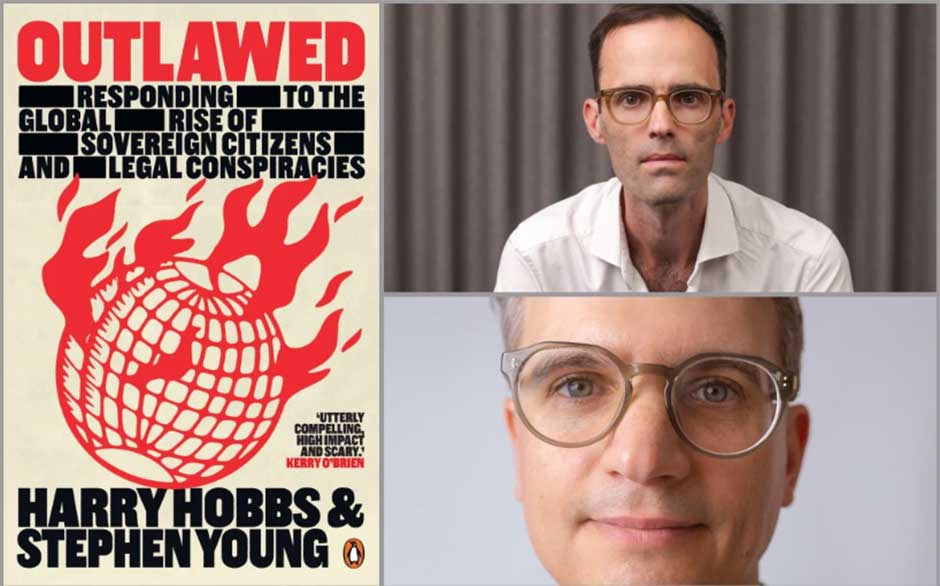
A new book by legal experts Harry Hobbs (top) and Stephen Young (below) explores the origins of the sovereign citizen movement and what is contributing to the global rise in pseudo-law.
What if someone told you your mortgage is illegal, your taxes are voluntary, that you don’t have to hold a license to drive and with the right words you could free yourself from the system forever?
A new book Outlawed: responding to the Global Rise of Sovereign Citizens and Legal Conspiracies (Penguin) takes readers into the pseudolaw movement, and studies its global rise.
Followers of the pseudolaw movement often call themselves ‘sovereign citizens’ and believe they can opt out of the legal system by appealing to alternative interpretations of law, history, or constitutional arrangements.
Otago Te Kaupeka Tātai Ture Faculty of Law Associate Professor Stephen Young has co-authored this book with Associate Professor in the Faculty of Law and Justice at the University of New South Wales Harry Hobbs.
The legal experts trace the movement from its 19th-century origins, with deadly shootings, attempted coups and bizarre court cases involving doppelgangers, secret trusts and accusations of treason and sorcery. Through to today’s courtroom confrontations, YouTube gurus, viral traffic stops, online radicalisation and anti-government extremism.
Along with intriguing stories, the work presents insightful analysis on how pseudo law thrives in times of distrust and inequality, and what makes this movement such an attractive alternative to established laws and rules.
“Through these case studies we can see how people in individual crises can get sucked into conspiracies,” Stephen says.
“Also, not all conspiracies are false. We are in an era where it seems that even if people are accusing executives and very powerful people of doing the wrong thing, they don’t have to admit it or resign. It seems like the legal system that should hold them accountable isn’t. I think people are reacting to that in a very real and serious way.”
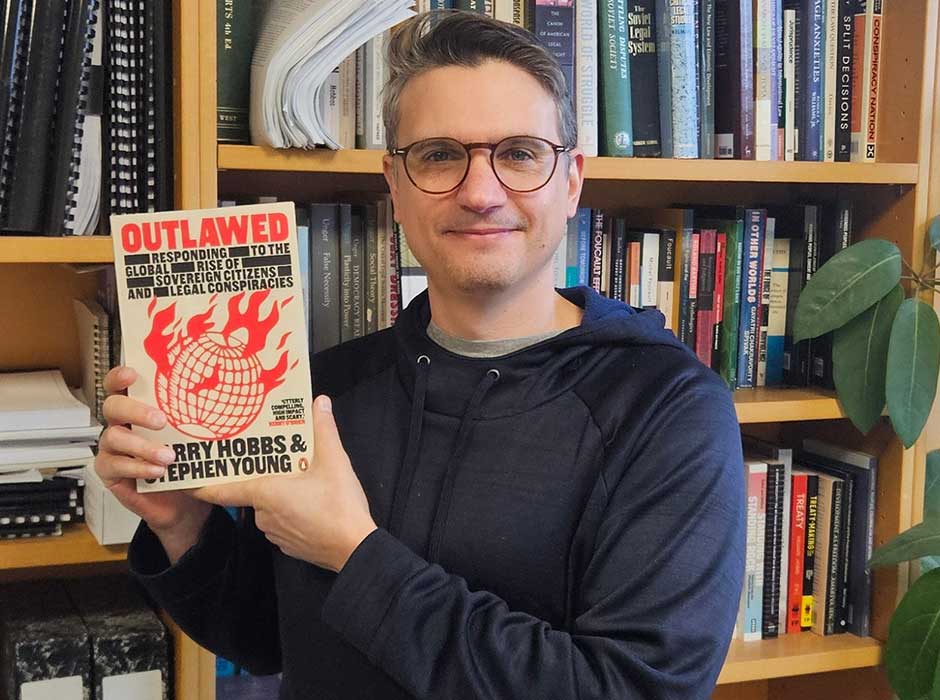
Associate Professor Stephen Young, holding a copy of his new book, says “There’s a lot we can do to make society better through how we approach law”.
Stephen has long held a fascination with this subject. He grew up just outside Chicago, Illinois, and sees the United States as the originating nation of the sovereign citizen movement.
He has observed the movement spread internationally, including Aotearoa New Zealand and Australia, where it intersects with local context and discourse involving colonial histories, Indigenous rights, and resistance to state regulation, particularly at local levels.
Stephen cautions against dismissing people presenting pseudolaw without seeking to understand if there is an underlying substantive argument or concern.
“There’s a lot we can do to make society better through how we approach law. If people can’t access information and aren’t being heard, they are going to move from being driven by a particular issue to being driven by an ideology. Once people become ideologically entrenched, there’s not much you can do to bring them back.”
Listen to the authors in an interview on Nine to Noon Radio New Zealand Outlawed: The rise of the ‘sovereign citizen’ movement
Read more and order through Penguin publishers
Author talk with Stephen Young: Dunedin Public Library, Dunningham Suite, 10 September, 5:30-6:30pm. Read more.
-Nā Communications Advisor | Kaiarataki Pārokoroko Antonia Wallace
Faculty of Law
Be part of Otago's unrivalled law community. Innovative, supportive and inclusive – we offer a world-class education to drive social change.
View