
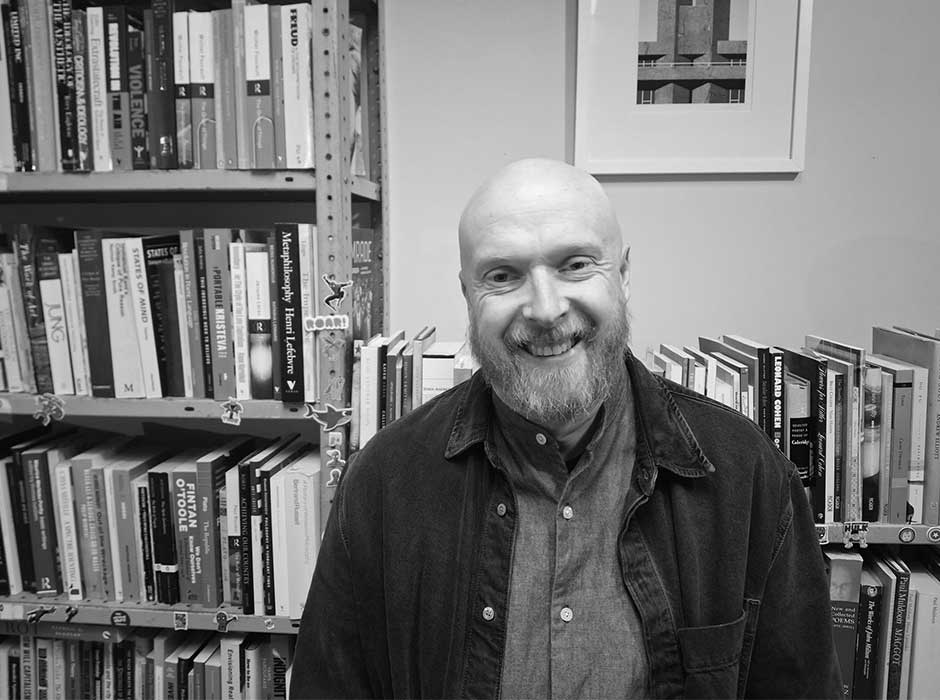
Dr Neil Vallelly says that the politics of borders is one of the defining issues of our time.
Dr Neil Vallelly has received an Otago Prestigious Writing Grant to complete a new book that challenges how we think about borders and their role in shaping societies.
In his book, provisionally titled Border-as-Flesh and Other Counter-Imaginaries, Neil, from the Sociology, Gender Studies and Criminology programme, will explore the ways that borders are imagined and how this shapes border policies and practices around the world.
“While borders often have devastatingly real consequences for many migrants, they are, first and foremost, imaginary ways of ordering space, territory, and populations. The aim of this book is to think of ways of re-imagining borders so that their real consequences are much less violent and exclusionary,” Neil says.
The book is based on the idea that borders are not only real objects and institutions but are intertwined with a dominant imagining of the border as something that shields and prevents contamination, and this shapes how societies understand and enforce them.
The book will comprise five theoretical essays that draw on thinkers such as Maurice Merleau-Ponty, Judith Butler, Jacques Derrida, Achille Mbembe, and Gilles Deleuze to examine how various border imaginaries and potential counter-imaginaries infuse contemporary border politics and practices.
These theoretical reflections will be combined with real-world examples of border politics, such as the employment of Immigration and Customs Enforcement (ICE) and Border Patrol agents on city streets in the United States, the transformation of the Irish border since the Good Friday Agreement, the imprisonment of asylum seekers in Australia and Aotearoa New Zealand, and border abolitionist practices in the US and parts of Europe.
Ultimately, the book’s aim is to construct border “counter-imaginaries” of relationality, hospitality, and care that aim to dissolve the violent and repressive border imaginaries that underpin much of today’s reactionary politics.
Neil says that the politics of borders is one of the defining issues of our time.
“I was born in Northern Ireland in the final decade of The Troubles. The border was a large part of the Irish political imagination at this time. There was also a hard border between the north and south of Ireland, with checkpoints, military towers, and the like. In the period after the peace agreement in 1998 this gradually became a soft border, and you’d only notice you had crossed it when the road signs changed.”
Neil says this experience shaped his understanding of borders, demonstrating both their significance and their fluidity.
He has been writing about borders in different ways over the last decade, from representations of forced displacement in literary fiction to the detention of asylum seekers in Aotearoa New Zealand prisons, especially in the context of the rise of anti-migrant politics across many parts of the world.
“This book is an attempt to try and synthesise much of this work through the idea of the imaginary. Imaginaries play a crucial role in contemporary demands for stronger borders, often by portraying migrants as threats or ‘enemies at the gate’, as the US Department of Homeland Security recently described them.”
Border-as-Flesh and Other Counter-Imaginaries presents an original intervention in critical border studies, continental philosophy, and critical theory, and it will be of interest to readers intrigued and concerned by the direction of border politics today.
Sociology, Gender Studies and Criminology
Sociology, Gender Studies and Criminology explore the impact of social change in our research and teaching.