
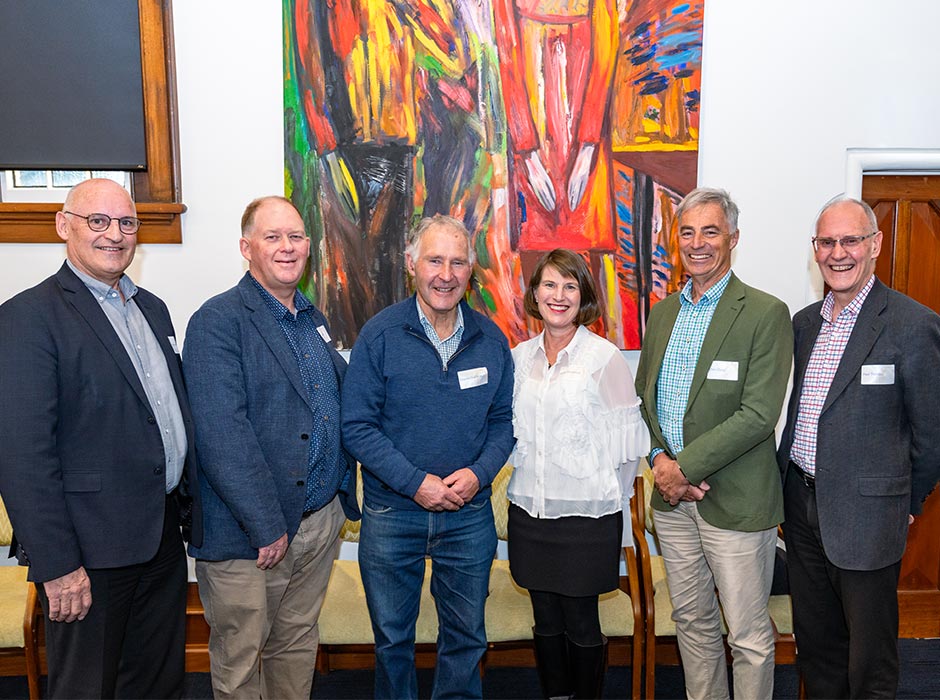
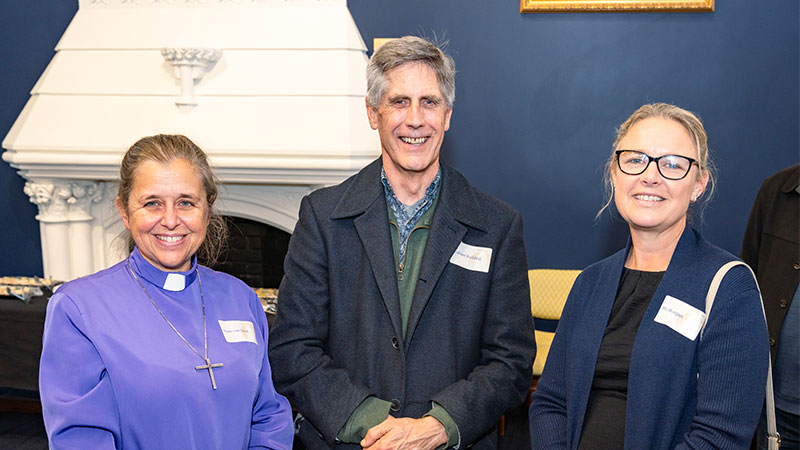
Pictured from left: Theology Professor Murray Rae, South Waikato farmer Gray Baldwin, Eastern Southland farmer Graeme Gardyne, Chair of Longview Trust Karen Whitehead, CEO Wilberforce Foundation Chris Clarke and Professor of New Testament Studies Paul Trebilco at an event to celebrate the Centre for Creation Care and thank key supporters.
The University of Otago has marked a significant milestone in the establishment of New Zealand’s first Centre for Creation Care, led by its Mātai Whakapono Karaitiana – Theology programme.
Bringing together faith, an environmental focus, and cross-disciplinary collaboration, the Centre aims to respond to growing concern about the state of the planet by exploring what it means to care for creation as an expression of Christian belief.
Head of the Theology Programme Professor Murray Rae says “Creation Care is theological vocabulary for looking after the environment. Doing so from a theological basis involves seeing the planet as God’s creation, and as a gift entrusted to our stewardship. Therefore, it is a Christian responsibility to care not just for people but also for the wider environment.”
One of the motivators in advancing this Centre for Creation Care at Otago was the 2023 Wilberforce Foundation Faith and Belief Survey, which reports that 37 per cent of New Zealand Christians cite the “state of the planet” as their number one concern.
“The environmental crisis is one of those ‘wicked problems’ that involves input across a range of disciplines. Because this Centre will be based in a university, we will be able to collaborate across disciplines locally and globally,” Murray says.
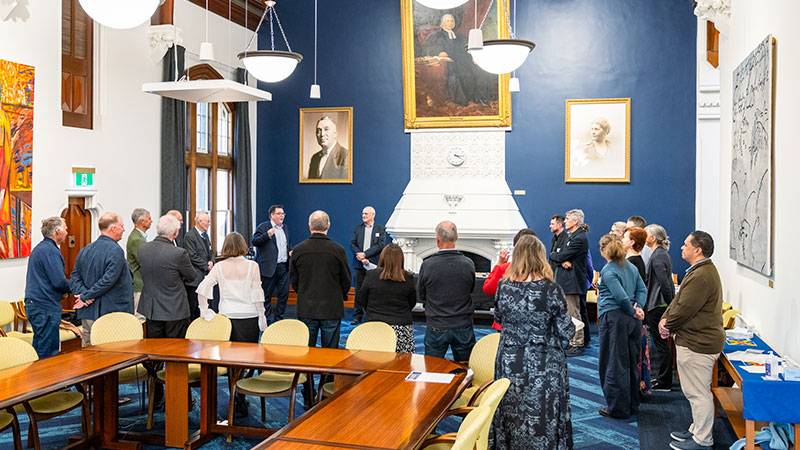
This Centre’s establishment and future promise is made possible by the support of the programme’s wider community. Some of the key supporters recently attended an event celebrating the launch of the Centre in the University’s Council Chamber.
Farmers, church and other theological leaders, researchers in sustainability and other partners were there to celebrate the significant milestone.
“I see an enormous future for the Centre, which will take a cross-disciplinary approach and ensure a theological perspective in addressing one of the most significant crises of our time.” – Vice-Chancellor Grant Roberston
Vice-Chancellor Grant Roberston thanked those gathered, acknowledging the importance of philanthropy in allowing the University to focus deeply on topics that matter.
“I see an enormous future for the Centre, which will take a cross-disciplinary approach and ensure a theological perspective in addressing one of the most significant crises of our time. The opportunity to have cross disciplinary conversations is where we find the answers,” Grant says.
One such supporter is South Waikato farmer Gray Baldwin, who is also undertaking a PhD in Theology at Otago. Gray says many farmers are supporting this as they connect to the kaupapa.
“We farmers occupy about 50 per cent of the land on planet Earth; we have a significant role in looking at whenua, animals, air. We’ve always done it. In this context, Christian farmers are interesting because they all have a faith connection – is looking after the land, looking after the creation something that is part of your faith? Spiritually, this has all sorts of connotations and connections,” Gray says.
Graeme Gardyne’s family have farmed in the Knapdale, Eastern Southland area for more than 150 years.
“This programme fits well with what a lot of farming families have done for generations. We have always farmed with a long-term view for the next generation and take pride in how the land is presented and sustained. It’s also important to keep an open mind to new ways of doing things, and this Centre of Creation Care fits into that,” Graeme says.
Pro-Vice-Chancellor of the Division of Humanities Professor Hugh Campbell is a leading researcher in agricultural sustainability and sociology. He says the thing that worries his students most is our environmental future.
“This issue is exactly where Theology should be, speaking at the very heart of these kinds of existential screamingly urgent concerns,” Hugh says.
Hugh also acknowledges the significance of having farmers supporting this initiative.
“Whenever I see farmers brought into these relationships (always very quietly) and supporting an initiative at a university like this, you know that it is both grounded and hitting an area of urgent concern.”
Former Chancellor of the University, Dr Royden Somerville KC, describes the Centre as "marvellous".
“Everyone involved should be congratulated on getting this underway,” he says.
Royden recalls being involved in Otago committing to The United Nations Sustainable Development Goals, the first university in New Zealand to do so, and which it still reports on.
“That’s significant, in my view,” he says.
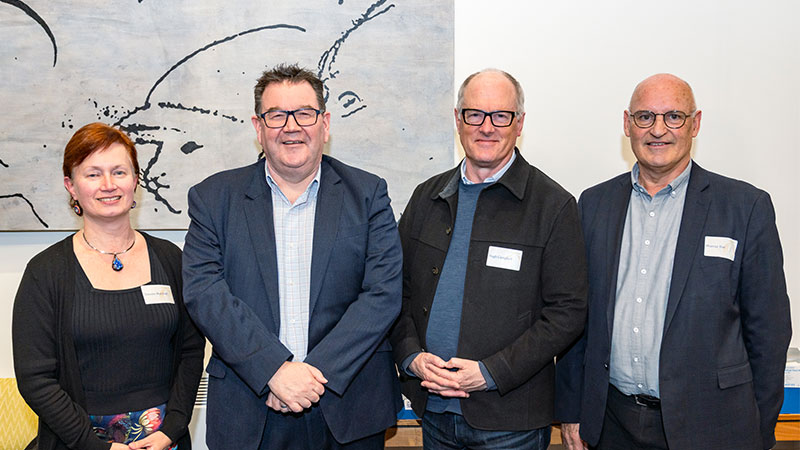
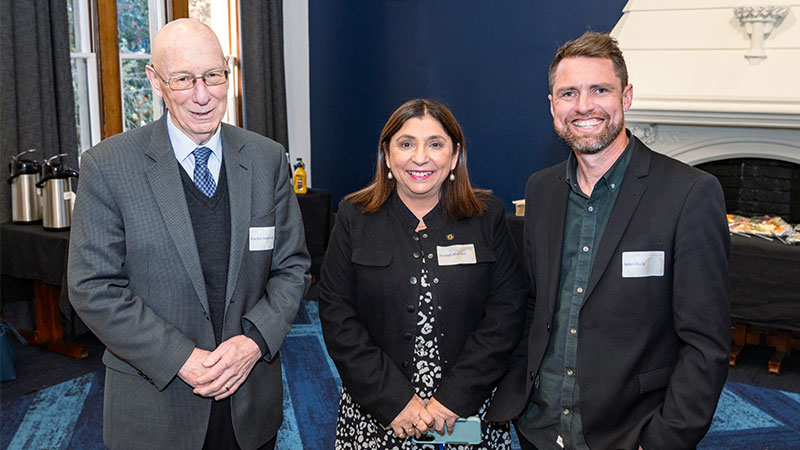
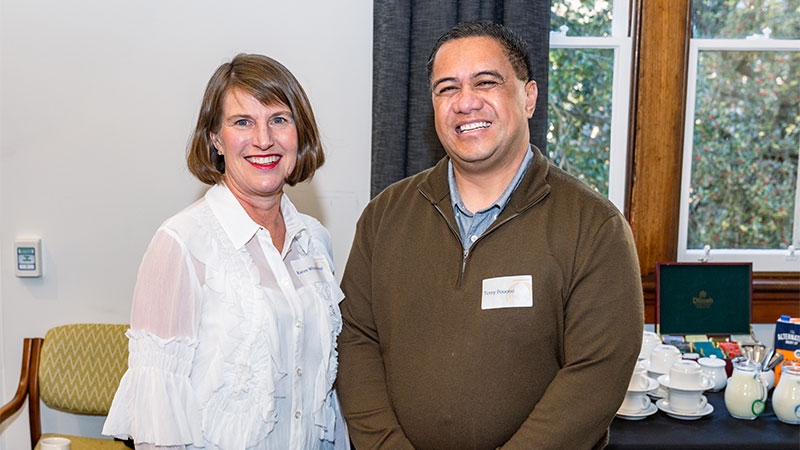
Chair of Longview Trust Karen Whitehead says they are pleased to lend their support to the Theology programme, with whom they have a long-established trust. With statistics that show a generation questioning the environmental crisis and our response, she believes the interdisciplinary nature of the Centre makes sense.
“Our lives aren’t lived in isolation, so neither should our response to this be in isolation. There is also a spiritual element, and it is wonderful to open that conversation.”
James Beck is the wearer of ‘many hats’, including a leader in the River Ōpāwaho Church, advisor on environmental matters to the Wilberforce Foundation and Director of A Rocha Aotearoa's Eco Church Network of 120 churches that have committed to integrating care of creation or sustainability into what it means to be the church.
He sees two big challenges in the church space when it comes to this topic.
“At one end of the spectrum there’s a lot of good thinking that hasn’t necessarily translated into action; there are beautiful statements on the importance of eco-theology, but it doesn’t necessarily integrate into how they function as churches. On the other end are a bunch of churches that have, for example, recycle bins but don’t understand how that relates to theology. I am passionate about both spaces. This programme works for both groups and that is so important.
“One of the things I love about this Centre for Creation Care is that people can come and study and, as part of the programme, they’re going to do internships where they have to tangibly apply what they are learning,” James says.
The cross-sector support reflects the Centre’s own intended collaborative approach.
Murray says the Centre will be committed to strengthening connections with mana whenua across Aotearoa.
The Centre will also build on its relationships in the Pacific, where a faith-based approach is integral to the care of the environment, and where the adverse consequences of climate change are already having a big impact.
More about the Centre
Head of the Theology Programme Professor Murray Rae says that, while fundraising efforts will continue, there is enough pledged for the Theology programme to recruit and appoint the three positions required to be able to establish the Centre. They are aiming to make these new appointments in time for Semester 1, February 2027.
For those whose interest is piqued and can’t wait for the Centre to be established, the work is already underway. Theology at Otago has been teaching in this area for some time, and several students have attained doctorates in this area.
Collaboration is key. Otago offers a range of studies in sustainability, some through its highly regarded Kā Rakahau o Te Ao Tūroa -Centre for Sustainability Research. There is also a multi-disciplinary Bachelor of Sustainability being developed, which the Centre will contribute to.
The Centre will have the three key pillars of research, teaching, and public engagement. Courses will be available within a wide range of qualifications, and there will also be a Diploma for Graduates specialising in creation care. The work of the Centre will include study in:
- Theological research on Creation Care.
- Teaching related to the Theology of Creation care
- Formation and field work experience, including a 13-week internship with external environmental organisations and projects.
- Collaboration with other research groups on climate finance, agriculture, energy research, green hydrogen, and food waste innovation.
“We are very excited to be launching our Centre for Creation Care. We welcome people involved in environmental ethics, sustainability, and theology to get in touch,” Murray says.
Study Theology at Otago
The Theology Programme at Otago offers campus and distance courses on the Bible, Christian theology, church history, public theology, pastoral and practical theology, ministry, and chaplaincy that will deepen your understanding of the Christian faith.
More about Theology