
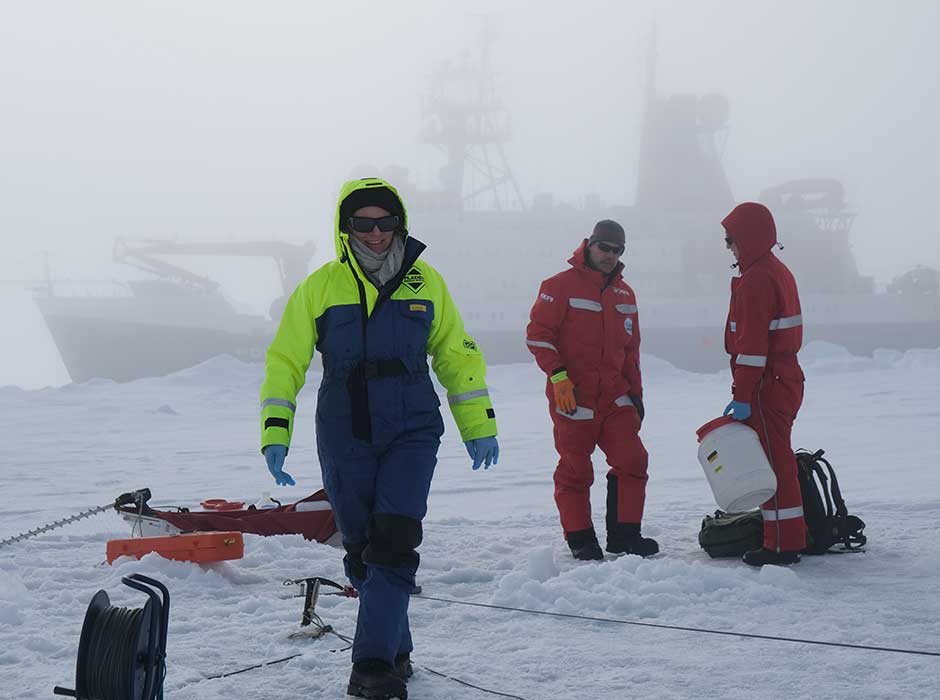
Associate Professor Linn Hoffmann, on the left, and her colleagues explore the Weddell Sea. PHOTO: M Wietz
Associate Professor Linn Hoffmann, a biological oceanographer from the Department of Botany, wasn’t expecting to be in the Antarctic, let alone being party to an island discovery this autumn.
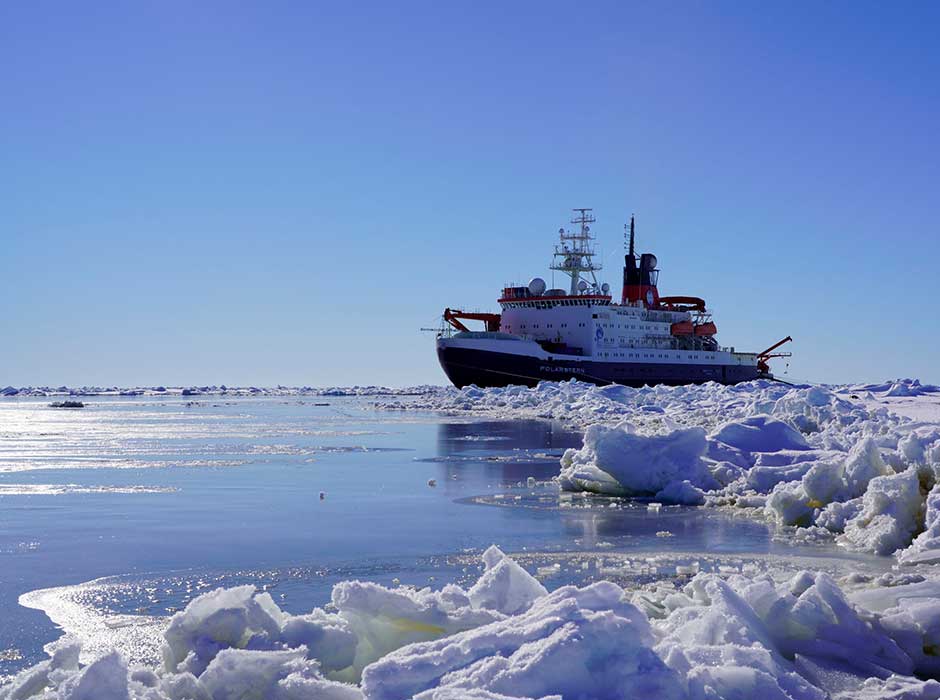
Germany’s Alfred Wegener Institute needed a biological oceanographer for their Summer Weddell Outflow Study after funding for United States scientists fell through, which is how Linn found herself on the Polarstern icebreaker research vessel, surrounded by icebergs in a region that’s only partially mapped.
Linn recalls one of the highlights from the voyage was completely unexpected.
“It was night and, all of a sudden, the scientists from the bathymetry team spotted what they thought was an iceberg. But after we took a closer look, it became obvious that it was an island,” Linn says.
The fifty scientists on board paused their planned research to use drones and sonar to map the island. At 130m long, 50m wide and 16m high, it’s roughly the size of Dunedin’s Toitū Museum, and about twice as big as the Polarstern.
“The Weddell Sea is covered by thick sea ice almost all year round and is one of the least explored places on Earth. The discovery of the island shows we don’t know our planet as well as people might think,” Linn says.
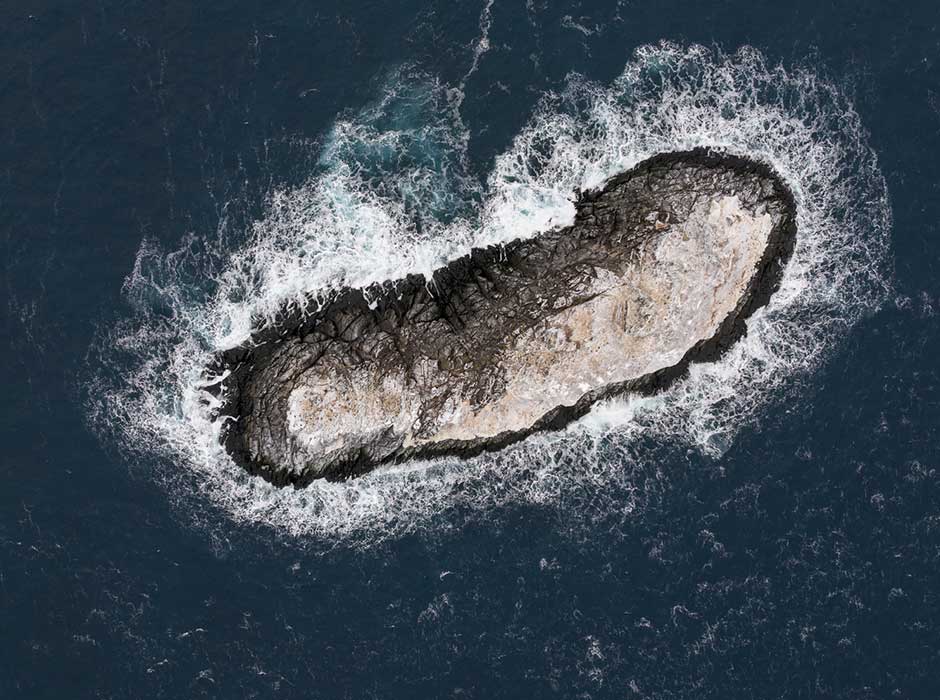
A proposed name has been submitted to an international committee, and the island will soon appear on nautical charts. With decreasing sea ice cover giving rise to more ship traffic in the Weddell Sea, the discovery will help improve maritime safety. But what really interests Linn about the island is the algae.
“The Weddell Sea is a desert of snow, ice and water,” Linn says.
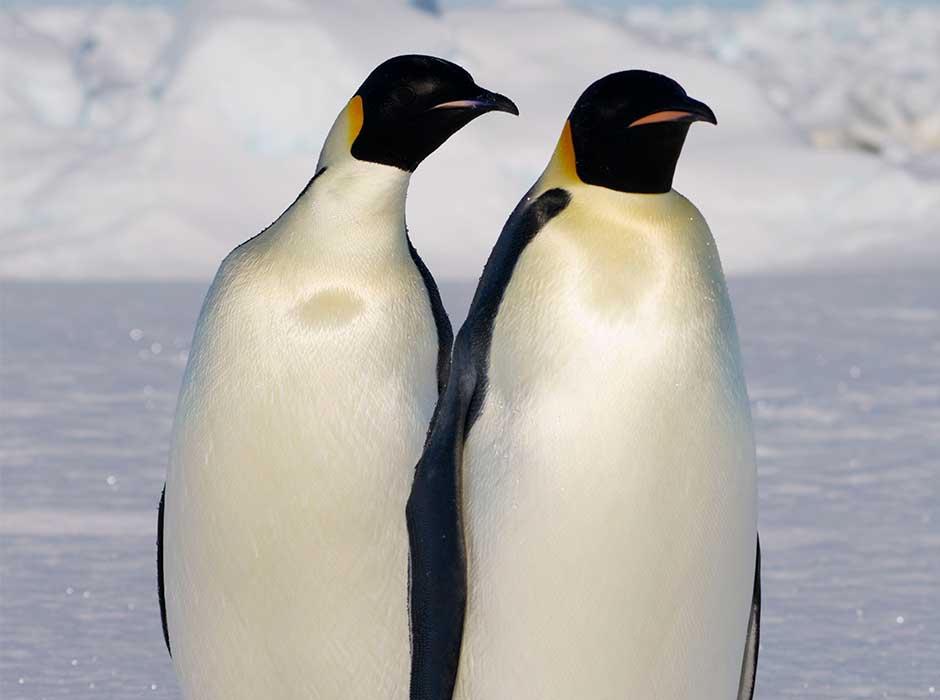
“The whales, seals, penguins and other seabirds that live there all depend on food that is produced by microscopic algae. Even small islands can be real hotspots of productivity in the ocean. The white cover on top of the island is partly guano from the shags, which fertilises the algae in the water around it.”
Linn says the Antarctic is a place of breathtaking beauty and unforgiving extremes.
“On the ship it’s constantly noisy with the engine, pumps, ventilation system, and the sound of the ice breaking and crushing against the hull. But when you step on the ice, it’s absolutely quiet. You realise how small the ship really is, and how vulnerable you are in the environment. Standing on ice floes, knowing we had 3000m of water beneath us, really gave me the chills.”
Supervised by emperor penguins, Linn and her colleagues drilled holes in the ice to collect samples. These will inform Linn’s investigation of phytoplankton communities and how they respond to climate change stressors.
“Our data will enable us to directly compare the water and ice algae communities and predict how changing ice cover will impact these critical organisms that are the base of the entire Antarctic food chain,” Linn says.
“I find it fascinating that organisms like phytoplankton, that are so small that we can’t see them with the naked eye, can have such massive global impacts on our climate and sustain all life in the open ocean.”
Linn says as the consequences of climate change become more obvious with increased storm and flooding events it is encouraging to be part of a team working on solutions.
“I do whatever I can to reduce my carbon footprint privately, and it feels great to be part of a scientific team that has a common goal of understanding and ultimately protecting this beautiful part of our planet.”
-Kōrero by Kathryn van Beek, Communications Advisor | Kaiarataki Pārokoroko
Department of Botany
The Department of Botany at Otago is the only university department in New Zealand specialising in the science of plants, and one of only a few in Australasia.
View