
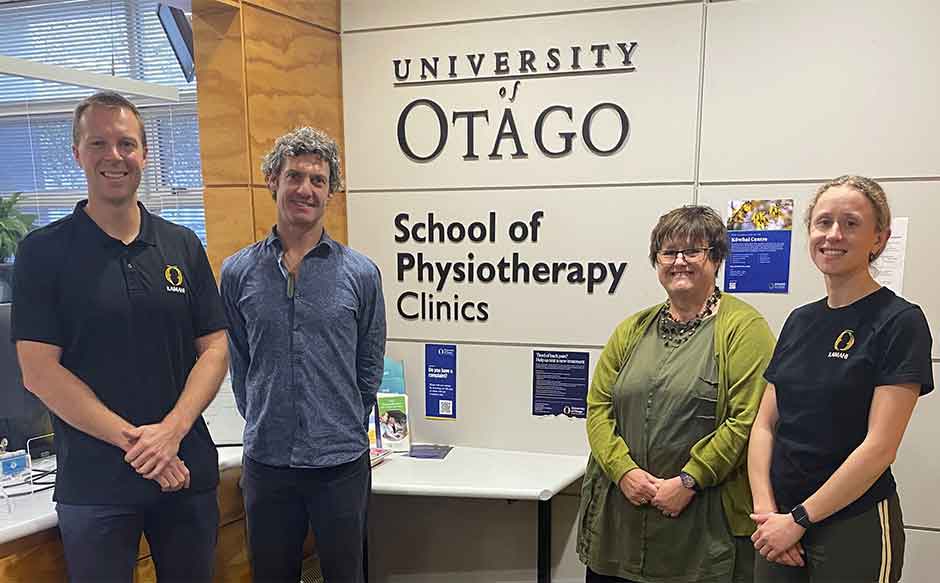
Senior Professional Practice Fellow Chris Higgs, Lecturer Dr Gerard Farrell, Professional Practice Fellow Dr Jackie Tagg and Professional Practice Fellow Ashleigh Taylor at the School of Physiotherapy Clinic which hosted the clinical communication skills pilot programme.
A pilot programme aimed at improving the clinical communication skills of second and third-year physiotherapy students for whom English is an additional language has proved a great success.
The trial programme involved three international students who were completing hands-on teaching at the School of Physiotherapy Clinic; a supervised teaching clinic which provides community-based care.
Paired with fourth-year physiotherapy students, participants engaged in a structured observation process that included pre-briefing on patient interaction, guided observation of real consultations, and supported reflection on communication practices.
A review of the programme indicated it was well received by the students, and it improved their understanding of rapport-building, informed consent, culturally appropriate communication and professional language.
Students said the programme grew their awareness of relational micro-skills including empathic acknowledgement, normalising statements and simplified explanations.
One shared: “I didn’t realise how important tone is. The same words can sound very different.”
The programme was designed and is led by Division of Health Sciences Professional Practice Fellow Dr Jackie Tagg, in collaboration with and supported by the School of Physiotherapy, including Senior Professional Practice Fellow Chris Higgs, Professional Practice Fellow Ashleigh Taylor and Lecturer Dr Gerard Farrell.
Jackie says relationship-building, small talk, and casual conversation are essential for patient-centred care, yet they are rarely explicitly taught.
“Standardised English language entry assessments primarily measure academic literacy rather than the relational communication required in real clinical interactions, but this programme fills that gap,” Chris says.
Observing the fourth-year students they were paired with also helped the students learn patient-centred language, professional boundaries, respectful disagreement and the nuance in balancing empathy with clinical authority.
“It’s fantastic to see a programme have tangible benefits for our international students. It’s reassuring to know that, wherever they might go after their studies, Otago will have equipped them with the communication skills they need to thrive in clinical settings and serve patients to a world-class standard,” Gerard says.
Jackie says essential communication skills are a vital part of student success.
“Otago is committed to creating tailored interventions for underserved students, addressing international students’ needs for academic success, and reducing educational disparities by providing tailored opportunities for clinical success.
“This programme will continue forward while repeatedly being reviewed to both support research into international students and make sure it remains a practical model that impacts these students in a genuine and positive way.”
Chris, Gerard and Jackie acknowledge implementing this programme wouldn’t have been possible without the willingness of professional staff, students and academics working in School of Physiotherapy clinic.
-Kōrero by Kelsey Swart, Division of Health Sciences Communications Adviser
School of Physiotherapy
Physiotherapists are health professionals essential to the rehabilitation and maintenance of optimal physical ability and healthy lifestyles.
View