
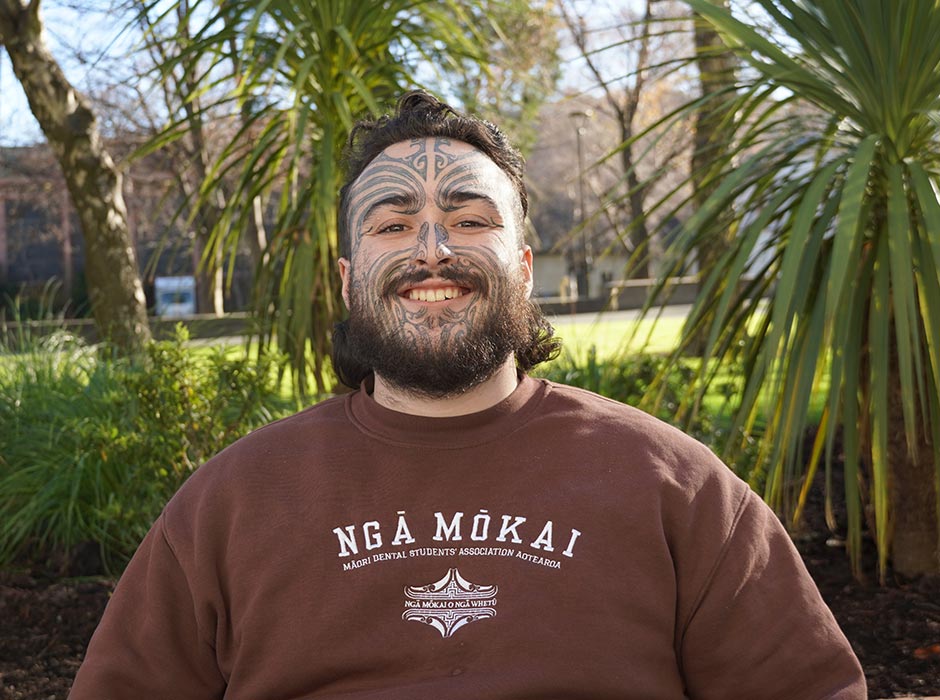
Te Tumu Professional Practice Fellow Kiringāua Cassidy finds marking assignments written in te reo Māori a “great puzzle to figure out”.
Writing an assignment in te reo Māori should not mean extra work, extra barriers, or extra pressure.
At the University of Otago – Ōtākou Whakaihu Waka, a new role is helping make that a reality.
Kiringāua Cassidy (Kāi Tahu, Ngāpuhi, Ngāti Mutunga, Te Ātiawa) was appointed as a Professional Practice Fellow within Te Tumu School of Māori, Pacific and Indigenous Studies earlier this year to support Te Reo Māori Academic Assist Service. The service was created in collaboration between Te Tumu and the Office of the Deputy Vice-Chancellor Māori in response to a growing number of tauira choosing to do their oral or written assessments and exams in te reo Māori across a wide range of subjects.
For more than 20 years, University policy has allowed tauira to submit work in te reo Māori for any paper.
“However, in the past, there has not been adequate resourcing to support tauira to do the work and also support kaimahi to mark that work,” Kiringāua says.
He was approached and encouraged to apply for the position and was successfully appointed.
A major part of role is to mark undergraduate assessments and exams submitted in te reo Māori, regardless of the subject area. While still in its early stages, Kiringāua says the role is going “amazingly well”, far exceeding expectations.
“We’ve had roughly 12 students this semester submit assignments across 14 different papers.”
Some tauira are submitting work in multiple papers, reflecting growing confidence in using te reo Māori throughout their studies.
Kiringāua believes those numbers will continue to rise.
“Not just in the following years,” he says, “but actually in the next semester.”
“There are plenty of tauira who have te reo Māori at Ōtākou Whakaihu Waka who have not felt empowered to be able to do their mahi in te reo.
“I hope that with growing understanding, trust and belief in the capability of this role and the goals that both tauira and kaimahi have, more and more people will jump on board.”
While demand continues to grow for greater te reo Māori support at the University, Kiringāua is clear that the role is not a translation service.
“The work that the tauira do does not get translated into English and then marked, it is marked in te reo Māori against the same marking criteria as the rest of the tauira in the same papers.”
The role requires close collaboration with academic staff at the University.
“I am no expert, by any means, in many of the subjects in which tauira are submitting their work in te reo, so this means I have a lot of hui with many kaimahi across varying subjects to gain a better understanding of the subject in order to mark the work of the tauira.”
That process often involves navigating specialised terminology that may not yet have widely accepted translations.
“It’s a great puzzle to figure out.”
For Kiringāua, the role represents an important shift in responsibility. Kaimahi who speak te reo Māori can feel less pressure to take on work outside of their own roles.
“For too long, the responsibility to support the marking of assignments submitted in te reo Māori has sat with kaimahi whose jobs were never intended to include that work, usually those in Te Tumu.
“This is significant because those kaimahi can and should be able to fully focus on the scope of their own roles, and this role is able to alleviate some of that added pressure from many of our kaimahi Māori.”
The role is yet another first of its kind, advancing the aspirations outlined in Pae Tata, Vision 2040, Te Aka Matua and Te Kaha Uia Te Kaha Mana to Mana Agreement by creating more opportunities for te reo Māori to be used throughout the University.
“This is also significant as more tauira Māori and tauira who want to use te reo Māori in their daily lives feel comfortable and capable to do so without being told to give translations or do extra work.
“They can just be themselves without feeling like they are adding an extra burden to their own and other people’s lives.”
The long-term goal is for the role to become a permanent part of the University and eventually expand into a dedicated team.
As with any new initiative, there have been challenges. Kiringāua says raising awareness among both tauira and kaimahi has been an ongoing focus, ensuring people have the understanding and confidence to engage with the service.
Being the sole person in the role has also presented challenges, particularly for a service he hopes will eventually grow into a team effort.
The benefits, however, are already clear.
“Tauira feel like they can succeed in their own language, in their own culture, while still succeeding in subjects that may not have much to do with their language and culture.”
As Kiringāua sees it, the result is bigger than marking assignments alone.
“Te reo Māori is becoming more normalised, used, respected and valued in every aspect of University life.”
–Kōrero by Ani Ngawhika, Kaitohutohu Pāpāho Māori