
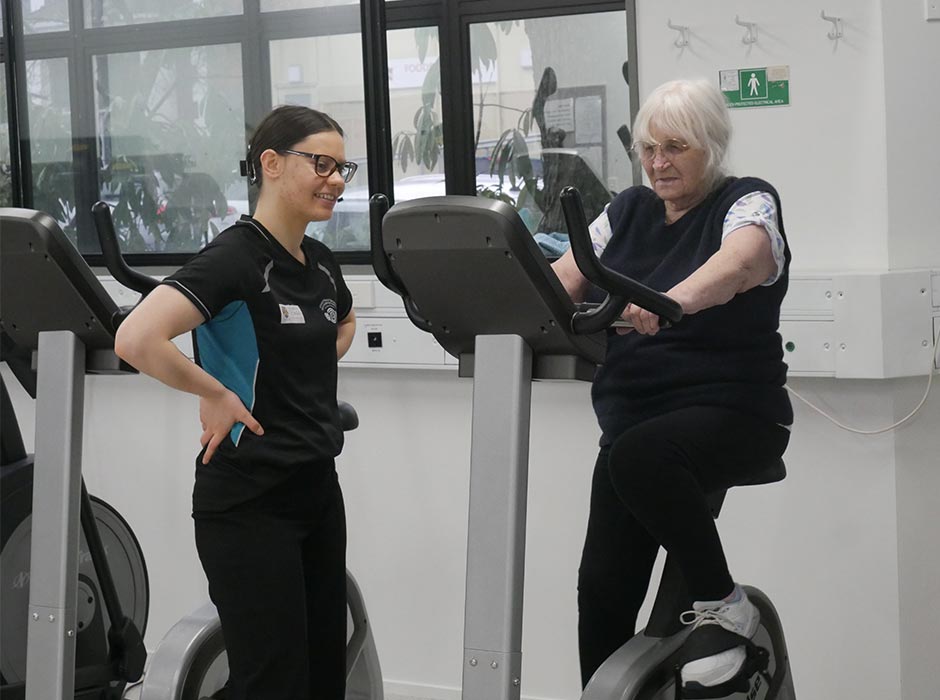
Clinical Exercise Physiology student Aliya Mottus (left) supervises client Pat Downing.
While riding a bike and touching your toes might seem like small feats, they are some of the big wins happening in Otago’s new Connection Through Movement Studio.
The studio is set up in the School of Physical Education, Sport and Exercise Sciences by postgraduate Clinical Exercise Physiology students to earn the necessary clinic hours needed for their accreditation.
Student Aliya Mottus says they work with about 45 members of the Dunedin community with a range of health conditions, such as cardiovascular disease, arthritis and cancer, to help improve their wellbeing.
“We’re trying to promote changes in physical activity so that once they’ve left the studio, they continue to make those changes in their everyday life,” she says.
After an initial consultation and baseline testing, students create a personalised exercise programme for each client, as well as running various classes.
This includes pregnancy-specific classes, a ‘strong and steady’ group for people over the age of 65 with the aim of maintaining and improving balance, and sessions for people with hypertension.
Aliya says clients can tailor the offerings to suit their needs.
“Some people don’t want to be in a group setting, so won’t come to the classes. Whereas, for some, it’s another social activity which helps build community.
“It gives them options.”
The studio has been running for about 10 weeks and clients are already making great progress, like one who is now able to ride a bike again.
“One client said it was the first time he could touch his toes in 20 years, while another said they don’t need to use both of their hands to get in and out of the car anymore,” Aliya says.
Fellow student Maxine McIvor says some of the clients in their pregnancy classes are finding everyday activities easier, while one in the hypertension class has reduced her blood pressure.
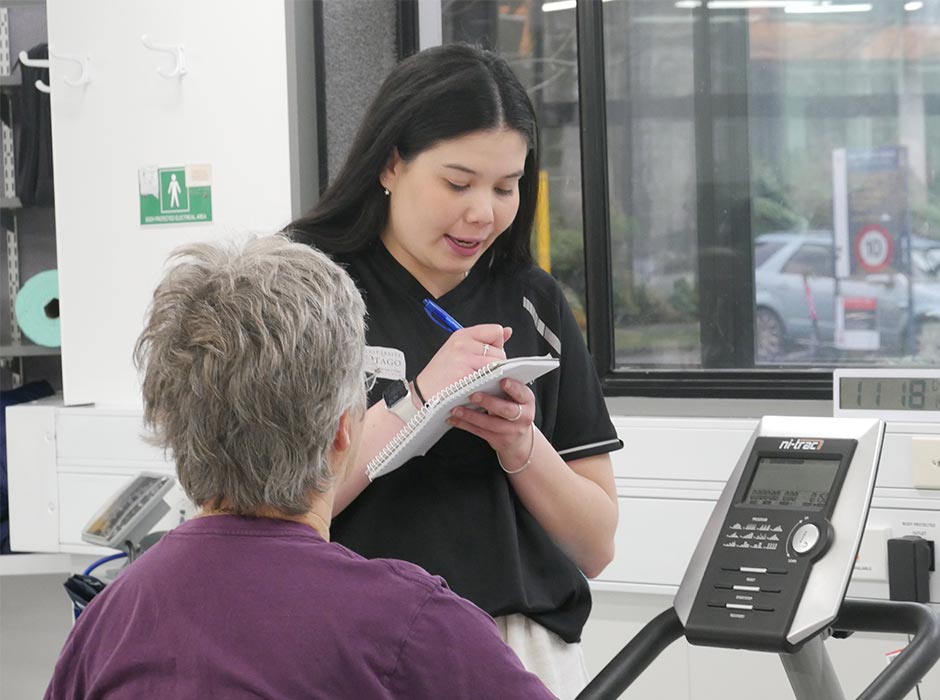
Clinical Exercise Physiology student Maxine McIvor takes notes as she talks to a client.
For some, simply getting out of the house to do something new was enough, she says.
“It’s nice for us to see them progress in those ways but you can also tell that they feel more comfortable and confident in their skin as well.”
Aliya agrees.
“Obviously they have been increasing their weights and reps, numerical strength-based stuff has improved but there’s also the cognitive and emotional aspect that we see as well which is the nicest part,” she says.
The clinic will run until the start of November and new clients are welcome to join.
“They’re in a nice, supportive environment, which helps provide them with the confidence that some people need to get going,” Aliya says.
“It’s good because everyone coming in is obviously motivated because they have to go out of their way to attend, but sometimes it’s just giving them an extra nudge to keep going.”
For more information, contact ctmstudio@otago.ac.nz
- Kōrero by Media Engagement Adviser Jessica Wilson
Te Kura Para-Whakawai
The School of Physical Education, Sport and Exercise Sciences (SPSES) is a global leader in sport-related teaching and research.
Find out more