
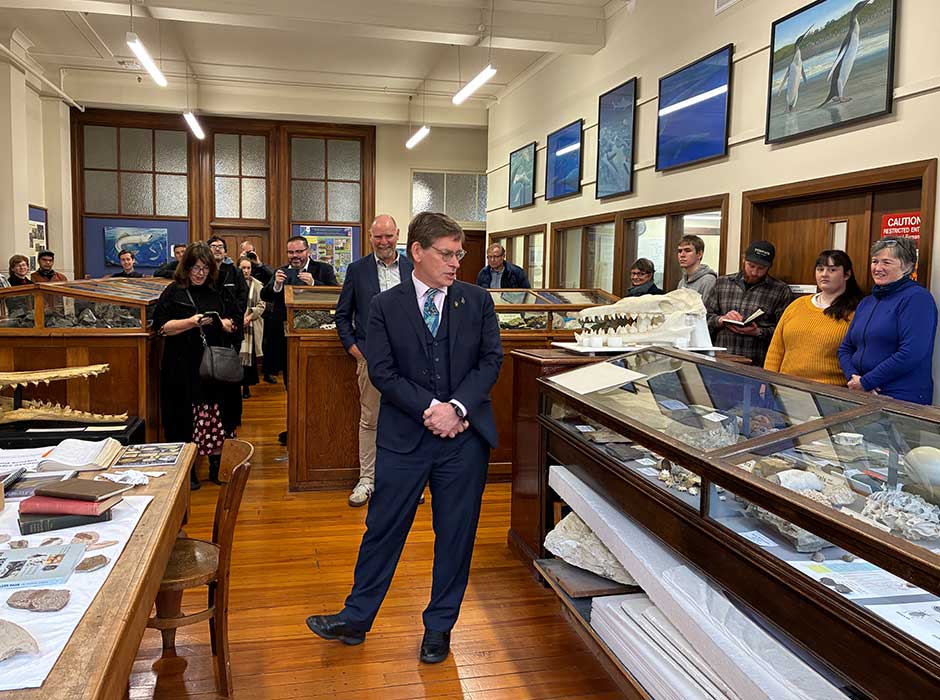
Professor Charles Brennan, Pro-Vice-Chancellor Sciences, speaks at an event celebrating the Geology Museum’s designation as an International Union of Geological Sciences (IUGS) Geo-collection of International Significance.
From tiny ants preserved in amber to enormous whales encased in sediment, from a small ball of possible dinosaur poop to the jaw of an ancient New Zealand crocodile, Otago’s Geology Museum is filled with natural wonders.
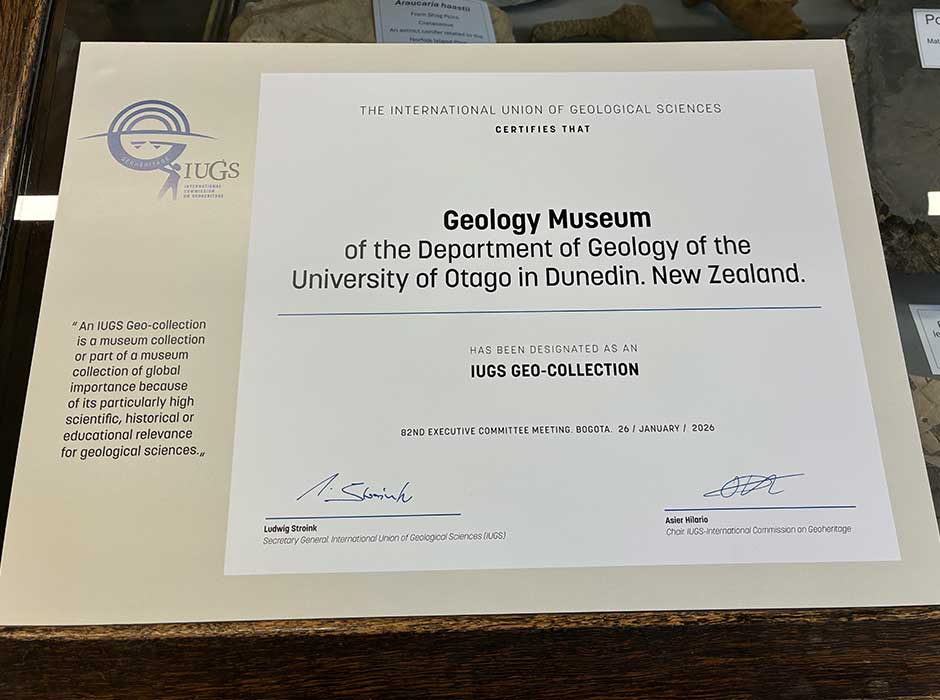
This month the museum became the first in New Zealand and fourth in the Southern Hemisphere to be designated an International Union of Geological Sciences (IUGS) Geo-collection of International Significance.
Professor Charles Brennan, Pro-Vice-Chancellor Sciences, says one of the first things he did after his appointment was tour the museum and its basement of priceless treasures.
“The Geology Museum, which contains many ‘type specimens’ of global importance, is a fantastic resource for students, researchers and the public,” Charles says.
“It helps us understand where we come from and it speaks to where we’re going. As custodians of this wonderful collection, the University of Otago has a responsibility – not only to the past, but also to the future – to ensure the museum is maintained and curated well.
“The IUGS designation speaks to the international significance of the collection, and also to the expertise and dedication of the Geology Department staff.”
The honour coincides with the 100-year anniversary of the museum moving to its current location in the grand Gothic Revival building that was once part of the Medical School. But the collection itself is much older than that.
“Teaching of Geology with Mineralogy began in May 1872, and this required rock and mineral specimens,” says Emeritus Professor Daphne E Lee, one of the museum’s curators.
“So, some of the fossil specimens in our teaching and research collections have been in use for more than 150 years. And what we have on display are some of the most beautiful specimens that tell the nicest stories.”
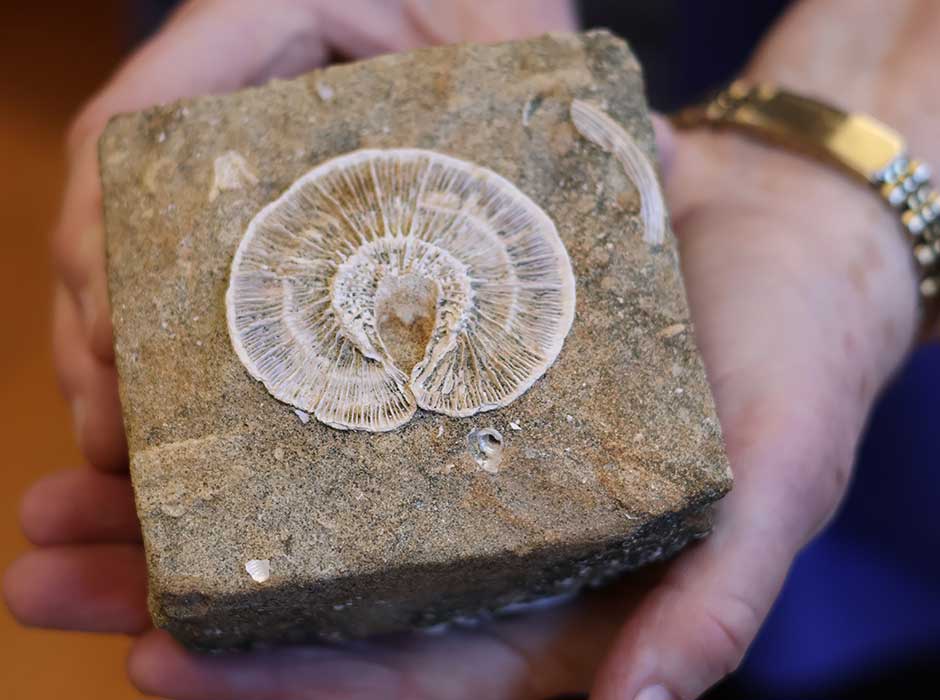
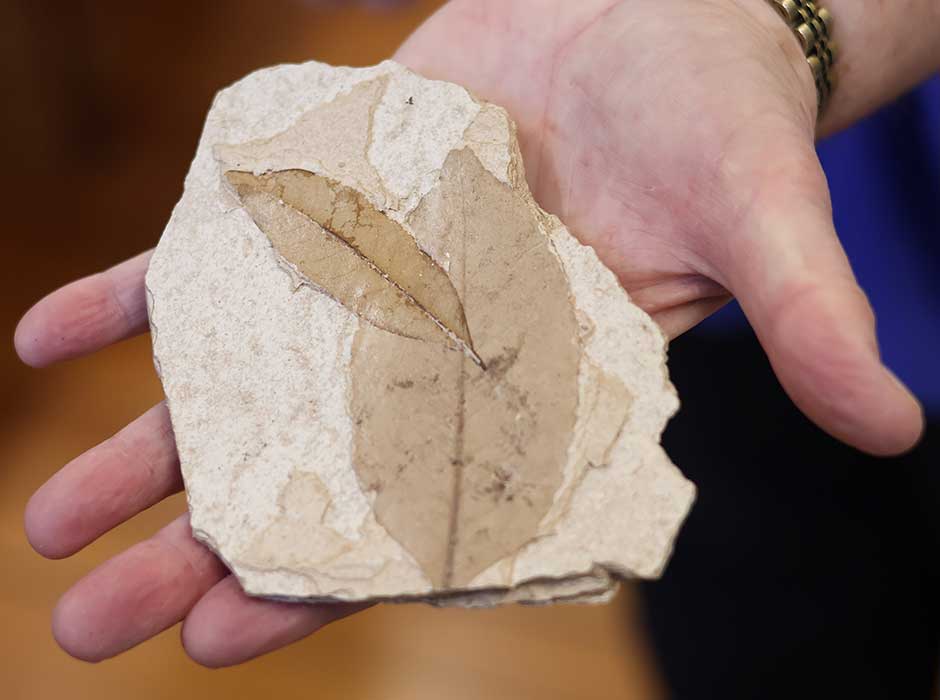
The museum houses thousands of minerals and tens of thousands of rocks, but Daphne says it’s the “amazing array of fossils” that is the “pinnacle of the collection”.
With taoka including plants and insects discovered at Otago’s globally significant Foulden and Hindon Maars, through to dolphins and penguins unearthed from the Waitaki Whitestone Geopark, the ancient fossils have plenty of modern admirers.
“We have a constant stream of visitors who come here to work with the material,” Daphne says.
“In the past month we’ve had researchers from the Smithsonian, Adelaide University and Te Papa, and collaborative research is ongoing with scientists from the University of Michigan, Museums Victoria and elsewhere. We also have hundreds of public visitors including residents, former students and tourists.”
Items from the museum are shared with other institutions. Locally, they can be viewed at Tūhura Otago Museum’s ‘Southern Land, Southern People’ gallery and at the Museum of the Vanished World in the Waitaki Whitestone UNESCO Geopark. Internationally, 3D fossil replicas can be found in the collections of iconic institutions.
Materials are also borrowed by researchers abroad. A treasure trove of miniscule insect fossils preserved in amber is currently on loan to the University of Göttingen in Germany.
“We found New Zealand’s first fossil insect in amber in 2011, and we’ve now got hundreds. They’re beautiful and amazing. They’re tiny, just a couple of millimetres long, but you can see their eyes and antennae. They’re completely new to science.”
Daphne’s far from the only person who’s captivated by the collection – the comments in the Geology Museum’s visitors’ book reflect its continuing impact.
“The one I like best is from Dr Nick Pyenson of the Smithsonian Institution,” Daphne says.
“He wrote: ‘This is one of my favourite places on the planet’. And it’s mine too.”
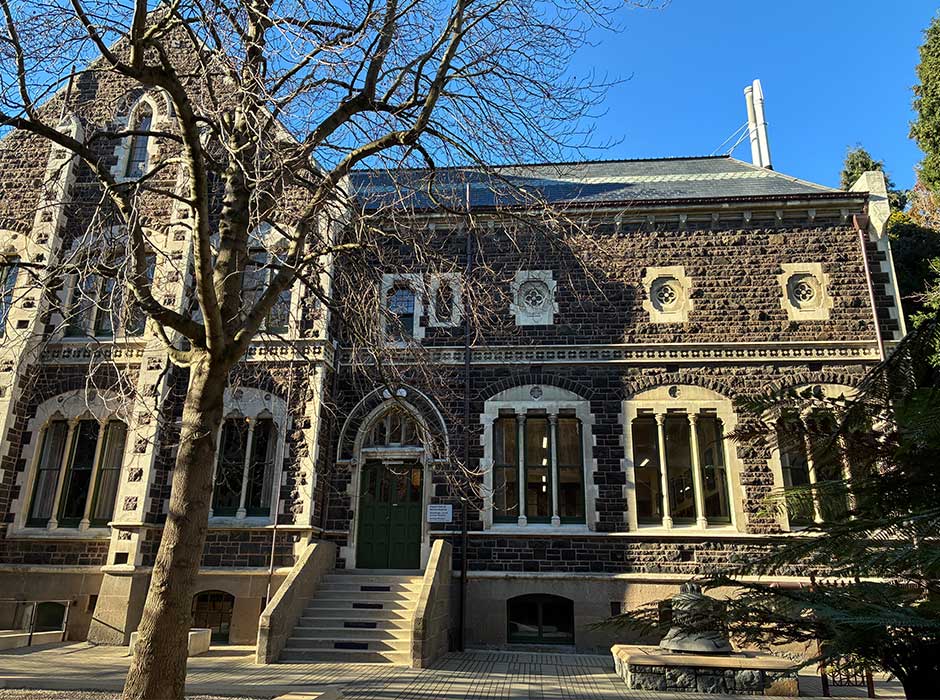
The Geology Museum is a popular attraction for local and international visitors and researchers.
Fossil Treasures of the Geology Museum
Fossil Treasures of the Geology Museum is a free, online book that invites you to explore the wonders within the collection. Here’s a small sampling …
Dinosaur poop
Though Daphne says the remains of Aotearoa’s five types of dinosaurs “would fit in a shoebox”, they may have left more than just bones behind. What looked like a small pebble found in the Waipara Valley, North Canterbury, was discovered to contain a mixture of plant fragments cemented together and may be a dinosaur dropping. The find has yet to be fully analysed, so it remains one of the many tantalising potential research projects within the Geology Museum collections.
Read more about the suspected dinosaur dropping.
St Bathans crocodile
Did you know there were once small crocodiles in New Zealand? Our first fossil crocodilian to be described is a small dark fragment of jaw from Early Miocene lake sediments in Central Otago. The approximately 16-million-year-old crocodile probably had a lower jaw 20cm long, with a skull of a similar size, and may have grown to around three metres long. You can view the jaw fragment in the ‘Southern Land, Southern People’ Gallery at Tūhura Otago Museum.
Learn more about the little crocodile.
Giant turtle named after fantasy writer
In 1995, PhD student Richard Köhler described and named the Waihao Greensand fossil turtle Psephophorus terrypratchetti in honour of British novelist (and turtle enthusiast) Terry Pratchett. The author, who saw the fossil during a visit to Dunedin, wrote, “It tickles my imagination. Forty million years ago this thing was paddling around the globe, eating jellyfish, and now there’s this link to this short bald guy whose own species, at that time, was still saying ‘ook’.”
Learn more about the giant turtle.
Ghost egg of a ghost fish
Chimaeras or “ghost fish” are shark-like fish that release eggs with a frilly capsule “shell” made from keratin and collagen. Once developed, the embryo leaves the egg capsule (known colloquially as a “mermaid’s purse”). It’s unusual to find a fossil made from soft tissues, but the Geology Museum contains a fossilised impression of an egg capsule that once lay on an ancient sea floor. The similarity in shape to modern chimeroid egg capsules tells us their basic mode of reproduction has remained essentially the same for the last 200 million years.
Learn more about the ghost egg.
Want to know more?
You can read Fossil Treasures of the Geology Museum eBook online for free.
- Kōrero by Kathryn van Beek, Communications Advisor | Kaiarataki Pārokoroko
Geology Museum
Our Geology Museum, which is open to the public, contains large and significantly important collections of rocks, minerals and fossils – the largest such collection in the South Island. There are displays in the museum itself and in the adjacent foyer.
View