

Nina Batucan, who graduates on Saturday with a PhD in Freshwater Ecology, stands by Ōwheo, also known as the Water of Leith.
When Nina Batucan became a nurse she joined her mother, two aunties, two uncles and a brother in the profession. But it was while undertaking her nursing training that Nina discovered her real passion – science.
“I picked up a book about neuroscience in the Polytechnic library, and it sparked my interest in science, the brain and psychology,” says Nina, who will graduate with a PhD in Freshwater Ecology this Saturday.
“I wanted to abandon my training and study neuroscience immediately, but Mum advised me to finish my nursing degree.”
Nina’s interest in the brain was further piqued when she began her nursing career in a rest home that specialises in dementia care.
“Dementia has behavioural and psychological symptoms, and I liked the challenge of it. You’re always on your toes, having to anticipate the needs of patients who can’t verbalise them.”
But the pull of neuroscience was strong, and after two years as a nurse, Nina came to Otago to study medicine.
“I did have qualms about leaving nursing, but one of my colleagues said, ‘once a nurse, always a nurse’.”
While in her first year of Health Sciences, Nina realised she was more interested in becoming a scientist than practising medicine.
“I met the late Professor Philip Bishop, a very charismatic individual, who talked about the wider world and how we have to look after it. That discussion made me realise how big the reach of the environment is. Medicine is about human health, but the environment is about everything, and I really liked the idea of that.”
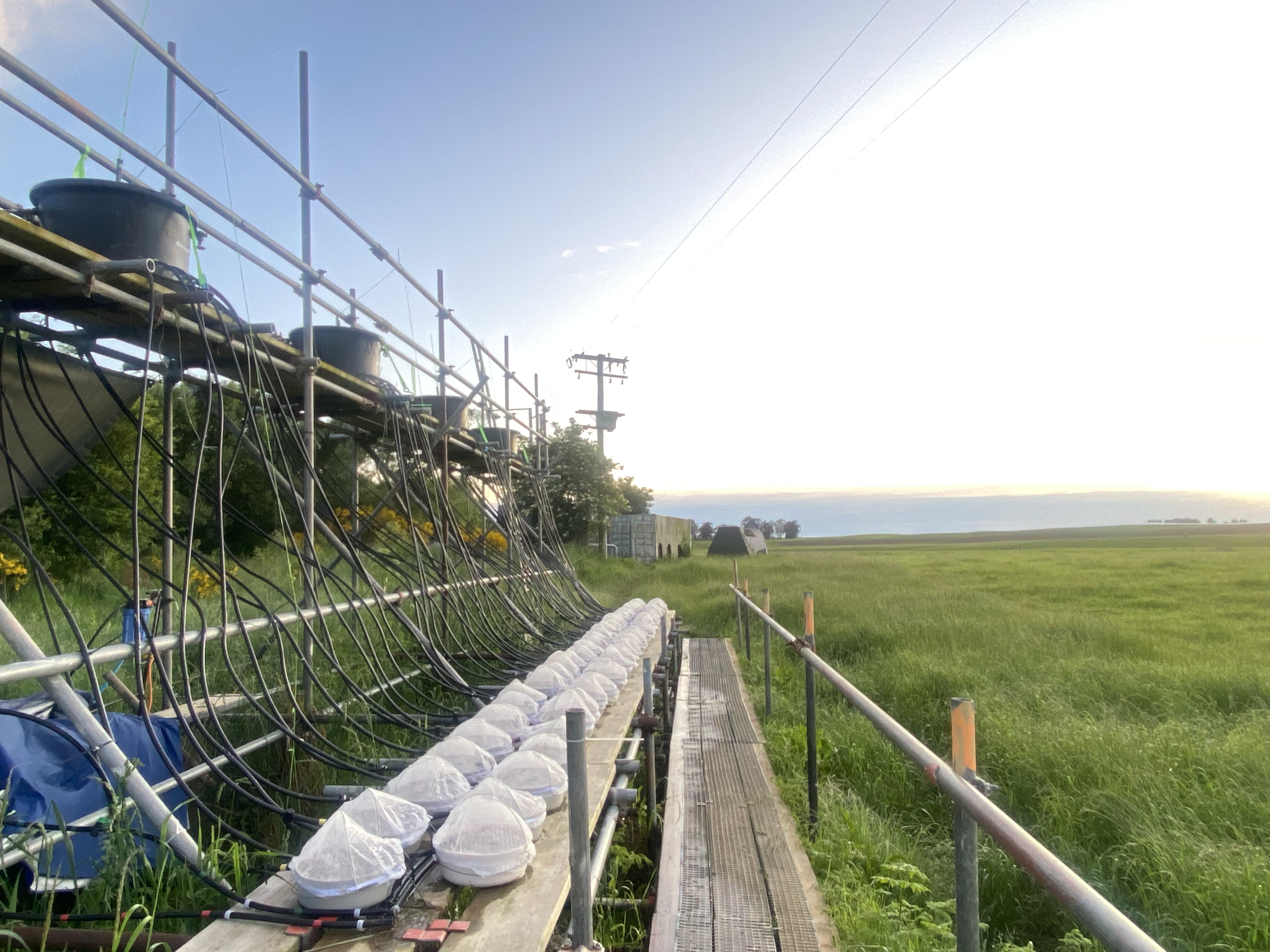
Safe from the prying eyes of cows, Nina's experiment fed Kauru River water into mesocosms, which model natural ecosystems.
Nina segued into Ecology, where she brought her nursing background to bear on her research looking at the impacts of pharmaceuticals and insecticides on freshwater systems.
“I went on to do my PhD exploring the contaminants of ibuprofen, carbamazepine, and imidacloprid, which is a neonicotinoid insecticide that targets the nicotine receptors of insects. The insecticide is definitely not great, and in other places around the world, like the United States and the European Union, there’s already regulation around the use of neonicotinoids.”
Though Nina primarily studied mayflies, she also learnt about another animal – cows.
“I spent six weeks camping on a farm where we did a field experiment using a system that took water from Kauru River and fed it into experimental mesocosms. The cows were very curious, and they’d follow us around. They’re also quite noisy at night. You’d wake up and hear them huffing!”
While she studied, Nina worked as a nurse in the psychogeriatric inpatient unit at Dunedin Hospital, where she spent quiet night shifts diligently doing her homework. All that hard graft paid off, with Nina being recognised through prizes and scholarships including the Premier Undergraduate Prize (Science), the Council Commendation for Exceptional Performance and the University of Otago Doctoral Scholarship
Nina is currently combining science, nursing and her interest in the brain in her role as Research Nurse at the Dementia Prevention Research Clinic. And she’s also discovered a new passion – Ōtepoti Dunedin.
“It’s a lovely place to be. I love running the beautiful trails, and I like that it’s a university city. I’d like to stay here, maintain my established connections and collaborate with other researchers.”
-Kōrero by Kathryn van Beek, Communications Advisor | Kaiarataki Pārokoroko
Department of Zoology
Zoologists study how animals evolved, their behaviour, physiology and ecological interactions, and how to conserve populations in the face of global change.
View