
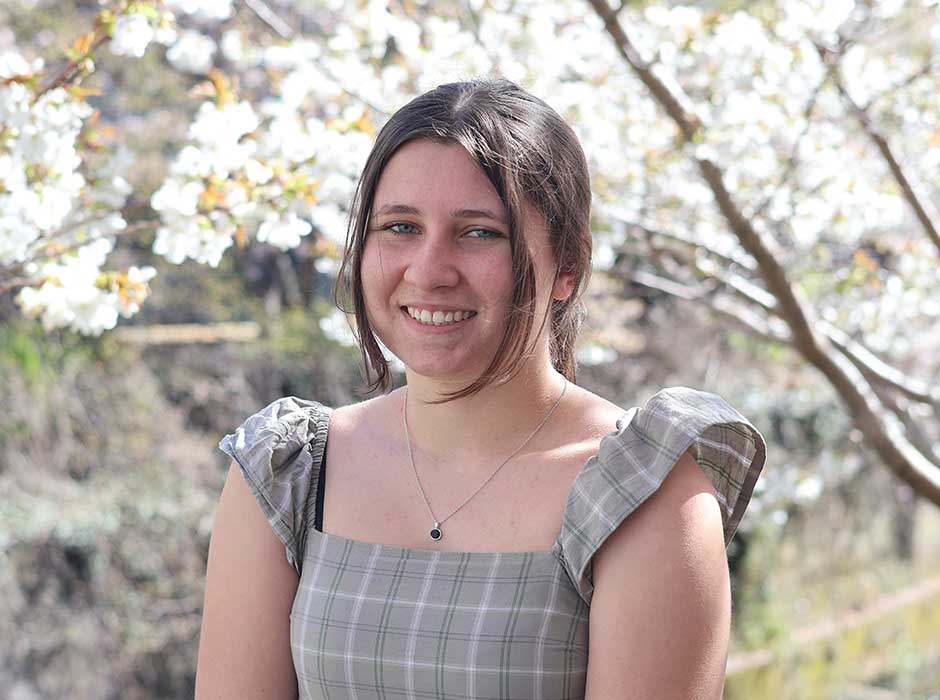
When she’s not solving problems or exploring the wilderness, Mathematics Master’s tauira Megan Macdiarmid also enjoys debating. “With both debating and maths, you spend a lot of time making arguments to solve something, and you have to think critically about other people’s arguments,” Megan says.
Mathematics Master’s tauira Megan Macdiarmid does some of her best problem-solving when she’s tramping outdoors. So when she was awarded the John Clark Memorial Prize last year, she knew just what to buy with the $500 prize money – a tent.
The prize is one of eight scholarships and awards Megan’s won since beginning her studies at Otago, but it has special significance for the former Logan Park High School student.
“John’s widow, Dr Austina Clark, established the prize. Austina has been one of my lecturers, and I’m really grateful to her. It was a big confidence boost,” Megan says.
The tent has since accompanied Megan on trips to Middlemarch and Wanaka. But when she’s not exploring the great outdoors, Megan can be found in the traditional habitat of an academic – an office.
“I spend half my time using existing literature and going to the whiteboard to solve problems by hand, and the other half writing code to run simulations,” Megan says.
Megan tests her code with supervisor Associate Professor Robert Van Gorder, who she says is “really friendly and encouraging”.
Robert’s one of several people who inspired Megan to pursue maths – beginning with her Scottish grandfather, a statistician.
“When I was a kid he would always play little maths games with me, and it would seem like a magic trick,” Megan says.
“I guess that’s what got me interested in it. It’s always been something I really enjoy, and I was lucky to have really good mentors.”
Megan began honing her code-writing skills while she was at school.
“Another student and I made a website for the school’s athletics day to run on, updating scores in real time,” Megan says.
“I think I still had to go to athletics day, unfortunately.”
She now spends her days calculating the speed at which different shapes of ice melt.
“The goal is to get a generic method approximating how long it would take to melt a generic shape,” Megan says.
If she can crack the problem, the solution won’t only apply to ice.
“It will be able to be used for things like population models, because a similar thing happens where they can grow or shrink depending on what’s happening inside,” Megan says.
“I’m interested in applied maths, particularly how you can make techniques that solve a bunch of different problems. It’s nice to see things connect in a way that you might not expect. I really like the idea of contributing useful tools to science.”
There’s one other problem Megan would love to solve – encouraging more young people into maths.
“I think I would just tell people it’s not as hard as you think it is. Don’t get put off before you even try.”
And if you do get stuck, try tramping.
“Honestly, I get stuck a lot, and I think the best thing is to go for a walk,” Megan says.
“I have all these notes on my phone from when I’ve been tramping and I’ve realised something and typed it down. When you’re tramping, you’ve got time to think.”
-Kōrero by Kathryn van Beek, Communications Advisor| Kaiarataki Pārokoroko
Department of Mathematics and Statistics
Understand the fundamentals of mathematics and statistics and solve real world problems.
View