
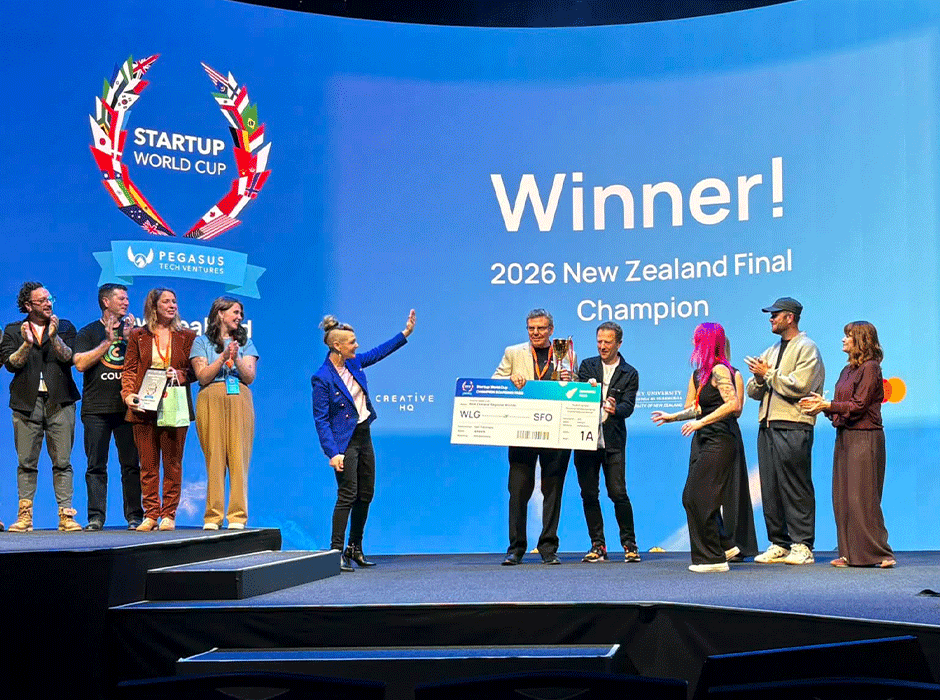
Professor John Reynolds (centre) won the New Zealand final of the Startup World Cup, earning him a trip to Silicon Valley and an opportunity to compete for the top prize of US$1 million.
An Otago researcher who is on a mission to restore function in people affected by brain disorders has won the opportunity to pitch his company to international investors in the United States.
Professor John Reynolds and his company Neumic Therapeutics Ltd recently won the Aotearoa New Zealand final of the Startup World Cup in Wellington, securing a ticket that takes him one step closer to the grand final in Silicon Valley in November.
John joins other winners from around the world who will have two minutes to pitch their company to the judges.
The 10 finalists will then give a four-minute pitch, followed by a two-minute question and answer session. The winner will be eligible for a US$1million (NZ$1.68 million) prize.
John says this is a huge milestone in the company’s journey.
“It’s really important for informing the world about Neumic and our aims, and for attracting interested partners to support the company’s growth.
“It’s very exciting.”
With dozens of high-level investors and business-people expected to attend, the event will be a great opportunity to network, he says.
“We hope to form some critical US contacts for advice and investment, in preparation for growing our business there.
“While it would be great to win, being able to showcase our company to investors will be incredible.”
Neumic was spun out this year from the University of Otago – Ōtākou Whakaihu Waka, which remains a partner.
While it is a young company, it has potentially life-changing goals, he says.
“Our aim is to restore brain function for people affected by brain disorders by precisely targeting drugs and stimulation treatment to affected brain areas non-invasively.
“We are developing a platform technology incorporating a wearable ultrasound headset, software for planning and monitoring treatment, and nanoscale drug-delivery packages that deliver drugs where and when needed in the brain.”
The outcome could be significant for people with conditions like Parkinson’s disease, epilepsy, brain tumours and tinnitus.
“The most rewarding outcome will be seeing people using our equipment and being able to go about their daily lives more freely.”
John and his team plan to start a trial for tinnitus in 2028.
“This will be a first in human trial for the condition, where we will use our headset and our knowledge of how to alter brain circuits to reduce the brain’s perception of tinnitus, which for some patients is very severe.
“Hopefully, we can start to bring some relief to people.”
Department of Anatomy
Like the proverbial iceberg, Anatomy at Otago is about more than just bones and muscles, it's about people: How we begin life and how we develop, how we move and how we function, how we remember and how we forget...
Find out more