
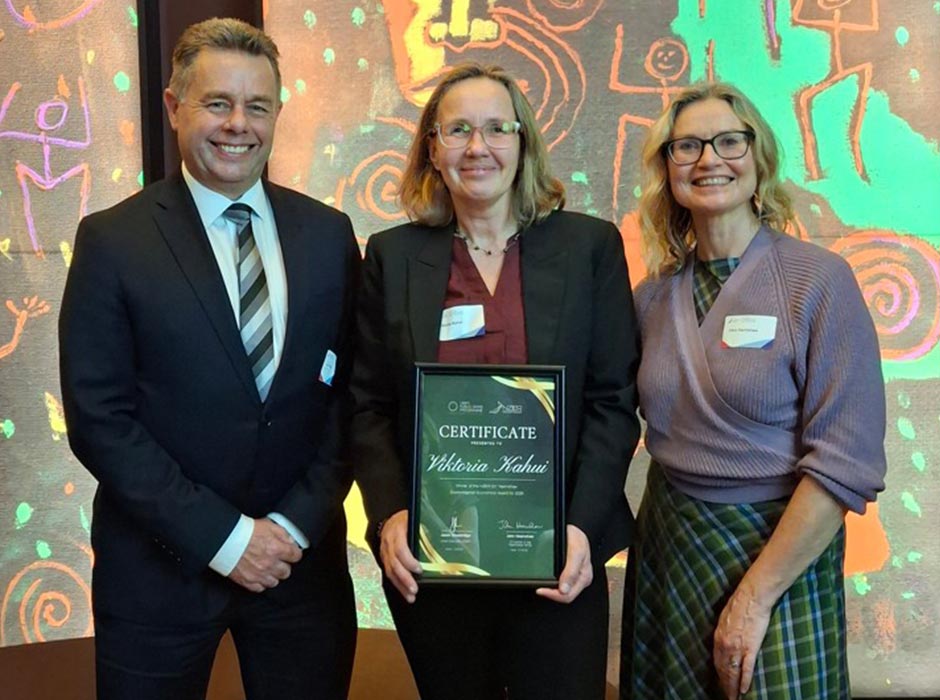
From left, Jason Shoebridge (Chief Executive of NZIER), Associate Professor Viktoria Kahui, and Alice Hearnshaw (sister of Ed Hearnshaw).
There’s a jeopardy-rich field at the intersection between economics and the environment that keeps Associate Professor Viktoria Kahui on her academic toes.
Her stellar work in this area – especially the despond-lifting hope she imparts – has just won her the 2026 New Zealand Institute of Economic Research (NZIER) Ed Hearnshaw Environmental Economics Award.
This biennial award was established in 2024 by the Hearnshaw family and NZIER (an independent, not-for-profit economic consultancy) to recognise and support outstanding contributions to environmental economics within New Zealand.
The award comes with a purse of $4,000 and honours the memory of Dr Ed Hearnshaw – a talented environmental economist and former Chief Economist for the Parliamentary Commissioner for the Environment. He died in a tramping accident in 2020.
Having read about Ed’s life, Viktoria says she shares his belief that environmental economics is about managing both environmental and human wellbeing.
“It’s something very close to my heart. We are part of the environment, we depend on the environment, and we thrive when we manage our environment well. So, the big question is, how do we go about doing this?”
Dr Bill Kaye-Blake, NZIER Principal Economist, says there were many things about Viktoria that impressed the judging committee.
“Firstly, Dr Kahui is clearly developing a new generation of people to be involved in environmental issues and giving them understanding about the economic tools available to address them. The feedback from her students demonstrates that she excites and inspires them with her teaching,” Bill says.
“Secondly, her academic research is focused on environmental issues, demonstrating a commitment to deep understanding of the subject.
“Thirdly, she is also involved in community action in support of the environment, as trustee and member of local environmental groups. This involvement demonstrates that environmental economics is not merely an academic interest.”
When asked what set her compass in the direction of environmental economics, Viktoria dates it back to the year she spent backpacking around the world in the late 1990s prior to beginning a Master of Science degree in Environmental and Resource Economics at University College London.
“I experienced the amazing natural beauty in countries around the world and realised that good management of the environment (or absence of) impacted on the wellbeing of people.”
Since completing her PhD in Economics at Otago, she’s thrown her research lens over fisheries and marine economics, climate change economics and, most recently, Rights of Nature. She’s particularly absorbed by the latter.
“I’m very excited about it. It embraces the Indigenous way of thinking and offers a new type of property rights – in environmental economics at least – where the environment owns itself. We have examples of that in Aotearoa with the Whanganui River and, most recently, the Taranaki Maunga.”
Alongside her research, Viktoria has been teaching environmental economics at undergraduate level since 2009. She relishes the challenge of making the topic interesting and relevant for her students – with a side serving of uplift.
“The thing that struck me early on in my career was that there’s a doomsday mentality out there and students often feel lost in the sense that there’s not much hope. But in a strange way, environmental economics actually provides a much more positive message. In my teaching, I focus on understanding and applying the tools of environmental economics to the issues our societies face.”
Viktoria says she’s grateful for the opportunity to teach young, questing minds.
“One of my biggest joys is when students tell me how the principles of the environmental economics discipline have fundamentally shaped their way of thinking about environmental issues, impacting both their life and career choices.”
As for winning a prestigious award for her contribution to environmental economics, she says, “I am absolutely delighted”.
- Kōrero by Claire Finlayson, Communications Adviser (Otago Business School)
Study Economics at Otago
Want to see the big picture behind big decisions? Economics gives you the clarity and confidence to understand and improve the world around you.
Explore Economics