

Dr Jordan Lima (PhD, right) receives a taonga pounamu before addressing Te Huka Mātauraka (the Māori pre-graduation ceremony).
Congratulations to all Department of Biochemistry - Tari Matu Koiora students who graduated in May. Tino pai rawa atu!
PhD
Toby Brown
The structure and operation of the binding site for the terminal quinone electron acceptor of Photosystem II
Photosynthesis is initiated by the enzyme Photosystem II (PS II). PS II absorbs light energy which it then uses to split water; this water splitting provides essential electrons and protons that drive the rest of the photosynthetic process. Electrons must be exported from PS II for photosynthesis to occur; this export occurs through the terminal electron acceptor, QB. This research employed mutations of the core PS II protein, D1, to study the binding site of QB in vivo. Results revealed novel detail about how each part of the QB-binding site contributes to the electron export process. An unexpected lateral energy transfer response from PS I into PS II also emerged when specific mutations targeting the binding site were made.
Joke Grans
Investigation of long non-coding RNAs as potential tumor suppressors in triple-negative breast cancer
Jordon Lima
Māu tēnā kīwai o te kete, māku tēnei: delivering circulating tumour DNA testing to Te Tairāwhiti communities
“Māu tēnā kīwai o te kete, māku tēnei.” That handle is yours, this handle is mine. This whakataukī embodies the combined mātauranga of biomedical research and the hapori of Te Tairāwhiti, that wove this thesis together. This research investigated how circulating tumour DNA testing, a blood-based method for detecting cancer, could be delivered to Te Tairāwhiti communities by grounding the research in their distinct geographic, socioeconomic, and cultural identities, needs, tikanga, and kawa. Narrative interviews with cancer patients and healthcare providers, alongside a proof- of-concept laboratory workflow for patient-specific tumour detection and surveillance, produced community-centred clinical recommendations for the future of this technology in the region – prioritising whanaungatanga, mana motuhake, and hapori partnership as the foundations of equitable cancer care.
Kaitlyn Tippett
Investigating the synergy of lncRNA-targeted therapies with current treatments for triple-negative breast cancer
MSc (Biochemistry)
Hamish Murdoch (with Distinction)
BSc Hons (Biochemistry)
Judd Adamson (First Class)
Sophie Tunnicliffe (First Class)
BSc Hons (Genetics)
Madeleine Ford (First Class)
Ella Mitchell (First Class)
BBiomedSc Hons (Molecular Basis of Health and Disease)
Marie Jones (Second Class, Division I)
Megan Lilly (First Class)
Mickle Manavalan Jose (First Class)
Joseph Ramana (First Class)
Alexandria Rutherford-Blyth (First Class)
Ella Simpson (First Class)
BSc (Biochemistry)
Max Boennic
Cushla Bridges
Luke Geddes
Sian Moloney
Ella Robertson
BSc (Plant Biotechnology)
Caesar Harper
Ella Sangster
BAppSc (Forensic Analytical Science, Biochemistry)
Nishil Gounder
Ella McClean
BBiomedSc (Molecular Basis of Health and Disease)
Isabel Kurta
Charissa Loader
BBiomedSc (Functional Human Biology, Molecular Basis of Health and Disease)
Thomas Li
BComSc (Biochemistry, Finance)
Ruoyu Zhang
BComSc (Biochemistry, Marketing)
Amanda Shallard
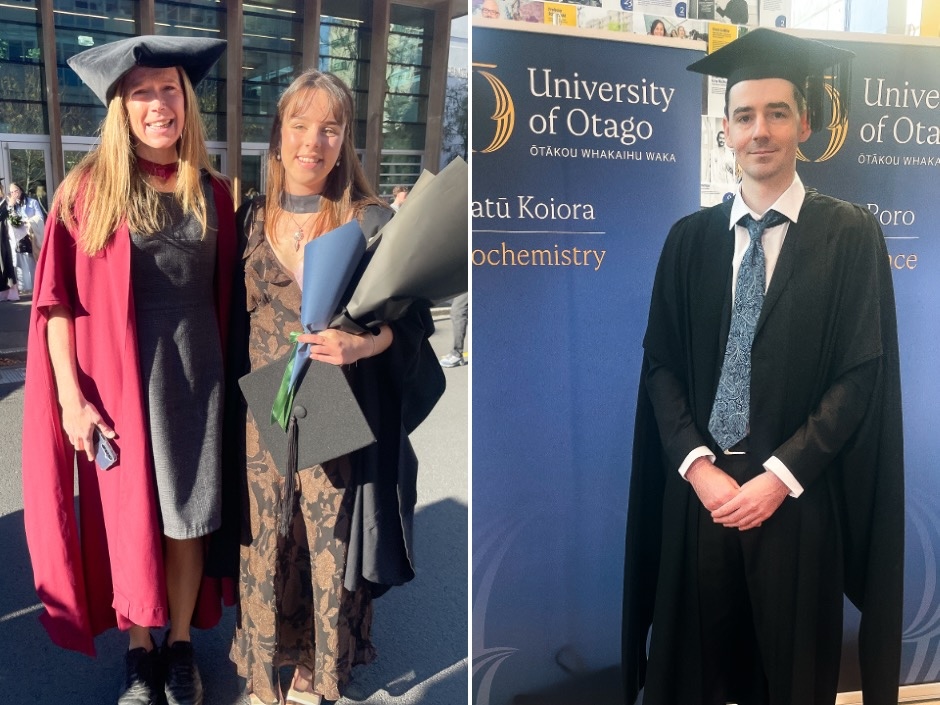
Sophie Tunnicliffe (BSc(Hons), middle) with her supervisor Associate Professor Anita Dunbier (left); Hamish Murdoch (MSc, right).
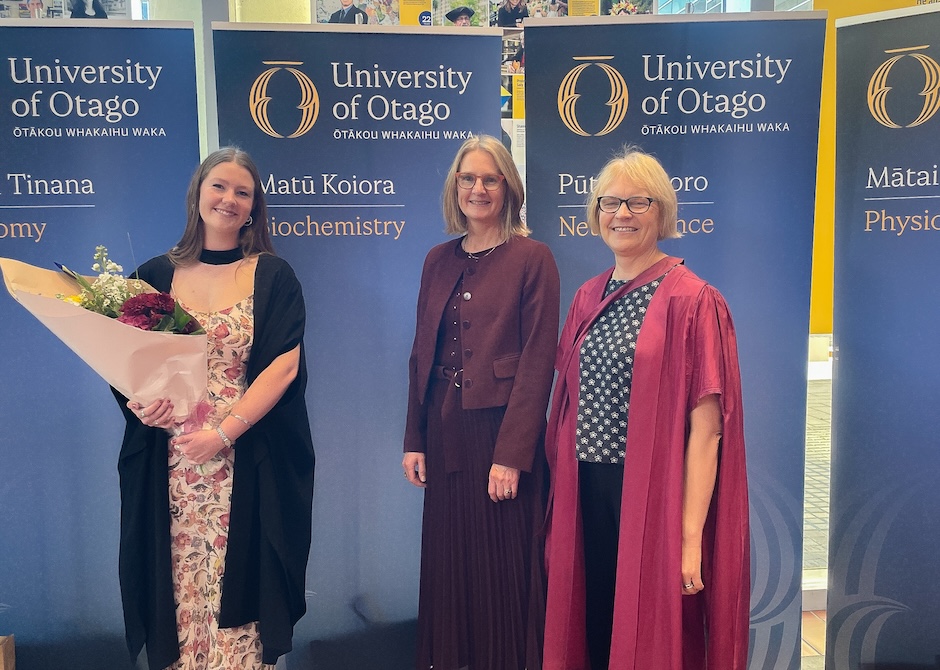
Erin Clark (Biochemistry minor with a BSc in Agricultural Innovation, left) with her mum Dr Sarah Clark (middle) who completed her PhD with Otago Biochemistry, and Professor Liz Ledgerwood.
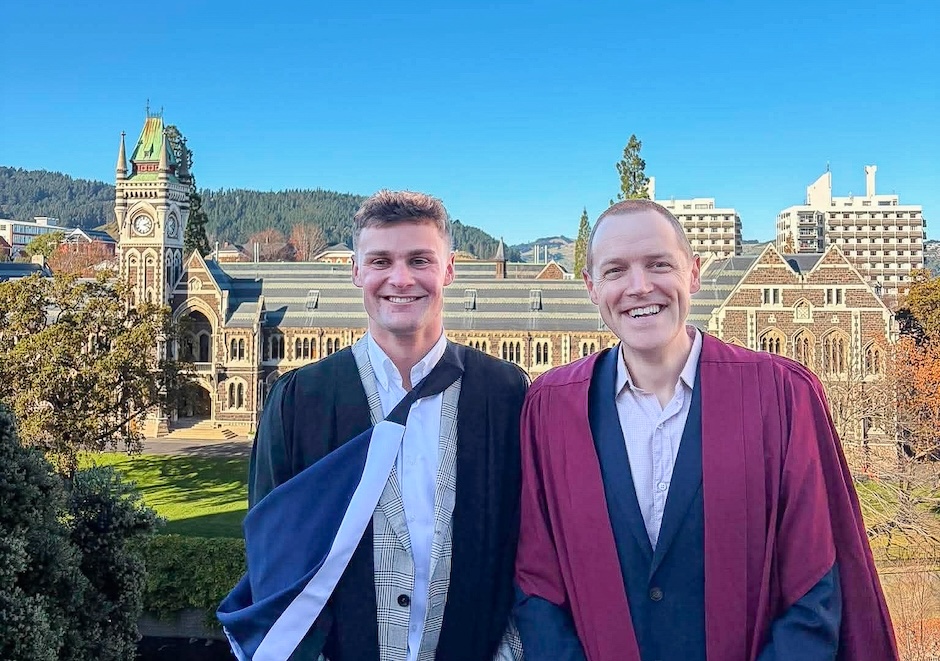
Judd Adamson (BSc(Hons), left) with his supervisor Professor Peter Mace.