
New Zealand has a vital stake in examining its position in the midst of a faltering international rules-based order, a leading University of Otago – Ōtākou Whakaihu Waka researcher says.
A distinguished group of international and national specialists will gather at the 60th Otago Foreign Policy School in Dunedin next week to examine how New Zealand should respond to the numerous global pressures and challenges.
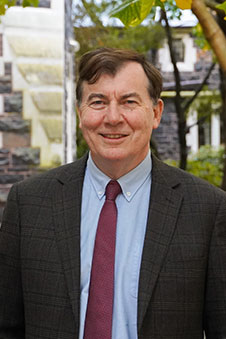
Professor Robert Patman
In 1966, lecturer in international relations Arnold Entwisle directed the first Foreign Policy School at Otago and the vision that inspired that first event remains as relevant today, School Co-Director Professor Robert Patman says.
“In his opening address to the inaugural School in 1966, Mr Entwisle said there was an urgent need for ‘a do-it-yourself kit’ in the area of New Zealand foreign policy making.”
Mr Entwisle’s assessment reflected concerns that the world was rapidly changing in the 1960s and was presenting challenges that New Zealand was not fully prepared for, Professor Patman says.
Today, New Zealand faces an even more serious challenge.
For many decades, New Zealand governments have championed the vision of a rules-based international order and the norm of multilateral diplomacy, but these foundational principles now seem to be threatened by growing lawlessness in the international arena, he says.
“Like most small and middle powers, New Zealand has a vital stake in ensuring that its security and economic well-being are not dictated by the unrestrained exercise of raw power.”
Developments in the 1980s such as globalisation and the demise of the Cold War toward the end of that decade seemed to expand the possibilities of the international rules-based order, however more recently, the post 9/11 era has been marked by the steady erosion of an international rules-based order on three fronts, he says.
On one front, there have been international challenges such as the US-led invasion of Iraq in 2003, Russia’s annexation of Crimea and subsequent full-scale invasion of Ukraine in 2022, and the US/Israeli war against Iran in 2026.
Secondly, this period has witnessed the rise of right-wing populist leaders in the US, the UK, Brazil and Hungary, which has served to diminish support within these countries for an international rules-based order.
The third front has seen international and national challenges morphing together to create a combined threat.
“Opponents of the rules-based order have sought, particularly in the social media space, to influence the political direction of states that have traditionally supported this order.
“New Zealand cannot be indifferent to these trends.”
The 60th University of Otago Foreign Policy School will consider the rules-based order through the lens of five related themes:
Liberal Institutions and Multilateralism: Theoretical and Empirical Perspectives
Free Trade, Sovereignty, Big Tech, and Democratic Governance
Upholding Rules in an Insecure and Unjust World
Alternative Approaches to an International Rules-Based order
New Zealand and an International Rules-Based Order under Strain
Speakers include:
Dr Hanna Shelest, Director of Security Studies and Global Outreach, Ukrainian Prism
Dr Malcolm Jorgensen, Max Planck Institute for Comparative Public Law and International Law, Heidelberg
Professor Zhang Qingmin, Chair of the Department of Diplomacy, School of International Studies, Peking University
Professor Ilan Pappé, University of Exeter
Associate Professor Fadhel Kaboub, Denison University
Further information:
Please click here for the full event programme.
To register, please click here.