
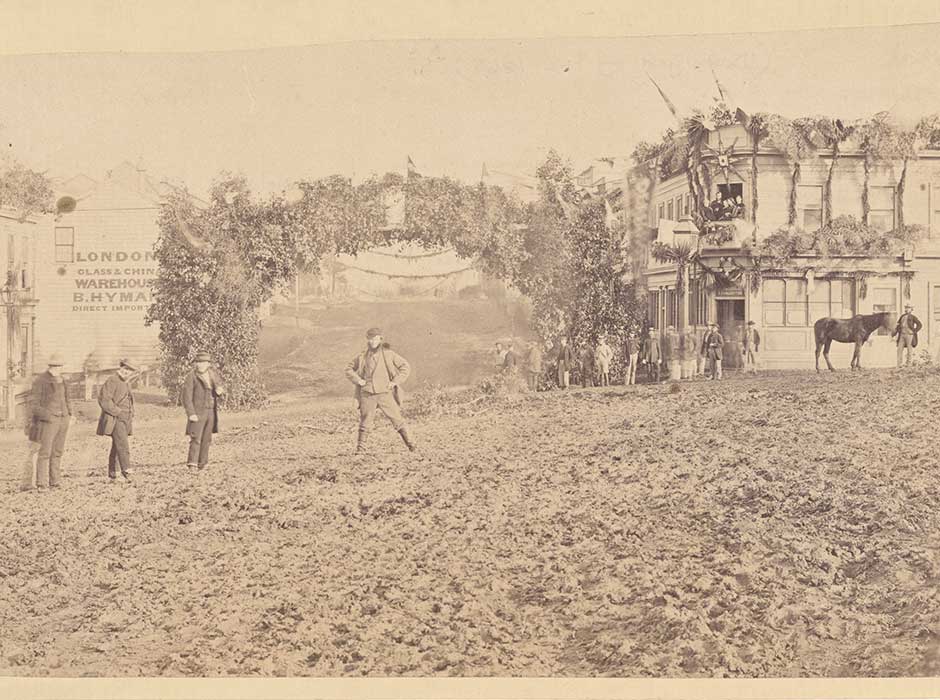
William Meluish, Octagon, decorated in honour of the marriage of the Prince of Wales and Princess Alexandra, July 1863, Box-167-007, Hocken Collections Uare Taoka o Hākena, University of Otago.
An illuminating exhibition showcasing rare photographs of mana whenua and early settlers is set to make its final stop on its tour down the country.
The University of Otago – Ōtākou Whakaihu Waka will host A Different Light: First photographs of Aotearoa, on display at Hocken Collections Te Uare Taoka o Hākena from September 20.
It presents a selection of some of the earliest photographs produced in Aotearoa, dating from the 1850s to 1900, tracing photography’s rapid development from the unique daguerreotypes made in the late 1840s to the widely shared cartes de visite of the 1860s and the emergence of amateur photography in the 1880s.
The exhibition has been years in the making, conceived as a collaboration between The Hocken, Tāmaki Paenga Hira Auckland War Memorial Museum and the Alexander Turnbull Library, National Library Te Puna Mātauranga o Aotearoa, with photographs from all three collections.
Hocken Photography Curator Dr Anna Petersen says this is a rare opportunity to view some of Aotearoa New Zealand’s original earliest photographs from three key institutions.
“Some of the photographs have most likely never been exhibited before,” she says.
Three curators - one from each partner institution - positioned at different ends of the country faced the unique challenge of confining the selection of photographs to roughly 35 items each.
The Hocken’s display will include 33 extra local photos from its own collection, for the benefit of its Dunedin audience.
“I am excited to see how good the exhibition is looking in the Hocken Gallery and pleased to have had the opportunity to add photographs that bring out the particular aesthetic of early photography, due in part to the technological limitations and materials and processes used,” Dr Petersen says.
“We will showcase more images by Dunedin’s nineteenth century photographers because we have such a rich photographic history that is not as well recognised as it could be.”
One Otago photograph that has been displayed throughout the exhibition’s tour is of a Kawarau Gorge rock formation, no longer in existence.
The natural bridge was used by early Māori as a crossing point en route to and from the West Coast and was also used by early European explorers and goldminers during the 1860s, she says.
“The Natural Bridge on the Kawarau by Joseph Perry includes a small group of miners near the bottom with a couple of manuka poles suspended a little way up.
“When the river was high, the miners would carry their provisions across by walking on the lower stick and holding on to the upper one.”
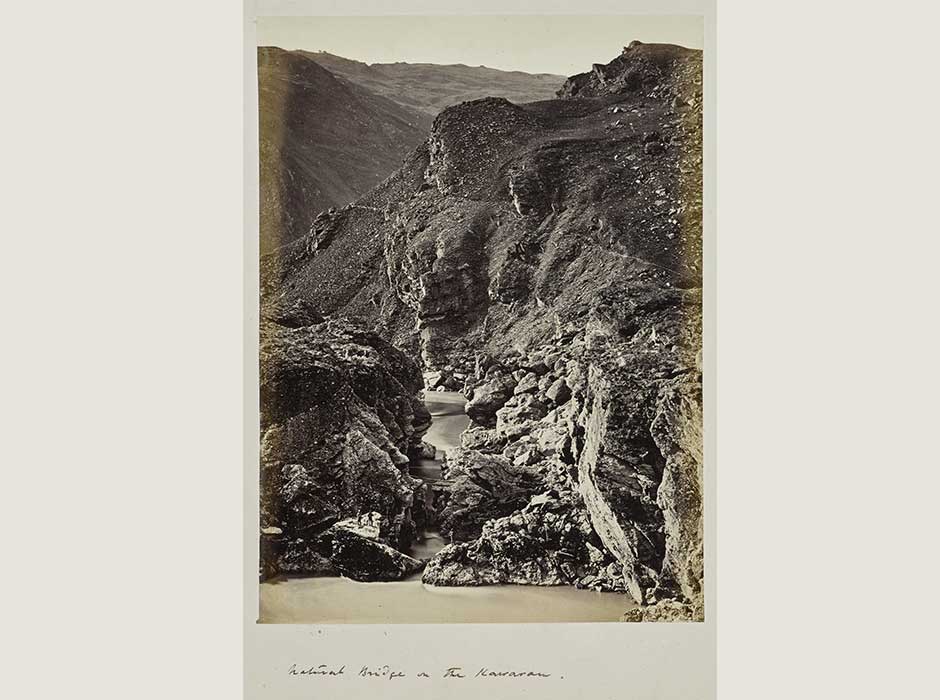
Joseph Perry, The Natural Bridge on the Kawarau, 1865, albumen silver print, P1910-004-015, Hocken Collections Uare Taoka o Hākena.
It was commissioned by geologist James Hector as part of a photographic survey of Otago for display at the first New Zealand Exhibition held in Dunedin in 1865.
Dr T. M. Hocken was the only person to buy the complete set of 100 images taken by Joseph Perry – two of which are included in the exhibition.
A Dunedin image, taken by William Meluish, shows Octagon buildings decorated to celebrate the wedding of Queen Victoria’s eldest son and future King and Queen of England, Prince Albert Edward and Princess Alexandra of Denmark, which took place in England on 10 March 1863.
“The photograph speaks of loyalty to the Crown as well as offering evidence of the state of the Octagon in the 1860s,” Dr Petersen says.
“Dunedin was referred to locally as ‘Mud-edin’.”
Professor Tony Ballantyne FRSNZ, from Otago’s History Programme, says the exhibition demonstrates the incredible riches held by the leading heritage institutions, and the great possibilities that collaboration offers.
“The images curated by the three institutions in A Different Light are arresting and they provide powerful pathways into our colonial past, a past that continues to have powerful legacies and which still challenge us today.”
Treasures on display from the Auckland Museum include a Bruno Hamel photograph taken on Ferdinand von Hochstetter’s survey of the Auckland Province in 1858-9 and an ambrotype attributed to Edward Eyre of Henare Taratoa in 1850-1854.
Images from the Alexander Turnbull Library include the ‘ghost’ of John Buchanan and the Urquhart album of military forces and Māori during a period of mounting tension in the Waikato c.1862.
As part of the exhibition, Otago staff members also co-authored an accompanying illustrated book published by Auckland University Press, and edited by Catherine Hammond and Shaun Higgins, with contributions by Angela Wanhalla, Shaun Higgins, Paul Diamond, Anna Petersen and Natalie Marshall.
A Different Light: First Photographs of Aotearoa, is on show at the Hocken Gallery, 20 September, 2025 to 7 February, 2026.
It is curated by Shaun Higgins, Natalie Marshall and Anna Petersen - a collaboration between Tāmaki Paenga Hira Auckland War Memorial Museum, the Alexander Turnbull Library and Hocken Collections Uare Taoka o Hākena.
Exhibitions and events at Hocken Collections
The Hocken Collections and Gallery are open to all researchers and exhibition visitors. We are open Tuesday to Saturday, from 10am to 5pm. We are closed on Sunday and Monday.
View