
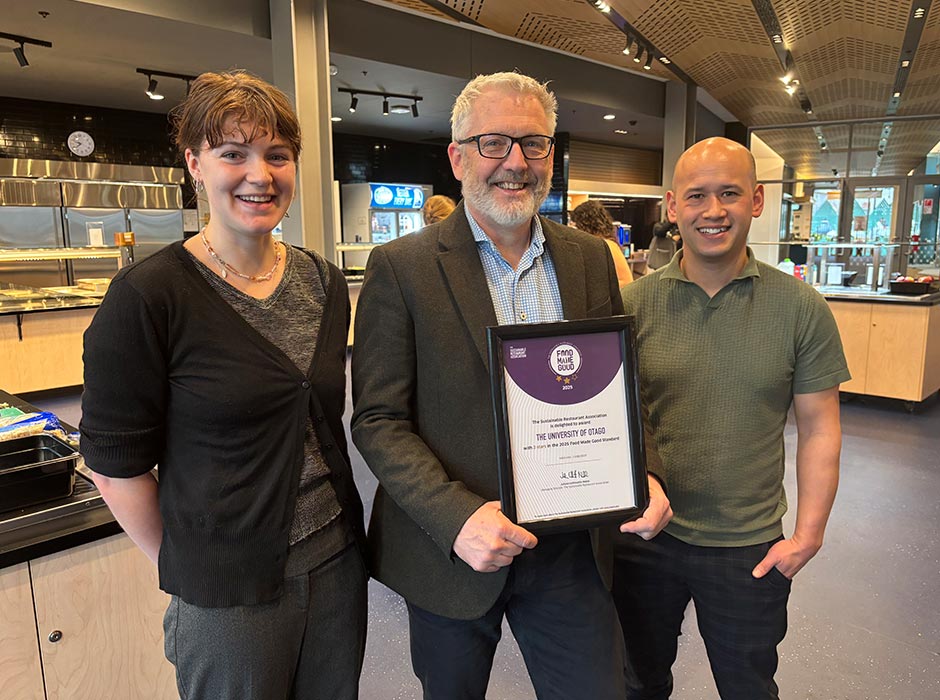
Teamwork ... With the University's new Food Made Good certification are from left, Bachelor of Science tauira Ella Court, Otago's Head of Sustainability Dr Ray O'Brien and Food Service Manager Dylan Henry. The trio all played a part in the process of applying for the certification.
Otago’s dedication to food sustainability has been recognised with a prestigious, global certification – the first University outside of the United Kingdom and the first hospitality business in Aotearoa to do so.
The University has achieved a two-star rating, out of a possible three, in the Sustainable Restaurant Association’s Food Made Good Standard - a global accreditation and rating system that helps food service providers operate more sustainably.
The Standard is a comprehensive evaluation of the University’s entire food and beverage operations, looking at how Otago sources ingredients, reduces its environmental impact and contribute to society — recognising areas of strong performance and identifying opportunities for further progress.
The Otago report says “attaining a two-star FMG accreditation is no easy feat, and it’s impossible to get this far without a clear dedication to sustainability across your entire team. You should be very proud of your admirable effort.
“It’s a brilliant result — and a big step forward for food service in New Zealand.”
Otago’s Head of Sustainability Dr Ray O’Brien says the certification is great example of the University’s sustainability strategic framework, Tī Kōuka, being implemented at a departmental level and contributing to a more sustainable University, country and world.
“To be the first university outside the UK and the first hospitality business in Aotearoa to take part in this certification, and then to achieve two stars, is something we’re incredibly proud of. It puts Otago — and New Zealand — on the global map for sustainable food leadership in a way that should be very visible to students.”
The University scored 69 per cent – one per cent off a three-star rating.
“A two-star rating under the Food Made Good Standard is a rigorous achievement. It tells us we’re on the right track, but also gives us clear guidance on where we can keep improving,” he says.
Among other projects and policies, including the University’s Net Carbon Zero 2030 programme, the certification specifically recognised developing Otago’s offering of plant-based meals served in colleges; the community gardens, the staff engagement activities, volunteering work undertaken in the community, initiatives that support Māori staff and students, and the removal of all single-use cups on the central Dunedin campus. Otago is also the only university in New Zealand to report on food emissions (the Greenhouse Gases that result from its supply chain).
Such projects and commitment required commitment from “the entire team”, Ray says.
“This achievement isn’t the result of one initiative or one department — it’s the outcome of genuine collaboration across our food services, sustainability team, suppliers and wider University community including the Food Science and Human Nutrition Departments. It shows what’s possible when everyone pulls in the same direction.”
The certification lasts two years.
“We see this as just the beginning. The Food Made Good Standard gives us a clear framework to lift our performance even further — and we’re excited to keep pushing toward that third star.”
While gaining the certification took hard work and dedication, actually applying for it took hours of commitment – in this case by third year Bachelor of Science tauira Ella Court.
Researching, and collating the information for the application was Ella’s main project when she took part in a summer scholarship in the Sustainability Office during the 2024/25 summer break.
“I was pleasantly surprised by the number of policies and initiatives in place; I knew Otago is strong on sustainability, but seeing and finding the full extent of them and being able to be a part of this was a great opportunity.”
She is modest about her role in the certification, but the report she produced about the experience of compiling the evidence will shortly be published in the peer reviewed journal, Pūhau ana te rā.
“It was a privilege to be able to do this, but I had a lot of help from other people. It was a team effort - just like the programmes and initiatives that have been recognised.”
One of the University’s Food Service Managers, Dylan Henry, says thinking and working more sustainably is a one of the priorities in all of Otago’s kitchens.
“This certification is beneficial in that it is measurable – we can see that the work we’re putting in is making a difference, but it also gives us clear goals on how we can improve,” he says.
Ray agrees, and sets down a challenge to others.
“We’ve still got a lot of room to improve and having that third star to strive for is a good incentive,” he says.
“We have great collaboration with other New Zealand universities and hospitality businesses around sustainability, and I’d really encourage any of them to go through this process too.”
Sustainability at Otago
Help make our University and the world a more sustainable and healthier place
Find out how