
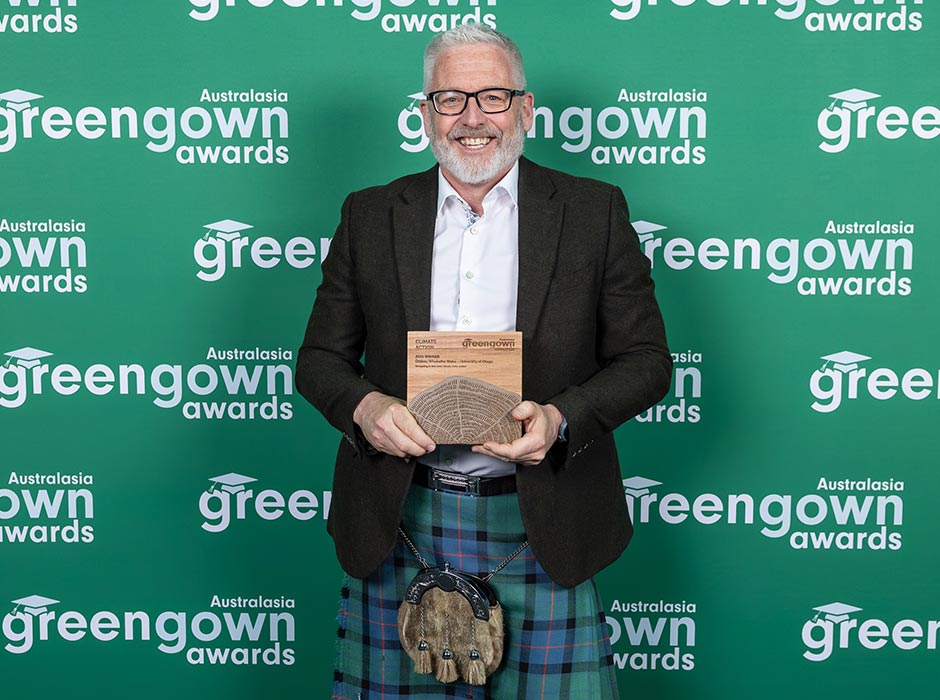
Head of Sustainability Ray O'Brien is all smiles after Otago takes home the evenings top honor 'Sustainability Insitution of the Year" at the 2026 Australasian Green Gown Awards.
Ōtākou Whakaihu Waka has been recognised as the leading sustainability institution in Australasia, taking out the prestigious Sustainability Institution of the Year award at the 2026 Green Gown Awards Australasia on the Gold Coast.
This year's event was the largest in Green Gown Awards Australasia history, attracting 53 finalists from 27 organisations across Australasia to recognise leadership, innovation and impact.
Otago's award-winning submission, Tī Kōuka: A vision of a thriving future, was recognised for its institution-wide approach to embedding sustainability across governance, operations, research, education and community engagement.
The University was also recognised with the Climate Action Award for its submission, Navigating to Net Zero: Values, Data, Action, highlighting Otago's commitment to turning climate ambition into meaningful institutional action.
Co-developed by Sustainability | Toitū te Taiao and the Office of Māori Development, Tī Kōuka is grounded in mātauraka Māori and shaped by the characteristics of the tī kōuka tree, a species of deep significance to Kāi Tahu Whānui.
Head of Sustainability Ray O’Brien says the award recognises a whole-of-university effort.
“Tī Kōuka sets out that we will do sustainability our way and prioritise thinking about sustainability that is strongly located here in Aotearoa. It demonstrates how Indigenous knowledge, institutional leadership and measurable action can work together to create long-term transformation.”
Net Carbon Zero Programme Manager Craig Cliff says receiving the climate action award is an important recognition for the University.

Net Carbon Zero Programme Manager Craig Cliff
“As an institution with a strong reputation for research and teaching on climate change, we are also serious about tackling the environmental impact of our own operations. It’s great to get this external validation for the work to date – work that cuts across every aspect of University life, from energy and waste to commuting and air travel.”
The Sustainability Institution of the Year judges unanimously selected Otago as the standout winner, praising the ambition and breadth of the Tī Kōuka framework, and the integrated approach that set Otago apart from other entrants.
Judges highlighted the framework's integration across governance, curriculum, research and operations, noting that strong senior leadership support and sustainability representation at Senate level demonstrated a deep institutional commitment.
They were particularly impressed by the intentional centring of Indigenous knowledge and Treaty-led principles throughout the framework, describing it as an authentic, place-based approach to sustainability from which the wider tertiary sector could learn.
Ray says the co-design of Tī Kōuka and centring of mātauraka Māori is what sets the framework apart and grounds Otago’s sustainability journey in place and purpose.
“The second part of the framework describes our way of approaching sustainability, rather than outlining a plan of actions to take. This approach allows teams and individuals at a divisional level to take ownership of Tī Kōuka within the context of their own mahi,” he says.
The judges also acknowledged Otago’s highly anticipated Bachelor of Sustainability and Te Uru: The Institute for Sustainability as evidence of the University's commitment to extending and embedding sustainability across its activities.
“This, along with the launch of the Tī Kōuka entrance scholarships, running our first Wānaka Taiao – a three-day environmental wānanga for staff, our first externally validated ‘sustainable conference’ accreditation, and our first sustainability exchange, are all strong indicators that Tī Kōuka is working,” Ray says.
Since 2019, the University has made significant progress towards its sustainability goals, reducing total emissions by 32 per cent, staff air travel emissions by 45 per cent, and landfill emissions by 68 per cent. Sustainability has become increasingly embedded in learning and teaching, with 86 per cent of surveyed papers contributing to one or more United Nations Sustainable Development Goals. Beyond emissions reduction, circular economy initiatives have diverted almost 500 tonnes of goods from landfill.
The Climate Action judges commended the University's clear approach to reducing emissions and the strong evidence of progress already achieved. They also praised the University's engagement with Māori communities and the integration of Te Ao Māori into its climate strategy, noting that climate action at Otago is delivering broader benefits through regeneration, health, student learning and financial stewardship.
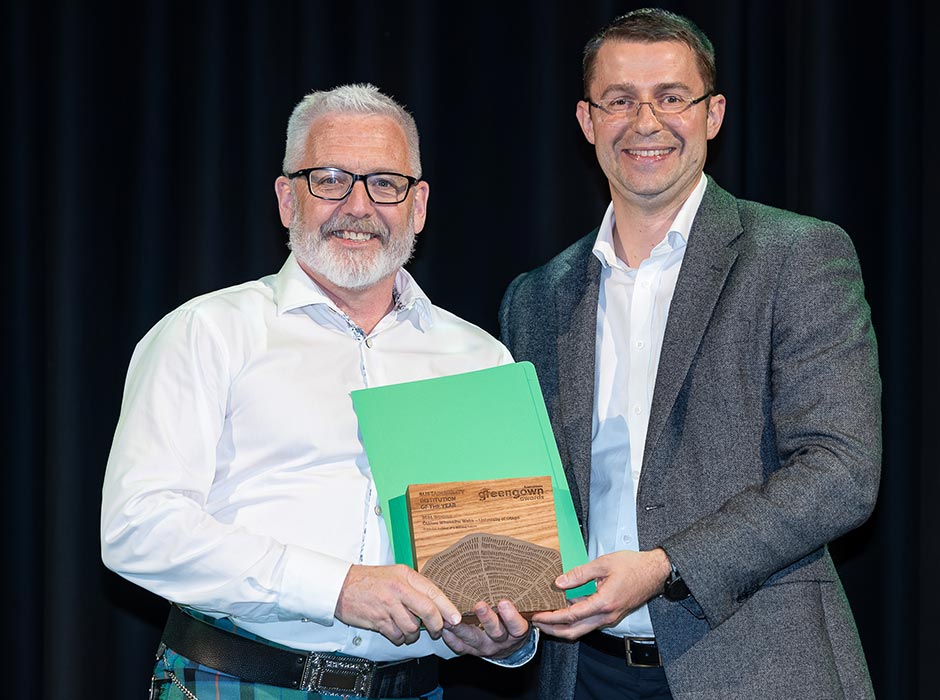
Head of Stainability Ray O'Brien with Pavlo Smoliy, CEO of Trellis Technologies and conference sponsor.
Craig says the Net Carbon Zero Programme was shaped by the same values that ultimately informed Tī Kōuka.
“Centring our climate mitigation work on orakataka — the health and wellbeing of ecosystems and society — means we don't just have our carbon blinkers on, but must consider wider impacts, positive and negative, of our actions.”
Vice-Chancellor Grant Robertson says the awards are recognition of progress made and the University's ambition for the future.
"The achievements of sustainability and the commitment of our wider university community demonstrate the value of collaboration, innovation, and shared purpose. At Otago, our sustainability goals are embedded in Pae Tata, championed through Tī Kōuka, and strengthened every day through teaching and learning."
Reflecting on the Climate Action Award, the recognition reinforces the important role universities play in addressing global challenges, generating solutions, empowering communities, and preparing future generations to respond to climate challenges, he says.
"Cultivating a culture of sustainability is a collective responsibility that requires ambition, innovation and sustained commitment – something I am proud to see exemplified by the work of Sustainability | Toitū te Taiao."
Ray says the recognition comes at an important time for Otago, with higher expectations from students around sustainability and increased emphasis on intentional research that contributes to a thriving future.
The judges encouraged the University to continue strengthening the measurement and reporting of outcomes, including student learning, accountability and progress beyond emissions reductions.
Ray welcomes the challenge and says there’s much more to learn, and he’s looking forward to continuing to build on the mahi and raise the benchmark.
"We now progress as finalists to next year's Global Green Gown Awards, so I'm looking forward to seeing how we stack up with the northern hemisphere."
The global awards will see Otago compete against leading universities from around the world, providing an opportunity to showcase Tī Kōuka and the University's sustainability journey on an international stage.
"It's important to celebrate the progress we've made while recognising there's still more to do. This award gives us confidence that we're moving in the right direction and encourages us to keep building on that momentum."
Watch: Ōtākou Whakaihu Waka - Institution of the Year finalist video.