
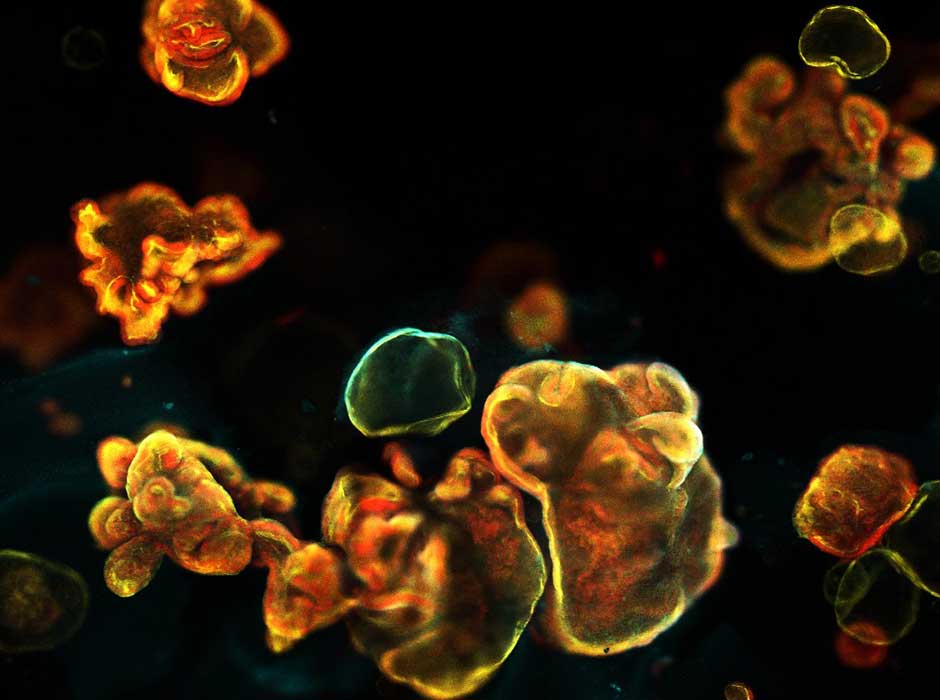
3D organoids from a Crohn's disease patient, under the microscope.
Research at the University of Otago I Ōtākou Whakaihu Waka looking at why some Crohn's disease sufferers don’t respond to treatments could lead to more effective personalised therapies.
Faculty of Biomedical Sciences Research Fellow Dr Safina Gadeock has received funding from the H.S. and J.C. Anderson Charitable Trust 2026 to explore how inflammation damages the gut lining and disrupts the stem cells needed for healing. It’s hoped the project will help explain why some Crohn’s patients don’t respond to current treatments.
Around 25,000 New Zealanders are affected by Crohn’s, and the problem is on the rise.
The inflammatory bowel disease commonly develops in teenagers and young adults, and can cause severe abdominal pain, diarrhoea, fatigue, weight loss, and damage to the intestine. It’s lifelong – there is currently no cure, and many people require long-term medication or surgery.
What’s worse, almost half of people with Crohn's disease do not respond to one of the most commonly prescribed treatments, known as anti-TNF therapy.
Safina’s research in Roslyn Kemp’s lab in the Department of Microbiology and Immunology aims to understand why.
She will use organoids – tiny "mini-guts" grown from patients' own intestinal stem cells – to recreate the disease on a personalised level in the laboratory.
“These miniatures will give us a way to study the stem cells that are essential for repairing the gut lining. We want to understand how tissue-targeted inflammatory molecules disrupt this repair process and whether we can restore it in patients who don’t respond to current treatments,” she says.
The mahi will also explore whether medicines already used to treat other conditions could be repurposed to restore intestinal healing in people with Crohn’s disease who do not respond to current treatments.
“Ultimately, this research aims to improve quality of life for people living with Crohn's disease while reducing the need for repeated medication changes, hospitalisations, and surgery,” she says.
“The goal is to move away from trial-and-error treatment and towards precision medicine, where we can better predict which therapy will work for each individual patient and help restore the intestine's ability to heal.”
Safina is now the New Zealand specialist in human organoid models.
She developed Aotearoa New Zealand’s first 3D intestinal organoid models as part of her PhD studies at the University of Otago in 2017, and further advanced her research at the Children’s Hospital Los Angeles (CHLA) and UC San Diego (UCSD).
She has since built an independent research study focused on using patient-derived intestinal models to understand why Irritable Bowel Disease (IBD) treatments fail and to identify new approaches to promote intestinal healing.
The novel technologies have created considerable global interest, won awards, and led to national and international collaborations.
Safina says using 3D models rather than traditional cell cultures gives researchers a more realistic way to study how the intestine functions and responds to disease.
“This brings us closer to understanding what is happening in patients and finding treatments that can improve outcomes.”
-Kōrero by Claire Grant, Communications Advisor, Faculty of Biomedical Sciences
Faculty of Biomedical Sciences
Our Faculty of Biomedical Sciences is delivering science that is transforming our world. Our work is vital to healthcare professions, our productive sector, and to our unique flora and fauna.
View