
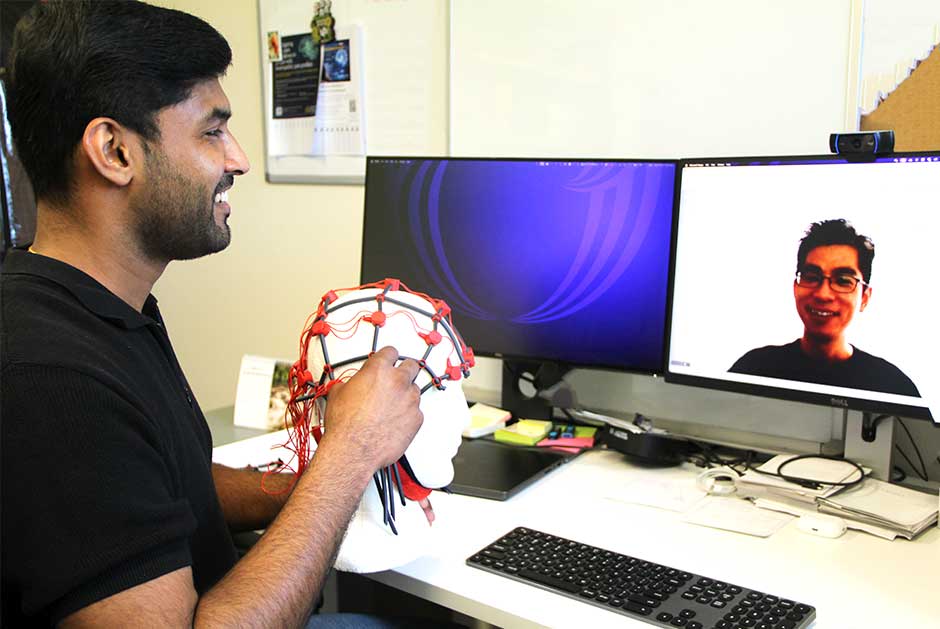
Dr Jerin Mathew talking online to Associate Professor Sizhong (Tim) Wang at the School of Exercise and Health at the at Shanghai University of Sport. Jerin has funding for an exchange to China to extend his research on chronic pain with the Shanghai University of Sport.
Funding for an international collaborative exchange will support a researcher in the Faculty of Biomedical Sciences in developing new approaches to understanding and treating debilitating chronic pain.
Dr Jerin Mathew, from the Department of Anatomy, has been awarded funding through the Catalyst: Leaders New Zealand–China Scientist Exchange to spend four weeks at Shanghai University of Sport in Shanghai, China, working with Associate Professor Sizhong (Tim) Wang and his research team at the School of Exercise and Health.
Jerin’s research at Otago focuses on chronic pain and neuromodulation – non-invasive technologies, such as brainwave training and brain–computer interface technologies, that target brain to improve pain outcomes.
Neuromodulation is a rapidly growing field of pain research globally. At Otago, Jerin is part of the interdisciplinary Otago Pain Mechanisms and Neuromodulation (OPaMEN) Research Programme, which aims to improve the outcomes for people living with chronic pain, a significant public health problem affecting around one in five New Zealand adults.
The programme investigates the biopsychosocial and behavioural factors that drive the chronic pain experience, while developing and testing innovative brain-based interventions to improve outcomes for people living with chronic pain.
His ongoing research is already making an impact.
Jerin’s research includes novel non-invasive brainwave training projects that is empowering people with chronic pain to regulate their own brain activity to help reduce pain experience.
The programme also provides hands-on research training for postgraduate students, who are actively involved in advancing the research.
Jerin will be heading to Shanghai in October and is looking forward to developing the relationship to support his research programme.
“We’re hoping to establish a new international research partnership to advance the understanding and management of high-impact chronic pain and neuropathic pain. These debilitating conditions affect millions of people worldwide and have significant impacts on physical function, mental well-being, sleep and overall quality of life.
The exchange will lay the foundation for a sustainable transnational research programme exploring innovative, technology-enabled approaches for chronic pain assessment and management.
This could mean new strategies to improve pain care and outcomes for people living with chronic pain in Aotearoa New Zealand, China and beyond,” he says.
Beyond advancing research, Jerin and Tim hope this exchange will strengthen connections between Aotearoa New Zealand and Chinese scientists, facilitate knowledge sharing, and create new opportunities for students and researchers through future collaborative exchanges.
Interestingly, Jerin and Tim completed their PhDs at the University of Otago.
“We share a similar academic background and research culture. Our collaboration has grown over the past year through various joint research projects, and this exchange will help take that partnership to the next level while opening new opportunities for future research,” he says.
The Catalyst: Leaders New Zealand–China Scientist Exchange Programme is funded by the Ministry of Business, Innovation and Employment (MBIE) and administered by Royal Society Te Apārangi in partnership with the Chinese Ministry of Science and Technology (MOST) and the China Science and Technology Exchange Center (CSTEC).
-Kōrero by Claire Grant, Communications Advisor, Faculty of Biomedical Sciences
Department of Anatomy
Like the proverbial iceberg, Anatomy at Otago is about more than just bones and muscles, it's about people: How we begin life and how we develop, how we move and how we function, how we remember and how we forget...
View