
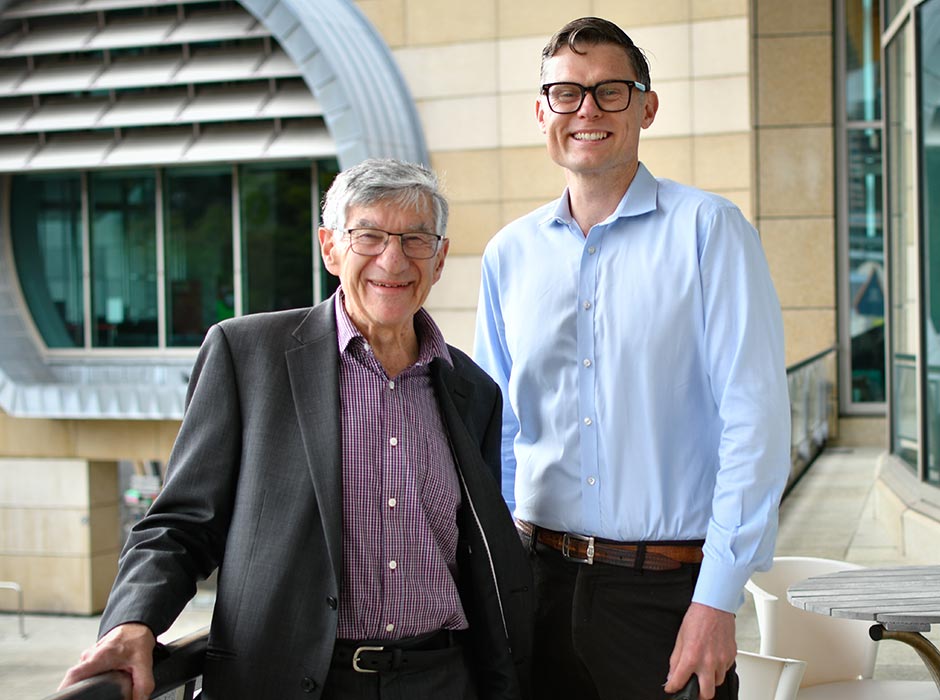
Professor Sir Jim Mann (left) and Associate Professor Andrew Reynolds are calling for a greater focus on fibre, backed by research showing the positive health outcomes of increased fibre intake.
Two prominent Otago researchers have called for dietary fibre to be officially recognised as an essential nutrient – the first ‘new’ essential nutrient in more than 50 years. In a feature that appeared in Otago Magazine, they explain why.
Associate Professor Andrew Reynolds has always been interested in food. The 2025 winner of the Rowheath Trust Award and Carl Smith Medal, which recognises the outstanding research performance of early career staff, Andrew originally tried his hand at culinary school before deciding to combine his love of food and science and study nutrition.
Andrew is based in the Department of Medicine (Dunedin), is Co-Director of Otago's Edgar Diabetes and Obesity Research Centre (EDOR) and Associate Dean of Research for the Faculty of Medicine – Dunedin. Over the past decade, he has been at the forefront of establishing the importance of dietary fibre on human health. Spend an hour speaking to Andrew and you will be swapping your white rice for brown before you can say Weetbix.
In a recent comment piece published in the prestigious international science journal Nature, Andrew, along with Professor Sir Jim Mann (KNZM) and other collaborators, makes the case for fibre to be recognised as an essential nutrient.
"There is some confusion about fibre actually being a nutrient, since nutrients are something the body absorbs but fibre passes through. But we actually found out in the 1970s and ‘80s that when fibre is broken down by the microbiome, it produces these short-chain fatty acids that go into the body and become a nutrient," Andrew explains.
There is no governing body that deems whether something officially becomes an essential nutrient, rather, it is more of a matter of public opinion and research. Still, Andrew believes the dial is slowly moving for fibre.
"Politically, we think it could be really important for the government to recognise that OK, fibre is an essential nutrient, and our population is having 30 per cent less than it should.”
“If increasing fibre reduces blood pressure, we can see why it reduces cardiovascular disease and stroke. If it reduces cholesterol, we can see why it reduces heart disease. If it reduces blood sugar levels, we can see why it reduces incidence of type 2 diabetes. And if it reduces body weight, which it did, then it helps with lots of things.” – Associate Professor Andrew Reynolds
For Sir Jim, who was knighted in 2022 for his services to health, the Nature piece is another vindication of his life's work investigating dietary fibre.
"The Nature paper, which was Andrew's idea, has been widely read and downloaded, so we are seeing the wider research community pay more attention to fibre. I've been working on fibre and health for over 50 years, so it's pretty rewarding to see this growing shift where it’s being taken more seriously as a key component of health," Sir Jim says.
Andrew says modern human diets have shifted significantly since pre-agricultural times. One of the biggest changes: a reduction in average daily intakes of dietary fibre.
"Things used to be a lot stringier or barkier," he says.
The drop is substantial. For most of human evolutionary history, people would have eaten around 100 grams or more of fibre per day. Today, for countries like Aotearoa New Zealand and the United States, that figure has dropped to 12 to 20 grams.
While Andrew is not advocating for a move back to 100 grams, he says modern diets are a far cry from early human diets – thanks to agriculture, food safety and selective breeding – but human physiology remains relatively unchanged.

Adding fibre to your diet can be as easy as switching some of your meat for legumes, eating more fruit and vegetables, or passing on that loaf of white bread for bread with whole grains Associate Professor Andrew Reynolds says.
Otago became involved in 2016 when the World Health Organization (WHO) contacted a group of nutritionists led by Sir Jim, asking them to pool the evidence base together for dietary fibre and its relationship to health. Until then, most people simply talked about fibre in relation to stool bulking (which can help with constipation), but the WHO asked the group to look beyond that.
"They wanted us to search for the association between fibre intakes and mortality, heart disease, certain types of cancer like colorectal, and type 2 diabetes," Andrew explains.
Led by Sir Jim, Andrew and his collaborators conducted a systematic review and meta-analysis of the known data, and combined it to search for links between dietary fibre and various health outcomes.
"We were combining data that existed already to get a bigger-picture view of fibre's relationship to heart disease, diabetes, death and certain cancers.”
When the results were published in a landmark 2019 paper in Lancet, they gained attention.
While long-term prospective health studies linked higher dietary fibre intake to improved health outcomes, smaller trials, where fibre is restricted, gave researchers a pathway for explaining the effects of fibre.
"If increasing fibre reduces blood pressure, we can see why it reduces cardiovascular disease and stroke. If it reduces cholesterol, we can see why it reduces heart disease. If it reduces blood sugar levels, we can see why it reduces incidence of type 2 diabetes. And if it reduces body weight, which it did, then it helps with lots of things," Andrew says.
"So we saw all those associations and we pulled it together for the first time, and that's what set off this slow wave of action since then."
"The Nature paper, which was Andrew's idea, has been widely read and downloaded, so we are seeing the wider research community pay more attention to fibre.” – Professor Sir Jim Mann (KNZM)
Since releasing that paper, Andrew has run his own randomised control trials in Dunedin, as well as capturing qualitative data to find out more about people’s perspectives.
"We are trying to capture the efficacy as well as the effectiveness: does it work, and will people do it?" explains Andrew. “If it's expensive, or inaccessible, there might be barriers to people increasing their fibre intake.”
Another important aspect of Andrew’s research is modelling – taking that link between fibre intake and health, and projecting it forward to see what might happen if the population upped fibre levels to those recommended. This type of analysis may impact government decisions on healthcare, greenhouse gas emissions, and the cost of food and groceries.
But how does fibre work? And how do we get more of it?
Andrew sheds light on this by tracing fibre's journey as it moves through the body.
In the mouth, high-fibre foods result in the mechanical removal of plaque.
"So we have an association between high fibre diets and lower incidents of dental cavities and extreme oral surgeries and things like that," Andrew says.
Fibre then travels down the oesophagus and into the stomach, where it influences gastric emptying, and can leave people feeling fuller for longer. After the stomach, it moves to the small intestine, where it blocks the uptake of cholesterol in the body, as well as blocking sugar absorption.
It then moves into the large intestine, the realm of the gut microbiome. Andrew says studies are now showing a clear link between the amount of dietary fibre and the density, diversity and functionality of the gut microbiome.
As fibre leaves the body, it increases the volume of the stool, reducing constipation.
Andrew says sneaking a bit of extra fibre in your diet can be as easy as switching some of your meat for legumes, eating more fruit and vegetables, or passing on that loaf of white bread for bread with whole grains.
– Kōrero by Conor Feehly
This story first appeared in Issue 59 of the University of Otago Magazine, released in July 2026. Download the full magazine.