
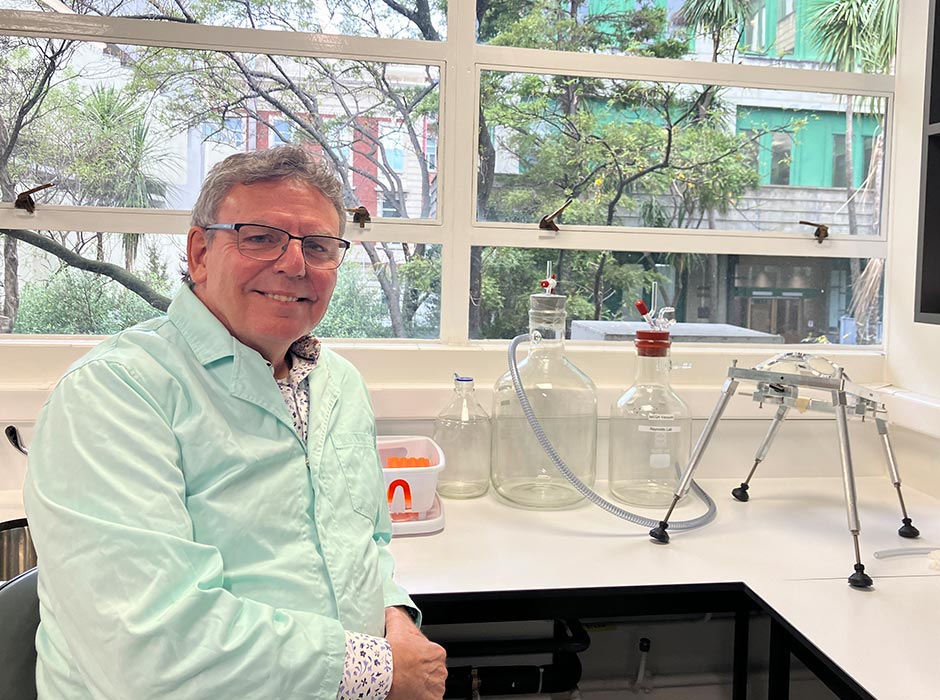
Professor John Reynolds in his University of Otago Department of Anatomy laboratory, investigating how ultrasound can be used for treating non-invasive neurological disorders.
A ‘smart patch’ that helps athletes breathe more easily and high-frequency sound waves that can treat brain disorders. University of Otago researchers are working at the cutting edge of non-invasive treatment.
It’s a challenge that’s stymied medical researchers for more than a century: how to treat disorders without invasive procedures or the drawbacks of drugs.
Now, scientists in the University of Otago’s Faculty of Biomedical Sciences are pioneering technologies that use the body and brain’s own bio-electrical signals to unlock exciting new avenues for treatment and predictive medicine.
Professor John Reynolds’ focus is on focused ultrasound, or what might be described as a surgical laser. Instead of light, however, it uses high-frequency sound waves that are precisely aimed at a specific point inside the body.
These waves pass harmlessly through the skin and tissue until they meet at their target, where their combined energy can be used for a range of tasks - from destroying a tumour to temporarily opening a gateway for drugs.
When it comes to treating neurological disorders, John, who spent the first decade of his career in medical electronics, has seen the practical problems that continue to frustrate doctors.
“We still have very few tools to treat these disorders. Not only do we have problems getting drugs effectively into the brain, but we also don’t understand how the circuitry operates well enough to treat it.”
The biggest problem is the blood-brain barrier: a natural armour that prevents most drugs from entering the brain. John says this is why a treatment shown to work well in a lab can often fail in a human.
While the concept of focused ultrasound was explored as early as the 1920s, a modern revolution in computing power is pushing it closer to becoming a clinical mainstay.
John sees two breakthrough applications for it.
One involves temporarily and safely making the blood-brain barrier “leaky” – creating a window of perhaps six to 24 hours to deliver critical drugs or genes exactly where they're needed.
This could revolutionise treatments for diseases like glioblastoma, a devastating form of brain cancer, and even enable gene therapies for conditions like Huntington's disease.
Another exciting role lies in direct neuromodulation: using ultrasound to directly stimulate brain circuits.
John’s team is exploring this for a range of conditions, including tinnitus, the persistent ringing in the ears. Their idea is to use focused ultrasound to suppress the brain activity that causes the ringing, providing a non-drug treatment.
“Using electrical stimulation in rats, we found we could suppress tinnitus by ‘rewarding’ other frequencies, so the ringing becomes less prominent,” he says.
“If we can achieve the same with ultrasound, people could receive treatment in a clinic without drugs, potentially suppressing their tinnitus.”
John believes this technology could transform treatment for a wide range of neurological disorders.
While international clinics are already using it to treat tumours with remarkable success, the cost and size of the machines remain a barrier. An MRI-guided system can cost millions of dollars and takes up valuable hospital resources, making it impractical for a country like New Zealand.
Instead, John and his team are developing a portable, accessible system that could be used throughout the country, ensuring equitable access to care.
They recently began a kaupapa Māori pilot project to explore how it might be delivered in remote communities, allowing patients to be treated in their own homes, surrounded by their whānau.
“I imagine someone in Hokianga with brain cancer who just can't get themselves down to Auckland all the time to have repeated treatments,” he says.
“We could be able to deliver this treatment in a more accessible place.”
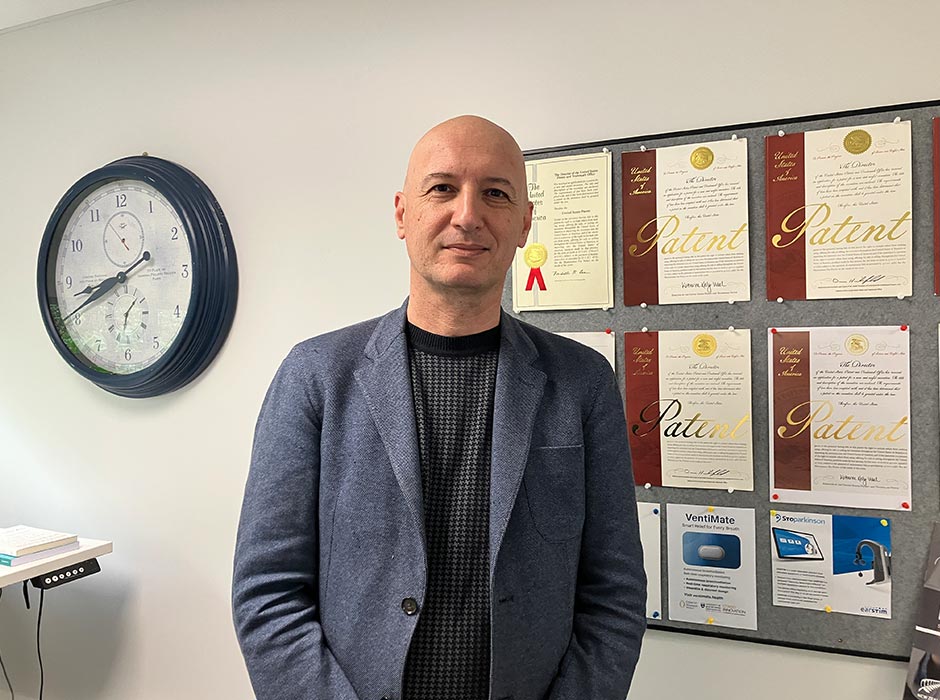
Associate Professor Yusuf Cakmak from the University of Otago Department of Anatomy is developing novel therapeutic wearables to treat diseases such as asthma.
A smart new solution for asthma attacks
While John works on the central nervous system, Otago colleague Associate Professor Yusuf Cakmak and Master’s student Joseph Balfe have been targeting the controller of our internal organs.
The autonomic nervous system regulates everything from heart rate to breathing, and its dysfunction can lead to debilitating conditions like asthma, which can cause attacks that become life-threatening within minutes.
During a severe attack, the airways tighten in a process called bronchoconstriction, making it incredibly difficult for inhaled medications to reach the deep, small airways where they’re needed most.
This delay is why, despite the availability of medication, about 1000 lives are cut short by asthma every day across the globe.
Yusuf, who has numerous patents on therapeutic wearables, says that frequent use of inhalers can also have side effects on other organs like the heart, and having to rely upon them can bring anxiety and risk – especially for children and athletes.
Joseph and Yusuf’s solution is a wearable, non-pharmaceutical device called VentiMate, which won last year’s Falling Walls Lab Aotearoa New Zealand competition.
It acts as a bronchodilator by using non-invasive nerve stimulation to open the small airways in real time – providing immediate intervention where standard inhalers can struggle to.
And rather than needing to be carried about, the device is designed to be worn between the shoulder blades, where it continuously monitors for early signs of an asthma attack.
When this happens, it sends a targeted stimulus to a peripheral nerve, balancing the autonomic nervous system to dilate the bronchioles before a full-blown attack occurs.
The research team has so far carried out three randomised, placebo-controlled trials showing that the device can prevent exercise-induced bronchoconstriction in healthy people.
The next step is a large-scale clinical trial with people who have asthma to validate the technology’s effectiveness.
Yusuf sees global potential for VentiMate, but also an acute need for it at home. New Zealand has one of the highest rates of asthma in the world, with around 7000 annual hospitalisations costing an estimated NZ$1 billion.
And, like John’s system, it could also provide more equitable access. Asthma is more prevalent among Māori and Pacific peoples and many of those affected live in rural areas.
Yusuf says an ideal version of VentiMate would be a rechargeable device that can be worn continuously, reducing the cost of treatment and the need for frequent clinic visits for prescription refills.
“It could just stick on skin for seven to 10 days, monitor what you are doing and activate whenever it’s needed, based on an individual algorithm.”
Both John and Yusuf say their new technologies highlight how modern machine-learning and artificial intelligence are helping to change the face of medicine, especially within predictive ‘closed-loop’ systems.
"When we can recognise patterns in people’s behaviour and train our model to make predictions, that’s really the way to go,” John says.
Yusuf’s team, including PhD student Alexander Yang, has already used machine learning to predict symptoms in their neuromodulation studies for cybersickness – a form of motion sickness triggered by prolonged screen use or immersive virtual reality technology.
They now plan to utilise the same technique for bronchoconstriction, using sensors they developed in collaboration with University of Auckland biomedical engineer Dr Brian Russell.
John’s research has been supported by the Health Research Council (HRC), Ministry of Business, Innovation Employment and Neurological Foundation of New Zealand, while Yusuf and Joseph’s work is supported by the HRC and the MedTech CoRE/ Te Tītoki Mataora’s Research Acceleration Programme.