
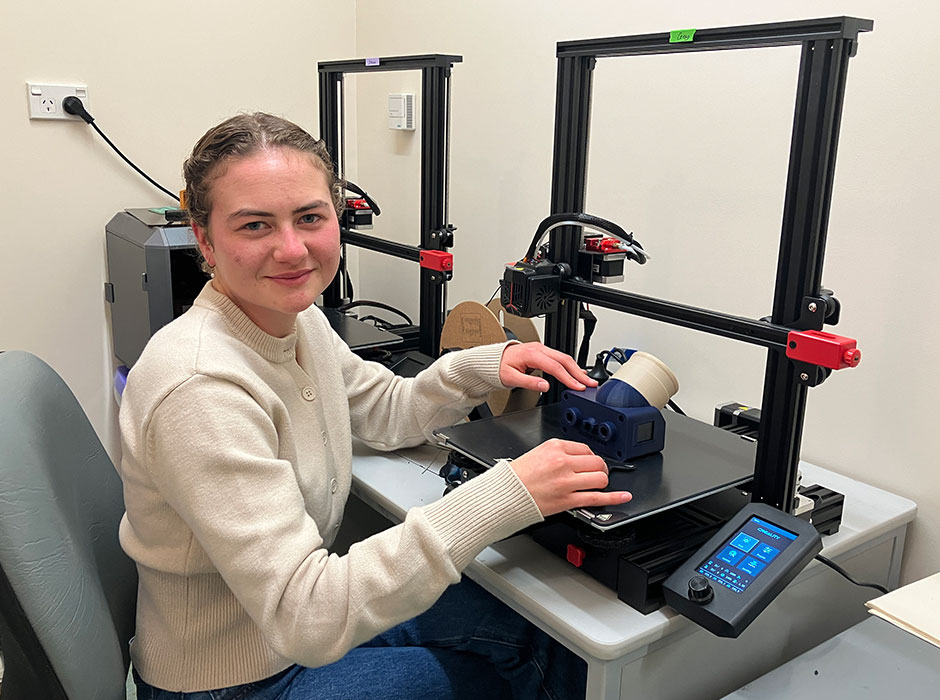
Otago tauira Kai Woolf builds smart cage for monitoring mice behaviour.
Just how do neural circuits in the brain respond to stress? Why do we change our sleep and eating habits during stressful times? And are there ways of controlling the brain signals to manage stress?
Otago School of Biomedical Sciences student Kai Woolf has many questions she’s hoping to find answers to.
Originally from South Africa, Kai came to Otago to study physiology and anatomy with the aim of learning how to help people manage stress.
In the process she has developed an innovative animal monitoring system that’s become a big success story.
Kai says while stress is part of a normal life, one of the unanswered questions for researchers is how stress becomes overwhelming for some.
Dr Joon Kim in Otago’s Department of Physiology is studying the neurons in the brain known for creating such stress behaviours.
Kai has been working with Joon on her fourth-year honours project specifically looking at brain circuitry associated with stress, to pinpoint which area of the brain could mediate the negative changes observed in individuals under stress.
“We know that the poor health we see in individuals under chronic stress is due to a confluence of many factors. We are hoping to tease apart these factors to better understand the root cause of negative health outcomes for individuals under chronic stress," Kai says.
Her research has made valuable inroads into better understanding how stress circuits cause physiological disruptions within the brain, and her practical contributions have also made a difference at Otago.
As part of her honours project, Kai developed a novel smart cage system for monitoring mice behaviour.
While such systems already exist commercially, they are prohibitively expensive. These are also closed systems, meaning they are not customisable to end-user’s specific needs, lack the ability to video behaviours, and cannot group animals.
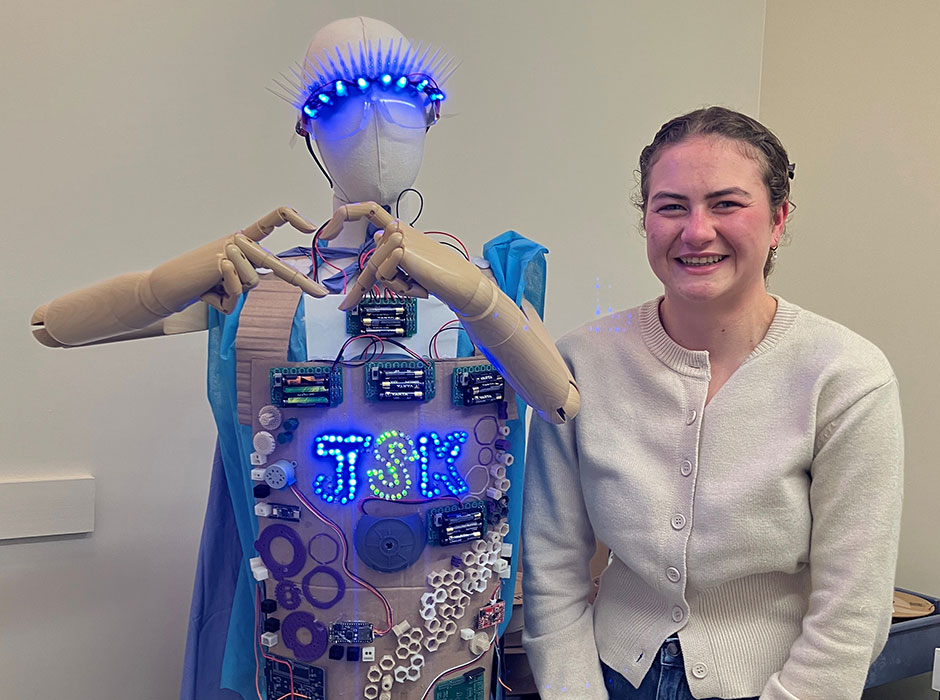
Otago tauira Kai Woolf with a custom-built suit created by Kim Lab students in the Department of Physiology for the annual Queenstown Research Week conference Fashinomics event. The concept of Fashinomics is to repurpose discarded laboratory materials into wearable art.
With no prior experience in coding, soldering, 3D printing, or even biomedical research, Kai built her own smart cage to automatically measure various animal behaviours including food and water intake, exercise, and sleep/wake activity.
The innovative 3D printed prototype system measured everything the study needed and only cost a few thousand dollars. Kai’s research using the smart cages led to novel insights on how chronic stress causes perturbations to physical activity, sleep patterns, and metabolism.
Joon says this prototype isn’t just a means to an end, it is a valuable product in its own right. Its development has created a buzz and research teams across disciplines at Otago are using devices tested and validated by Kai’s work.
Because the team built the system using freely available knowledge, they are also freely sharing the codes and designs to the improvements they have made, so labs around the world are also adopting the new features developed here.
Joon says Kai took on a Herculean project, “This project was a combination of kiwi ingenuity, cutting-edge neuroscience, and innovation. Kai’s work demonstrates a level of innovation and novelty that few students, even PhD graduates, achieve.”
Kai is receiving recognition for her research, including speaker awards at the Otago Medical School Research Society, Physiological Society of New Zealand, New Zealand Society for Endocrinology, and the Hypothalamic Neuroendocrinology and Neuroscience Australasia symposiums.
She is now studying medicine at Otago, a place she’s happy to continue to call home. Stress and anxiety are still a strong interest, and she is considering how to combine her research and clinical knowledge to help better understand and treat the problem.
She says while stress is unavoidable, it’s not simply a matter of switching stress on or off, rather seeing how it can best be moderated.
“So, while it’s not something that will be solved in the few short months of an honours project, it has been exciting to bring key new information to light. I know as we learn more, we can fine tune and better target clinical treatments and potentially find new treatment options.”
Kōrero by Claire Grant, Communications Advisor, Faculty of Biomedical Sciences
Faculty of Biomedical Sciences
Our Faculty of Biomedical Sciences is delivering science that is transforming our world. Our work is vital to healthcare professions, our productive sector, and to our unique flora and fauna.
View