
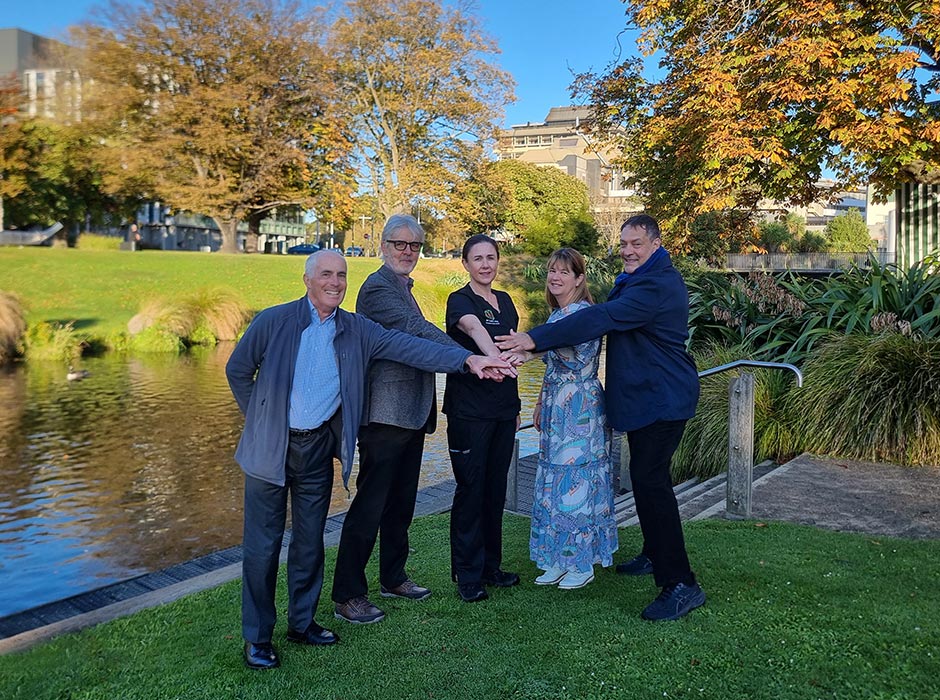
Otago UNIVANTS award winning team, from left-right: Chris Florkowski, John Pickering, Laura Joyce, Vanessa Buchan (Te Whatu Ora Canterbury) and Martin Than.
A team led by University of Otago Faculty of Medicine – Christchurch Ōtautahi researchers and clinicians has received international recognition for transforming the way patients with suspected heart attacks are assessed in emergency departments.
The Canterbury ICare Faster (improving Care by FAster risk-STratification in the EmeRgency Department) project has won a Teams of Achievement award at the 2026 UNIVANTS of Healthcare Excellence Awards, one of the world's leading honours recognising innovations which improve patient care.
The award celebrates the successful introduction of high-sensitivity point-of-care troponin testing at Christchurch and Ashburton hospitals, enabling clinicians to diagnose or rule out heart attacks in minutes rather than waiting longer for conventional laboratory results.
The project was led by emergency physician and Department of Medicine Professor Martin Than, alongside Otago colleagues Professor Christopher Florkowski, Professor John Pickering and Dr Laura Joyce. They joined Te Whatu Ora Canterbury and Health New Zealand clinical, nursing, laboratory, data, digital and project support staff who also played critical roles.
Martin says the award reflects years of collaboration across multiple disciplines, all focused on improving care for patients.
"This award is a wonderful acknowledgement of what a genuinely multidisciplinary team can achieve when everyone works towards the same goal.
"Ultimately this is about giving our patients faster answers at one of the most frightening moments they can face, and that is what makes this work so meaningful,” Martin says.
Troponin is a protein released into the bloodstream when heart muscle is damaged and is a key marker for diagnosing heart attacks.
Traditionally, blood samples are analysed in a laboratory, delaying clinical decision-making.
Before introducing the bedside test, the team verified its accuracy against laboratory methods, established a safe low-risk threshold using data from more than 2,000 patients, integrated results into electronic health records in real time, updated clinical pathways and trained more than 400 nurses.
Since implementation, 29,414 patients have been assessed using the point-of-care test across Christchurch and Ashburton hospitals.
Emergency department length of stay has fallen by 11 per cent in Christchurch and 35 per cent in Ashburton, an average reduction of 47 minutes across both hospitals. Importantly, there has been no increase in missed heart attacks or cardiac deaths among patients discharged home.
Emergency Physician Dr Laura Joyce, from the Department of Surgery and Critical Care, says the study demonstrates how research can rapidly translate into better patient care.
"Every minute matters for patients arriving in the emergency department with possible heart attack symptoms. Faster testing means patients receive answers sooner, clinicians can make decisions with greater confidence, and emergency departments are able to care for more people without compromising safety.
"This project brought together expertise from emergency medicine, laboratory science, nursing, digital health and research. It is a powerful example of how collaboration can deliver innovations that improve both patient experience and healthcare efficiency,” Laura says.
The international honour builds on work first announced in 2022, when Christchurch Hospital became the first in the world to implement high-sensitivity point-of-care troponin testing as routine clinical care. That Otago-led research demonstrated that bedside testing could safely accelerate assessment for patients with suspected heart attacks while reducing pressure on busy emergency departments.
For Martin, the award ultimately recognises the impact the innovation has had on patients.
"The technology is important, but the real achievement is improving the experience of patients. Being able to provide reassurance or begin treatment much sooner can make an enormous difference during an incredibly anxious time, and we're proud that work developed here in Christchurch is now being recognised on the world stage," he concludes.
– Kōrero by Lorelei Mason