
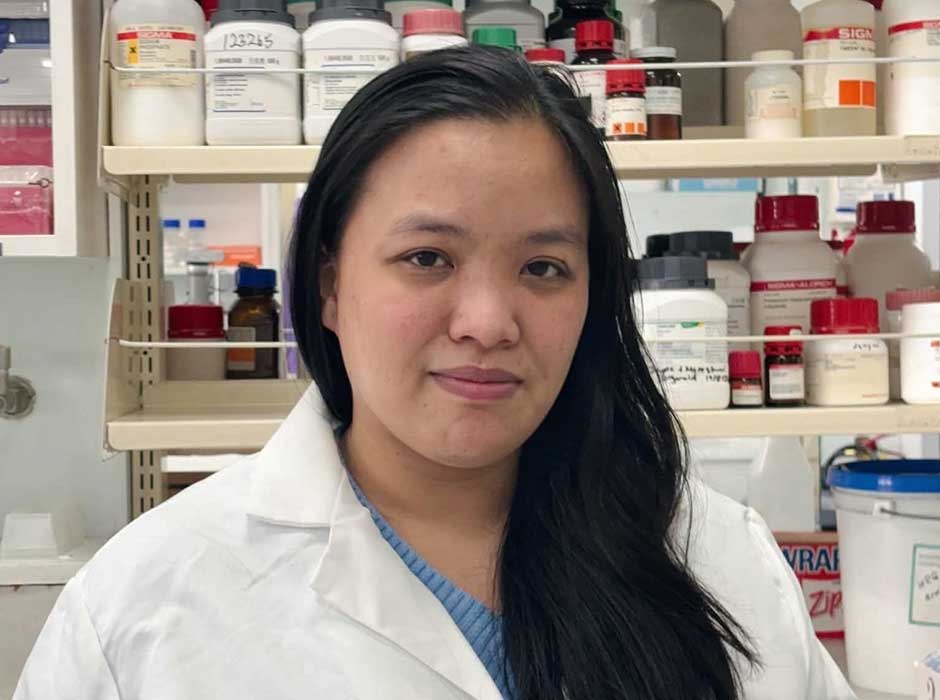
CMRF Emerging Research Fellowship winner 2026 Dr Arielle Sulit from the Department of Pathology and Biomedical Science.
Seven researchers from the University of Otago, Faculty of Medicine-Christchurch Ōtautahi have been awarded over $800,000 in funding support from the Canterbury Medical Research Foundation (CMRF) in its 2026 Grant round.
The CMRF Grant and Fellowship recipients are being supported in a variety of research projects - investigating bowel cancer bacteria, long-term ketamine therapy for depression, mental health in menopause, drug harm reduction, antipsychotic medication safety, and improving diagnosis of severe infection – all aimed at benefitting patients in Canterbury, New Zealand and internationally.
Department of Surgery and Critical Care researcher Dr Arielle Sulit was awarded one of two prestigious 2026 CMRF Emerging Researcher Fellowships (worth $220,000 each). Her study will investigate how bacteria living within bowel tumours may influence cancer behaviour and how well patients respond to treatment.
Her work focuses on a bacterium previously identified by her research group as being associated with a subtype of bowel cancer that responds better to immunotherapy. Earlier work also suggests that the bacterium may influence DNA methylation – a process that helps determine which genes are switched on or off.
“Our research explores the role of bacteria that live within tumours and how they might influence cancer behaviour,” Dr Sulit says.
Using advanced sequencing and digital spatial profiling technologies, the project will examine how exposure to bacteria affects cancer cells and the tumour microenvironment. The aim is to identify molecular changes associated with treatment response and potentially contribute to more personalised approaches to bowel cancer care.
“I am incredibly grateful to CMRF for supporting this research and giving us the opportunity to investigate an important question in bowel cancer,” Dr Sulit says.
“I would also like to acknowledge the people I work with every day – my supervisors, colleagues and collaborators. This is very much a team effort, and I am fortunate to be part of such a supportive research environment.”
Five Christchurch campus colleagues – Dr Kate Eggleston, Dr Matthew Tennant and Dr Nathan Monk (all from the Department of Psychological Medicine), Dr Rose Crossin (Department of Public Health) and Dr Michael Maze (Department of Medicine) – were awarded CMRF Major Project Grants (worth up to $120,000 each). The Department of Pathology and Biomedical Science’s Dr Annika Seddon was awarded a $5000 Travel grant.
Faculty of Medicine–Christchurch Ōtautahi Dean Professor Lutz Beckert says Canterbury is fortunate to have the CMRF as such a longstanding and independent supporter of health research.
“Its investment enables our researchers to pursue questions that matter to patients and communities. We want to strengthen that partnership by sharing what this research achieves and listening closely to the health questions Canterbury wants us to tackle next,” he says.
This year the CMRF awarded a total of $1.5 million in new funding for Canterbury medical research, supporting 14 researchers across the province’s three universities. Included is a $240,000 grant to support up to 32 summer research students at the University of Otago and University of Canterbury.
The CMRF was established in 1960 and has now provided more than $37 million in support for health and medical research in Canterbury thanks to philanthropic donations and bequests from individuals, families, trusts, businesses and organisations.
CMRF Foundation Director Jo Dowling says the breadth of research being supported this year reflects the strength and diversity of Canterbury’s health and medical research community.
“We are incredibly proud to support researchers who are tackling some of the important health challenges facing our communities. Their work has the potential to make a real difference to people’s lives here in Canterbury, across New Zealand, and around the world.”
CMRF’s 2026 grant recipients
This year’s recipients are undertaking research across mental health, public health, infectious diseases, cancer, immunology, clinical research, epidemiology, speech and language and neurology.
2026 Emerging Researcher Fellowship - $220,000
Dr Arielle Kae Sulit – University of Otago
Investigating Microbial Imprints on the Colorectal Cancer Epigenome
Dr Kae Sulit is exploring how microbes may leave biological signatures associated with colorectal cancer, potentially contributing to better understanding and future approaches to cancer diagnosis and treatment.
Dr Liam Murphy – University of Canterbury
Personalising haemodynamic support in circulatory shock patients: model-based cardiovascular monitoring moving beyond global metrics
Dr Murphy is developing more personalised approaches to monitoring and supporting patients experiencing circulatory shock, with the goal of helping clinicians make better-informed treatment decisions.
2026 Major Project Grants – up to $120,000 each
Dr Kate Eggleston – University of Otago
Improving women’s cognition and mental health across the menopause transition
Dr Eggleston is investigating ways to better understand and improve women’s cognitive and mental health during the menopause transition.
Dr Rose Crossin – University of Otago
A collaborative re-imagining of drug harm reduction services in Waitaha
Dr Crossin is working with communities and stakeholders to explore how drug harm reduction services could better meet the needs of people in Canterbury.
Dr Michael Maze – University of Otago
Harnessing the immune system: precision diagnosis of severe infection
Dr Maze is investigating how the immune system could help provide faster and more precise diagnosis of severe infections, with the potential to improve treatment and patient outcomes.
Dr Matthew Tennant – University of Otago
Ketamine Maintenance Therapy for Treatment Resistant Depression: A Pilot Randomised Control Trial
Dr Tennant is investigating whether ketamine maintenance therapy could offer a longer-term treatment option for people living with treatment-resistant depression.
Dr Tim Chambers – University of Canterbury
Nitrate in drinking water and adverse pregnancy outcomes: A national retrospective cohort study
Dr Chambers is examining whether exposure to nitrate in drinking water is associated with adverse pregnancy outcomes, using data from across New Zealand.
Dr Nathan Monk – University of Otago
Antipsychotics and blood monitoring: Identifying barriers and improving monitoring for priority groups
Dr Monk is investigating barriers to blood monitoring for people taking antipsychotic medications, with the aim of improving safety and health outcomes for priority groups.
2026 Travel & Personal Development Grants - $5,000
Dr Annika Seddon – University of Otago
ASI Clinical Translation School & FIMSA Advanced Immunology Course 2026
Dr Seddon will undertake professional development focused on immunology and translating research into clinical practice.
Dr Matthew Hobbs – University of Canterbury
Australasian Epidemiological Association (AEA)
Dr Hobbs will undertake professional development through participation in the Australasian Epidemiological Association, strengthening knowledge and connections in epidemiological research.
Dr Lisa Furlong – University of Canterbury
Speech Pathology Australia National Conference
Dr Furlong will attend the national Speech Pathology Australia conference, developing knowledge and connections in speech and language research and practice.
2026 In Aid Grants – pilot studies to support grant applications $5,000
Dr Nadia Mitchell – Lincoln University
Investigating Phospholipid Alterations in Ovine Batten Disease
Dr Mitchell is investigating changes in phospholipids associated with Batten disease in sheep, contributing to understanding of this rare neurological condition.
Dr Amy Osborne – University of Canterbury
Oral microbiome signatures of sleep disturbance in neurodivergent children: A pilot study
Dr Osborne is exploring whether changes in the oral microbiome could provide clues about sleep disturbance in neurodivergent children.
2026 PhD Scholarship - $40,000 ($120,000 in total over three years)
Dr Kate Tyson – University of Canterbury
Treatment for communication difficulties, with a specific focus on acquired stuttering, in Parkinson’s disease
Dr Tyson is investigating approaches to treating communication difficulties experienced by people with Parkinson’s disease, with a particular focus on acquired stuttering.
-Kōrero by Lorelei Mason, Communications Advisor
University of Otago, Christchurch
Research and study in Christchurch for a career in medicine and health science.
View