
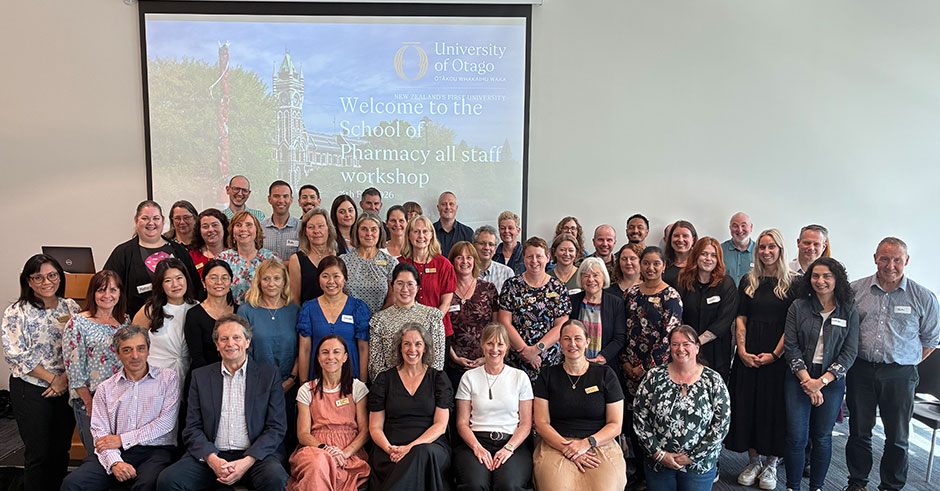
The 2026 School of Pharmacy workshop involved professional and academic staff from across the School gathering to strategise about how they could build a better future for kaimahi and tauira.
He Rau Kawakawa School of Pharmacy staff gathered to discuss how they can work together to build a better future for their kaimahi and tauira.
Taking place on Wednesday, 4 February, in the Terrace Lounge, the half day-event saw professional and academic kaimahi from across the School come together to reflect on what processes are working well and how they can build on those foundations.
The day’s activities were run by the Dean of the School, Professor Bruce Russell, with opening remarks from both the Pro-Vice Chancellor of the Division of Health Sciences, Associate Professor Megan Gibbons, and Head of the Faculty of Health Professional Programmes Associate Professor Ailsa McGregor.
“The workshop presented a fantastic opportunity to connect with pharmacy kaimahi and allowed me to remind them that the exceptional mahi they do is seen and deeply valued. I look forward to seeing what they do in 2026 and I’m grateful for their enthusiasm in wanting to continue improving the School,” Megan says.
“As the whakataukī says, He taura whiri Kotahi mai anō te kopunga tai no i te pū au - from source to sea we are one. As a pharmacologist who spent ten years in the School of Pharmacy, this feels like a really special moment to acknowledge where we’ve come from and where we’re heading together,” Ailsa says.
The workshop focused on identifying ways to strengthen communications, teaching, research, and operational processes across the school.
Participants also reflected on how the recent amalgamation of the Department of Pharmacology and Toxicology with the School of Pharmacy aligns with Pae Tata and the Vision for 2040.
The Department transitioned from the School of Biomedical Sciences and formally joined the School of Pharmacy last year, following discussion and consultation with staff.
The alignment of these two areas of research is recognised internationally and supports students considering careers in pharmacy, pharmaceutical sciences and pharmacology and toxicology.
“Both pharmacology and toxicology, and pharmacy studies were founded at the University of Otago in 1963, before being divided into two different departments by Professor Fred Fastier in 1969,” Bruce says.
“However, there is teaching overlap between the two areas and reviews from Otago’s Quality Advancement Unit have strongly encouraged a strategic amalgamation.
This is an exciting opportunity as it gives kaimahi a chance to consider how we might operate as one team, build a unified approach to teaching, increase opportunities for collaboration, and learn from each other’s expertise.”
Director of the Christchurch-based consulting firm The Flourishing Institute, Jane Davis, also attended the workshop to share her expertise on how organisations can use research-backed data to thrive both practically and positively.
With over 30 years’ experience in organisational psychology, Jane spoke about how enhancing people’s leadership capabilities can help build high-performing teams that foster positive workplace cultures.
Alongside Jane’s presentation, the team enjoyed kai and social activities to connect and conclude the busy day working on strategic initiatives.
Study Pharmacy at Otago
Pharmacists help improve health outcomes for communities, while enjoying an amazing work–life balance.
Study Pharmacy