
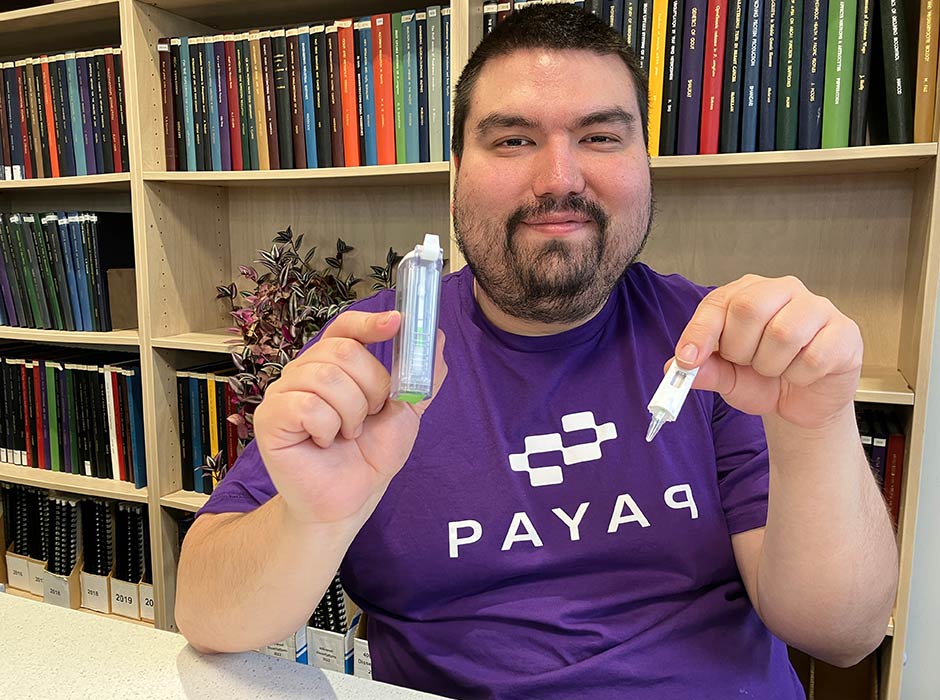
Graduand Benjamín Durán-Vinet with a portable testing device incorporating the biosurveillance platform he integrated to detect species ranging from invasive pests to endangered species.
It might take a village to raise a child, but it can also take a community to help a PhD candidate graduate, as Benjamín Durán-Vinet’s eventful journey has proved.
Benjamín graduates on Saturday with a PhD in Genetics, focused on environmental biosurveillance and biosecurity applications.
He’s grateful to make it to the graduation stage after overcoming significant challenges – shifting his family from Chile, Covid-19 disruptions, an overseas trip for a life-saving operation for his baby daughter and supporting his wife following a cancer diagnosis.
And while all were daunting, Benjamín, who is based in the Department of Anatomy, sees the many positives from his experiences – specifically from people who’ve helped.
“I literally wouldn’t be graduating right now without support – from my supervisor Professor Neil Gemmell, from my departments [Anatomy and Biochemistry], from the University and Dunedin communities, health professionals, and crowd-funding support from complete strangers. It was heartwarming and is something I want international students to know – there is support that wraps around you when you need it.”
Benjamín and his wife Karla Araya-Castro are from Chile. Karla had completed her PhD study in her home country while Benjamín shose to study for his PhD at Otago to work with Neil who was interested in his experience and skills on molecular methods for surveillance.
He planned to start his PhD in Dunedin in 2020, but Covid-19 delayed it until 2022.
His thesis is “The development and deployment of CRISPR-Cas-based environmental biosurveillance.” The study involved integrating and developing an environmental biosurveillance platform using artificial intelligence, CRISPR and environmental DNA (eDNA) approaches to quickly and accurately identify invasive species.
Meanwhile Karla, a biotechnologist expert in nanotechnology and co-design for research impact, took on postdoctoral research in the Department of Biochemistry.
A year after setting up home in Dunedin, Karla gave birth to Amelia, a sister for Máximo, now aged 8.
However, there was a problem with Amelia’s skull – it was prematurely fusing, meaning imminent neurological damage without prompt medical intervention.
The treatment option in New Zealand involved a period of waiting, then major surgery to remove and reconstruct parts of the skull. Karla and Benjamín instead arranged for an operation in El Paso, Texas, USA, that used a novel, less invasive endoscopic technique which could be undertaken much earlier to prevent intracranial pressure that could lead to permanent neurological damage.
Getting the five-week-old to the operating table on the other side of the world involved the kindness of strangers - crowd-funding.
“We were astonished at the financial and emotional support – we had only been here for 16 months and had a small network but suddenly everyone was helping us to get there in an extremely short amount of time.”
There were many obstacles to overcome, but the outcome was a successful operation and smooth helmet therapy.
“All of those people who donated or helped in some way are part of our journey and the reason Amelia is a happy active 3-year-old who loves playing on slides and swings. Karla and I celebrate how lucky we are - Dunedin feels like home.”
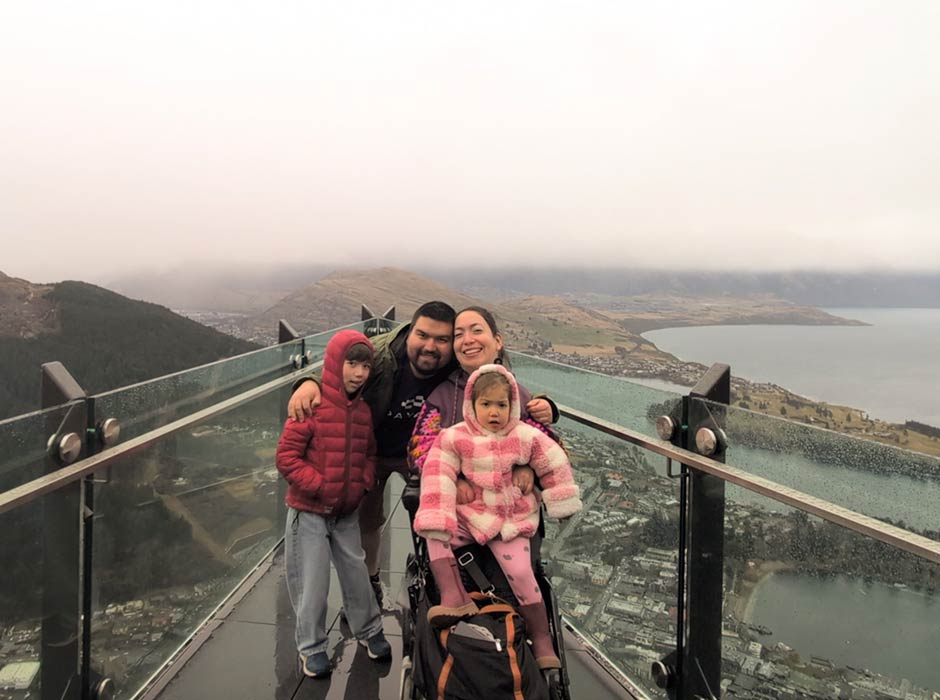
Máximo, Benjamín, Karla, and Amelia visit the Queenstown Skyline earlier in the year. Benjamín graduates this week with a PhD in Genetics, focused on environmental biosurveillance and biosecurity applications.
However, the couple faced another life challenge only a year later, when Karla was diagnosed with ovarian cancer and underwent laparoscopic surgery. Neil again told Benjamín that it was okay to take time away from his thesis because family came first, and colleagues again rallied to help.
“It was rough, but Karla is doing well and is now working with the University’s Disability Information and Support Centre, providing accessible lecture notes for students with impairments.”
Meanwhile, the research Benjamín has continued to progress throughout these personal challenges is attracting growing international attention.
In fact, the eDNA-based test he’s been working on detected two significant invasive marine species in New Zealand in only a few months, and the platform technology is now being further improved to help monitor and manage endangered Hector’s and Māui dolphins.
A novel integration of technology, the biosurveillance platform he has developed to identify a diverse portfolio of species is called Smart Environmental Nucleic-acid Tracking using Inference from Neural-networks for Early-warning Localization (SENTINEL).
Benjamín is passionate about its potential to do good for the environment and people.
Technologies like SENTINEL are portable and can detect species from tiny amounts of DNA, he says.
“They are therefore of growing interest to biosecurity agencies and researchers worldwide – field workers can test water on-site with relatively little equipment and obtain rapid, meaningful results.
"It means New Zealand has a great opportunity to help lead the development of next-generation biosecurity tools that are more accessible, faster, lower-cost, portable, and better suited for early detection in the field, saving time and money.
"Better early-warning biosurveillance could not only benefit the Hector’s and Māui dolphins, but also help us protect biodiversity, agriculture, aquaculture, livestock, and human health, complementing current pest biosurveillance and conservation management tools and efforts.”
The science behind the biosurveillance tool
CRISPR is best known as a gene-editing technology, but some CRISPR systems can also be programmed to recognise specific genetic sequences.
This capability can be used to rapidly detect tiny, fragmented genetic clues left by organisms in the environment - eDNA, which helps determine where a species - in this case the Hector’s dolphin - is now or has been recently.
“We already test water and soil, and will soon test air also for the presence of invasive species, endangered species, pathogens or disease-causing organisms.
"We’re excited to be integrating AI and CRISPR technology as the next-generation tool for detecting eDNA and improving biosecurity – our platform can already provide rapid results,” Benjamín says.
“It’s critical to detect environmental threats at the earliest opportunity to maximise biosecurity management interventions, before they spread uncontrollably and cause adverse social, cultural, ecological and economic impacts.”
Not only is Benjamín thankful for personal support across his PhD journey, he also acknowledges the people who have developed the science he’s basing his research on.
“The work my science builds from enables me to do what I am doing.”
Benjamín is thankful to the Otago researchers who all have projects which helped bring the SENTINEL platform to the next level, including Distinguished Professor Neil Gemmell (ETSCP: Demonstration of Rapid Point-of-use Environmental DNA Workflows for Biosecurity Detections), Dr Alana Alexander (UORG 2026: Environmental biosurveillance of taonga species using CRISPR), Dr Nathan Kenny (Rangapū Rangahau: Better bivalve biosurveillance through partnership and cutting-edge molecular biology), Associate Professor Michael Knapp (MBIE Smart Idea: A rapid, point of need diagnostic test for infectious diseases in livestock; Rangapū Rangahau: He Oranga Kauri o Te Au Warawara – a rapid point-of-need diagnostic tool for Kauri dieback) and Associate Professor Htin Lin Aung (MBIE Smart Idea: A rapid, point of need diagnostic test for infectious diseases in livestock).
He also thanks Dr Antoinette Piaggio (United States Department of Agriculture), Rob Fagerlund (Microbiology), Dr Sebastian Alvarez-Costes (Anatomy), Gracie Kroos (Anatomy), Donna Huber (student, Van Hall Larenstein University, Netherlands), Amorangi Rayner (student, UO), Daniel Kardailsky (student, UO), Nishil Gounder (student, UO), Freja Dynesen (student, Aarhus University, Denmark), Sara Ferreira (former, Anatomy) and Jackson Treece (former, Anatomy)
Kōrero by Claire Grant, Communications Advisor, Faculty of Biomedical Sciences