
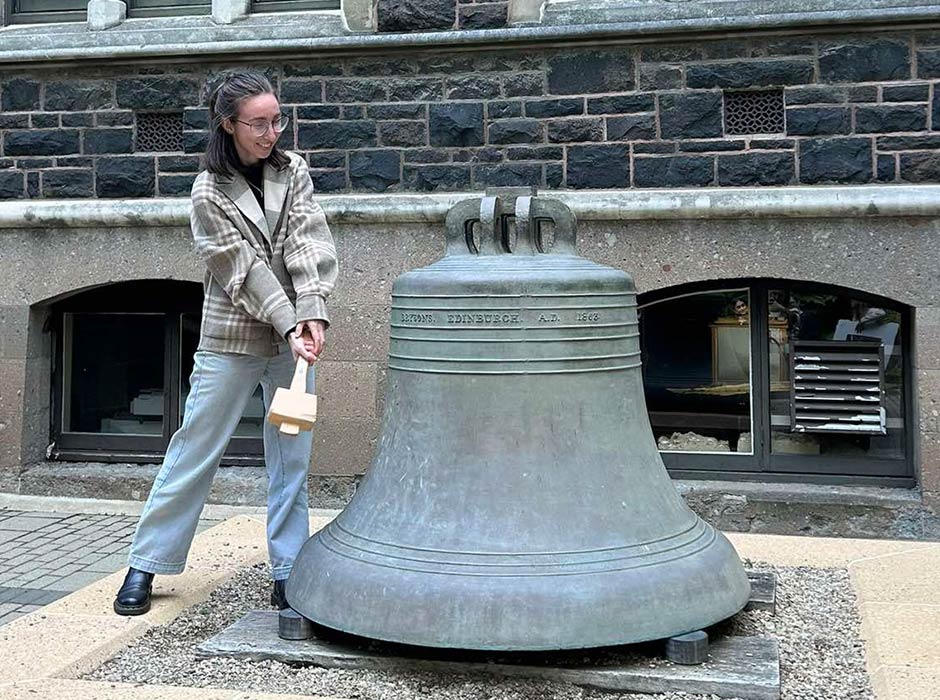
Rebecca Grimwood strikes the University bell on the Dunedin campus after submitting her PhD thesis.
Precious little is known about viruses specific to New Zealand, but the work of one of Otago’s new graduates is making inroads into understanding our unique virosphere.
Rebecca Grimwood graduated on Saturday with a Doctor of Philosophy in Genetics.
Working with Professor Jemma Geoghegan in Otago’s Department of Microbiology and Immunology, Rebecca’s three-year-long PhD project focuses on the New Zealand virosphere – that is the world of viruses that exist on the planet.
Jemma says Rebecca’s work is significant for a postgraduate student, and very useful for New Zealand.
Viruses are essential but often overlooked players in the formation, turnover, and maintenance of life on Earth.
These invisible parasites don’t just cause infectious disease outbreaks, they embed themselves in every facet of biology, yet we have only scratched the surface of identifying them and knowing their purpose – in fact science has probably only discovered one per cent of what’s out there.
Rebecca says given how little is known about the true extent of viruses on earth, New Zealand’s geographic isolation must mean there are undiscovered viruses here that are unique to our country and our Indigenous species.
Rebecca’s thesis "Traversing the Virosphere of Aotearoa New Zealand and Beyond with Metatranscriptomics” sets out to address this knowledge gap by exploring virus diversity in local host species.
Her research looks at the virome of 24 hosts, including some native species and fish (a virome is the collection of all viruses found in an organism).
As a result, she has discovered 83 endemic novel viruses, is part of 12 publications and authored five, and has produced previously unknown data on the natural environment, and New Zealand’s farming and fishing practices.
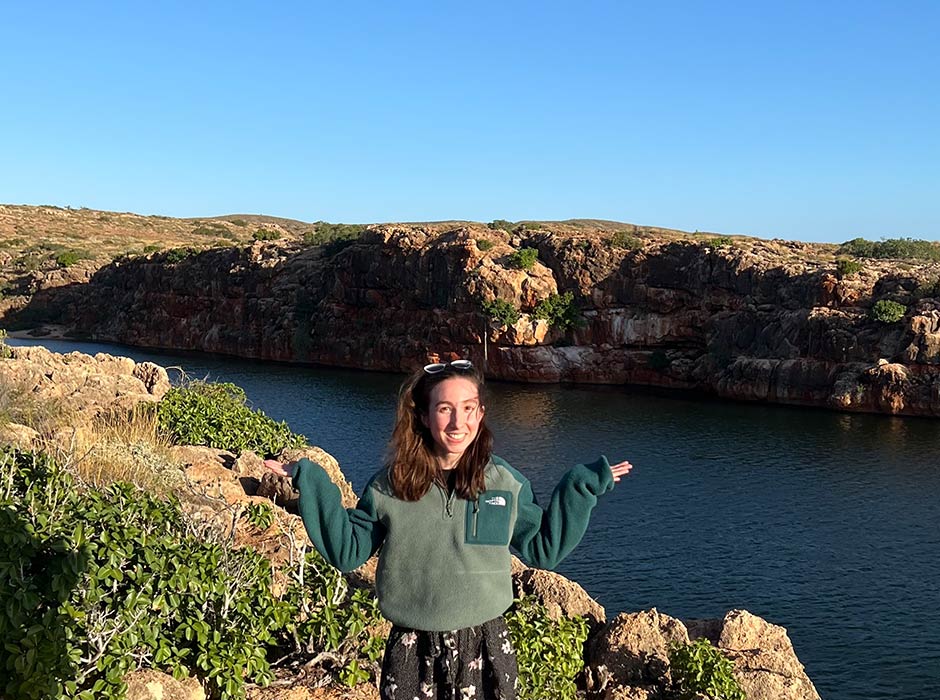
University of Otago graduate Rebecca Grimwood exploring her new surroundings after relocating to Western Australia.
Rebecca says there are two main reasons knowledge on viruses is crucial.
“It helps with surveillance and the very real risk of exotic disease incursion. If a virus causes problems, we can quickly identify if it’s new or has been part of our New Zealand-specific species.
“Pathogen genomic information also informs conservation and is part of how we will manage our environment. We’re building knowledge about what the role of some of these viruses are, particularly fragile environments that are experiencing loss of biodiversity,” Rebecca says.
On Rēkohu Chatham Island for instance, Rebecca found that viromes of native New Zealand fish were highly diverse, carrying many viral families. Common smelt, in particular, showed evidence of long-term virus-host codivergence with viruses.
On two of the islands in the Chatham Islands Rebecca identified abundant parasites and novel viruses that transmitted across species of native, introduced, and migratory birds, including the critically endangered Chatham Island Black Robin.
Interestingly, there is strong evidence of diversity in viruses in fish from the Ross Sea in Antarctica. Although a less populated ecosystem, polar fish viromes have similar viral diversity to fish from bigger and more biodiverse oceans.
The research includes two emerging diseases in agricultural species.
Rebecca studied a Red rock lobster crustavirus associated with tail fan necrosis in spiny lobsters, this shell disease affects its health and economic viability.
She also found two particular viruses in dairy calves associated with ill-thrift syndrome.
Rebecca says her study demonstrates how important it is to integrate genomics into wildlife surveillance and disease investigations, particularly in understudied animals, birds and fish.
“Genomic sequencing tools are giving us new opportunities to understand what’s around us – in particular pathogens that pose a threat to agriculture and wildlife.”
The project created a lot of interest in New Zealand and globally with scientists studying viruses. Rebecca worked with New Zealand organisations including the Ministry of Primary Industries and the Department of Conservation and has presented her work internationally several times.
Rebecca says Otago is a great place to study.
“I loved my work in Jemma’s lab, and having the opportunity to travel and to meet other researchers. It’s been very satisfying. I enjoyed a good study work life balance. And I liked demonstrating and tutoring and would encourage people to get involved.”
After finishing secondary schooling at Burnside High School in Christchurch Rebecca originally considered being a genetic counsellor. With this in mind, she majored in genetics at Otago with a minor in computer science for her Bachelor of Science degree in 2020, before completing an honours programme.
Her PhD studies then pivoted towards virology rather than clinical work. She says being part of uncovering invaluable knowledge on the virosphere over the last three years has cemented her ambition to be a scientist.
Now in Geelong, Australia she’s enjoying working for Australia’s national science agency Commonwealth Scientific and Industrial Research (CSIRO) as a post-doctoral researcher focused on similar pathogen work in wild and agricultural species with a biosecurity-focused perspective.
Kōrero by Claire Grant, Communications Advisor, School of Biomedical Sciences