
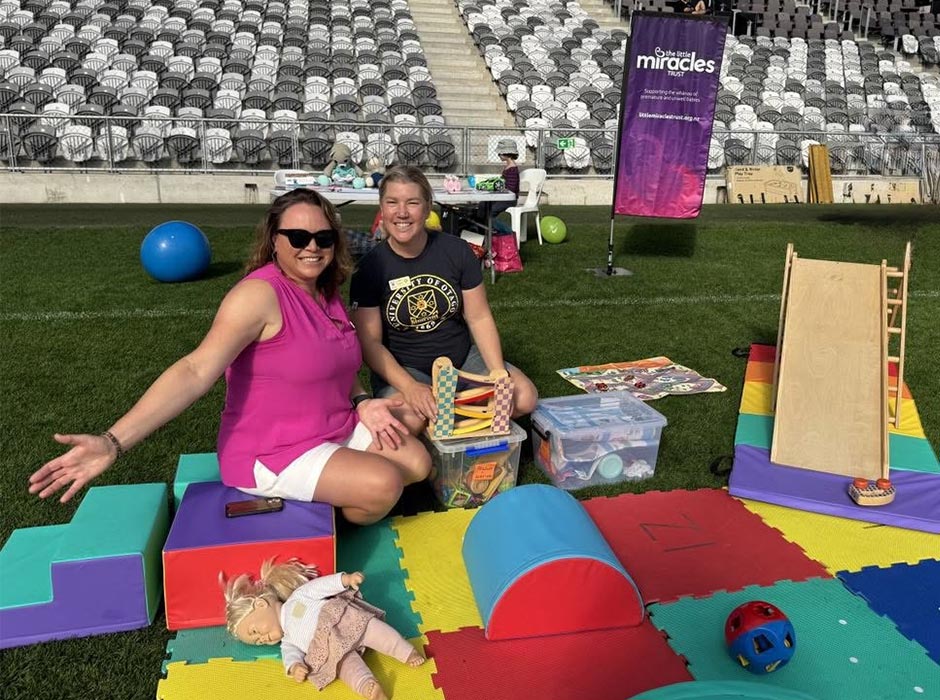
Family Support Coordinator Shelley Gorman (left) and PhD candidate Donna Smith (right) promoting the playgroup at Dunedin’s Children's Day event this year.
Undeterred by Covid-19, staff from Otago’s School of Physiotherapy joined with the Little Miracles Trust in 2020 to establish a Dunedin-based developmental playgroup for whānau and pēpi coming out of the neonatal intensive care and special care baby units.
Successfully operating for the past six years, the School of Physiotherapy provides developmental support by providing Physiotherapy staff and students to facilitate the group. This includes PhD candidate Donna Smith, who teaches at the School and is mum to two boys born preterm.
“Having somewhere safe to go after my boys were born was so important, and I wanted to be able to help provide that support to other whānau. Plus, as physiotherapy is a role that spans across the lifespan, having an opportunity for our students to interact with children and whānau is really important.”
This results in a supervised paediatric learning opportunity that provides physiotherapy students with meaningful clinical experience, while supporting families who are going through a challenging, often unexpected, healthcare journey.
As Aotearoa New Zealand’s national neonatal charity, the Little Miracles Trust coordinates these developmental playgroups in Auckland, Waikato, Wellington, Christchurch and Dunedin.
In Dunedin they fund the Plunket room venue, provide funding for Family Support Coordinator Shelley Gorman to attend, and work to secure grant funding to grow the playgroup’s resources and provide services like morning tea for attending families.
“It’s a fantastic partnership,” Donna says.
“Our students gain meaningful hands-on learning in child development and family-centred care, and the Trust benefits from having physiotherapy expertise integrated into the playgroup so families can access developmental support in a relaxed setting.”
Donna says babies who are born preterm have increased risk of cerebral palsy, developmental delays, hearing and sight problems, and behavioural and mental health issues. Likewise, the families of preterm infants have increased risk of post-traumatic stress, anxiety and depression.
“Whānau attending the playgroup benefit from having a welcoming space where they can connect with others who understand the experience of preterm birth and children with additional developmental needs.”
The developmental therapy offered at these playgroups means staff can monitor a child’s development and refer them to New Zealand’s Child Development Service when needed. Named ‘We-Play’, the group runs from 9:30-11:00am on the first and third Thursday of every month while operating as a student placement opportunity for second-year Physiotherapy tauira.
Roughly four students take part in the placement at a time as it runs from midsemester break in semester one through to the end of semester two. During the other parts of the year, third or fourth year tauira volunteer their time at the playgroup as it serves as an excellent learning opportunity for those interested in paediatrics.
Sessions run as a drop-in service with no need to book, allowing flexibility in attendance for whānau. The playgroup in Dunedin is open to all families with children aged 0-5, with a special focus on those who have had a preterm or challenging journey. The only prerequisite is that all attendees are in good health so vulnerable children are protected.
– Kōrero by the Division of Health Sciences Communications Adviser, Kelsey Swart.
Study Physiotherapy
Physiotherapists are health professionals essential to the rehabilitation and maintenance of optimal physical ability and healthy lifestyles
More about Physiotherapy