
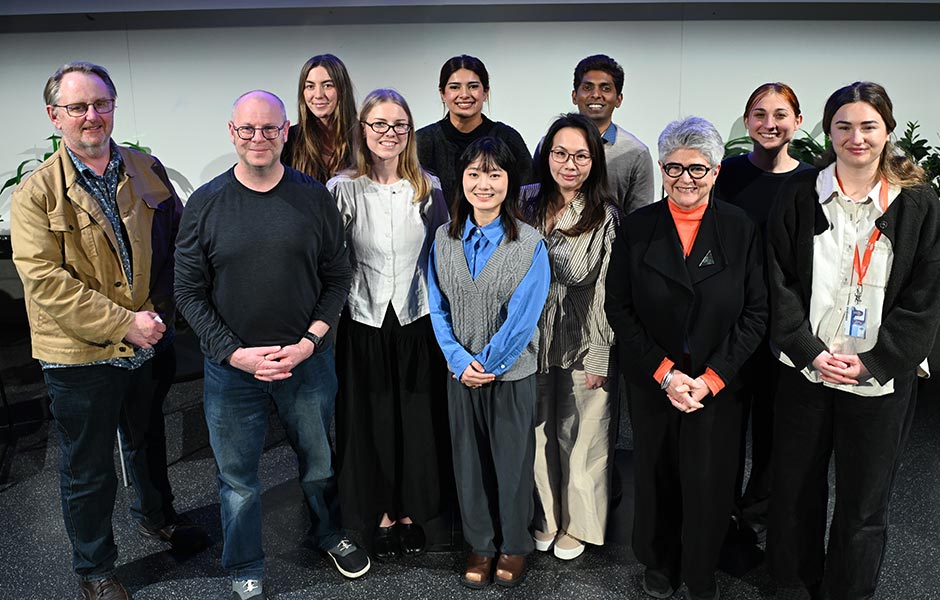
Contestants and judges are pictured with Coordinator Student Experience Trevor Williams (far left), who organised the Wellington Heat of the Three Minute Thesis (3MT) competition held in the Nordmeyer Theatre on 29 July.
Seven Masters and PhD students took up the challenge of explaining their research topics in plain English in just three minutes in the Faculty of Medicine – Wellington Heat of the 2026 Three Minute Thesis (3MT) competition on 29 July.
With the clock running, the students got creative to describe their research. PhD candidate Lydia Le Gros from the Department of Public Health used the idea of a ‘generation rent’ board game to explain being locked out of home ownership, while Master of Science student Zoe Moltschaniwskyj from the Department of Surgery and Critical Care compared optimising the performance of a flow cytometer to tuning a violin.
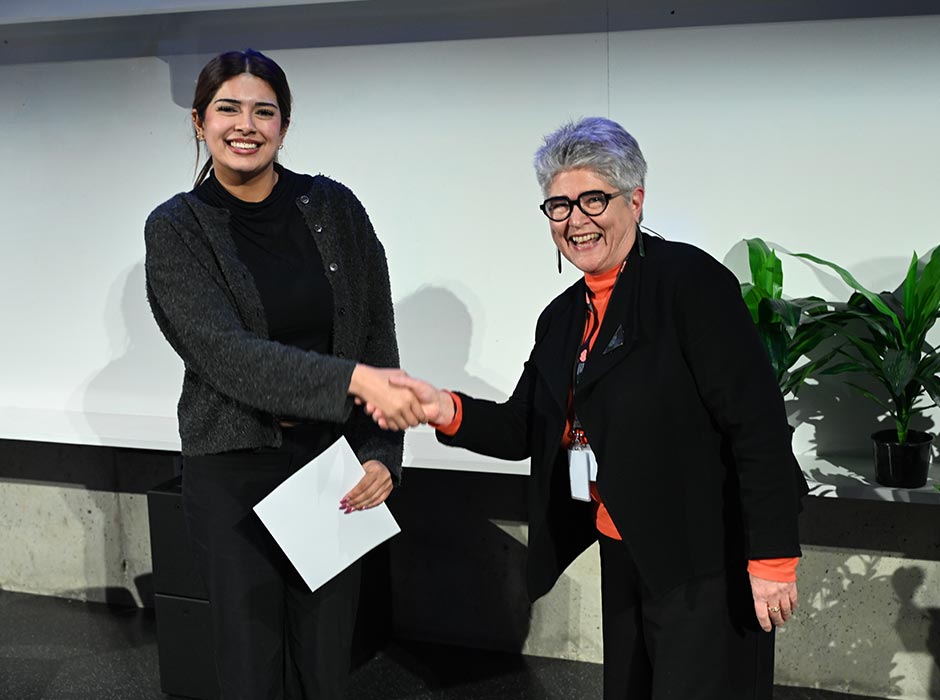
Three Minute Thesis (3MT) Wellington Heat winner Aparna Menon is congratulated by judge Emerita Professor Dawn Elder.
Aparna Menon won over the judges with her Crime Scene Investigation (CSI) approach to explaining her work on developing a test to enable ED doctors to quickly determine if an infection is caused by a virus or bacteria. Aparna, a Master of Biomedical Sciences student from the Department of Surgery and Critical Care, was awarded a prize of $500 donated by Research for Life for the best presentation. She goes forward to compete in the University of Otago grand final in Dunedin on 1 September.
The other competitors were Jenny Hill (a Master of Biomedical Sciences student in the Department of Pathology and Molecular Medicine), who discussed her work on whether a viral infection can predict rheumatoid arthritis response; Zhiting Chen (a PhD candidate in the Department of Public Health), who explained her research on freezing and overheating in New Zealand homes; Coco Kho (a PhD student in the School of Performing Arts and the Department of Medicine) who talked about the use of music in chronic pain management; and Paris Henderson (a PhD student in the Department of Pathology and Molecular Medicine), who explained the role of skin resident memory T cells in allergy.
The event was MC’d by Dr Nick Baker, a Senior Teaching Fellow in the Graduate Research School in Dunedin. Nick was also one of the three judges for the competition, alongside Emerita Professor Dawn Elder from the Department of Paediatrics and Child Health and Dr Hemakumar Devan from the Department of Medicine.
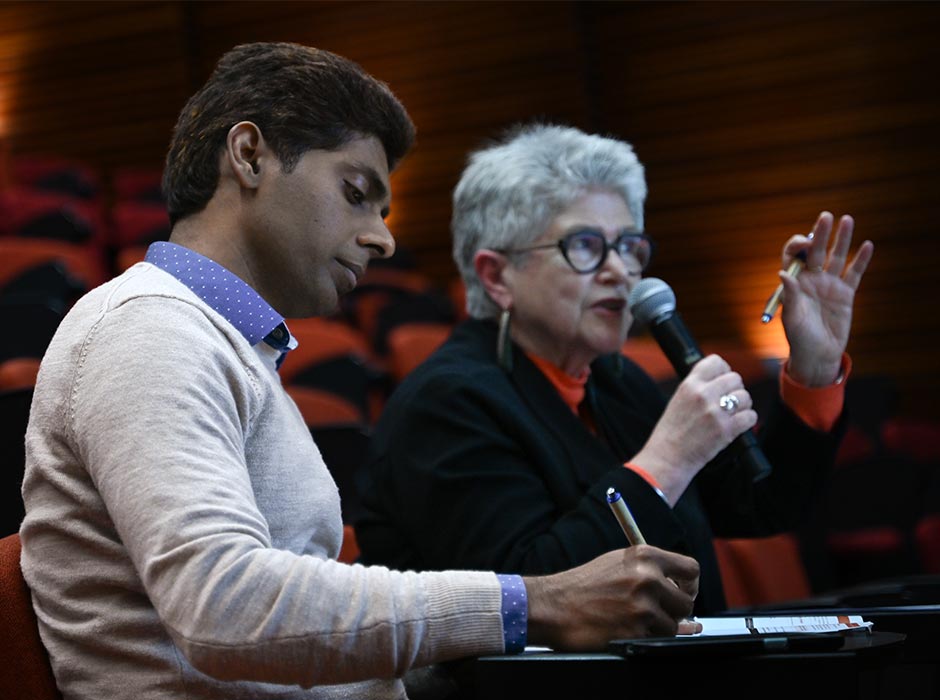
Dr Hemakumar Devan and Emerita Professor Dawn Elder share their feedback during the Wellington Three Minute Thesis (3MT) Heat.
University of Otago, Wellington
At our Wellington campus we teach Medicine, Radiation Therapy, Physiotherapy, postgraduate qualifications and papers, and undertake a wide variety of health-based research.
More news from Wellinton