

Professor Michelle Glass (left) and Professor Melanie Bussey (right) are winners of the 2026 Proof of Concept Competition.
Research into alleviating chronic pain and managing head impact risk were centre stage at this year’s Proof of Concept competition, taking out the top spots for two Otago researchers.
School of Pharmacy and Pharmacology Professor Michelle Glass won $100,000 of R&D investment from Otago Innovation to progress her research into a new class of pain medication toward commercialisation and real-world impact.
School of Physical Education, Sport and Exercise Sciences Professor Melanie Bussey secured a $100,000 convertible note – an investment to support the formation of a startup company – to commercialise a decision support analytics tool to manage head impact risk in contact sports.
The convertible note investment comes from NZ Innovation Booster (NZIB), Booster NZ’s university partnership fund and Movac, New Zealand’s largest venture capital fund.
The 2026 competition also had six new awards for postgraduate researchers, offering an internship to help them understand different aspects of the commercialisation process, from planning to business case development.
The Proof of Concept (PoC) competition, organised by Otago Innovation Limited (OIL), is an opportunity for Otago researchers to test the commercial viability of their ideas in front of an expert panel of judges. This year, the competition celebrates 20 years since it first launched.
OIL Chief Executive Officer David Christensen says they received a record number of applications this year, numbering at 55.
“The number and quality of entries this year vastly exceeded our expectations.
“Each year the judges comment that the quality of the projects coming forward is increasing, and this year was no exception.”
While the record number of applications has given the OIL team plenty to work on, David encourages researchers to reach out to OIL even though the competition has ended.
“Commercialisation is more than a once-a-year or 20th anniversary competition. We remain very much open for business and look forward to many more opportunities being tabled going forward.”
The 2026 Proof of Concept winners
Professor Michelle Glass, School of Pharmacy and Pharmacology
A new generation of safer pain medications
$100,000 R&D investment to progress an idea toward commercial application
By any measure, pain is a global health problem, affecting millions of people worldwide.
Professor Michelle Glass says due to several existing pain medicines causing significant side effects or becoming less effective over time, there is an ongoing need for safer and more effective treatment options.
Recognising this need, Michelle, in collaboration with University of Auckland Associate Professor Dan Furkert, has focused on developing a new class of pain medication.
“We’re researching pain medicines that work by enhancing the body's own natural pain-modulating systems rather than directly activating them.”
The PoC funding will help establish if their discoveries can move beyond the academic environment towards clinical development, Michelle says.
“Early-stage drug discovery is particularly challenging because researchers must generate substantial evidence before it becomes clear whether a discovery has genuine therapeutic and commercial potential. Funding for this critical early stage is often difficult to secure.
“This award provides an opportunity to take an important next step and assess whether our findings represent not only an interesting piece of science, but a realistic pathway towards improved treatments for patients.
“While there is still considerable work ahead, the long-term goal is to develop new treatment options for people living with chronic pain, beginning with chemotherapy-induced neuropathic pain, a common and often debilitating side effect experienced by cancer survivors.”
Michelle acknowledges the team effort that goes into drug discovery and translating discovery into impact.
“This project builds on many years of work. In particular, it reflects a highly productive collaboration between the University of Otago and the University of Auckland, combining expertise in pharmacology and medicinal chemistry.
“I am also incredibly grateful for the support of Otago Innovation and for the confidence shown by the judges.”
Professor Melanie Bussey, School of Physical Education, Sport and Exercise Sciences
Managing head impact risk in contact sports
$100,000 convertible note investment by NZIB and Movac, to accelerate formation of a university spin-out company.
Athletes, from professionals to the occasional weekend players, are at a higher risk of head impacts due to the physical nature of sports.
Proper prevention and timely treatment of sports-related head injuries are essential to ensure athletes’ long-term health and performance.
To support better interventions and return-to-play decisions, Professor Melanie Bussey and her team have created a decision support analytics tool backed by years of research into the science of head impacts.
“The research underpinning this venture centres on instrumented mouthguard technology and head impact biomechanics in contact sport, particularly community and youth rugby.
“Over several years, my team has built up one of the more comprehensive datasets on head acceleration events in rugby players, giving us a much clearer picture of real-world impact exposure than lab-based testing alone can offer.”
The $100,000 convertible note, an investment by NZIB and Movac, will be used for the creation of a startup company.
This will help the team take concrete steps towards turning their research into a commercially available platform, Melanie says.
“Research findings only create impact if they reach the people who need them – coaches, clinicians, sporting bodies and families making real decisions about player safety.
“The commercial platform translates our research into a decision support analytics tool – rather than functioning as a diagnostic device – helping clubs, schools and medical staff understand impact exposure patterns and make more informed decisions around player welfare.”
The potential real-world impact is significant, she says.
“Better data means better-informed return-to-play decisions, more targeted interventions, and ultimately safer participation in contact sport at every level.”
Commercialisation provided the pathway to real-world impact that made sense, Melanie says.
“Commercialisation will help us get this technology and data out of the lab and into everyday use at scale, rather than have it sit in academic papers.
“OIL and Proof of Concept offers a platform for structured support, funding to test whether the science could stand up as a viable product, and to sharpen our thinking on governance, regulatory positioning and go-to-market strategy – things academic training doesn't usually prepare you for.”
Booster Innovation Fund Manager Melissa Yiannoutsos says the growing ambition among researchers to pursue startups as a pathway to value creation is an exciting step change for New Zealand.
“It helps retain more innovation, expertise and economic value in Aotearoa. We’re delighted to partner with Movac and OIL to help unlock capital and turn high-potential research into well-positioned startups.”
Movac Senior Investment Manager Byron van Vugt echoes the sentiment.
“Melanie’s research brings together a compelling blend of technical novelty and real-world engagement with potential customers, supported by her desire to take steps toward commercialisation.
“It’s incredibly exciting to be able to support her next steps alongside both Booster and OIL.”
Postgraduate researcher awards
$6,000 postgraduate internship with support from Otago Innovation, undertaking planning, market research, customer discovery, competitor analysis and business case development on/around their own projects
- Mary Hawkes, Biochemistry, Faculty of Biomedical Sciences
- Ford Iammongkol, School of Computing
- Charlotte Marshall, School of Physiotherapy, Christchurch Campus
- Nurun Popy, Department of Marketing, Otago Business School
- Grace Shaw, School of Performing Arts (Music)
Two decades of supporting impact
The University's Proof of Concept competition turns 20 this year, marking two decades of supporting research impact across Otago.
The competition gives researchers the opportunity to test the commercial viability of their ideas in front of an expert panel of judges who are innovators in the technology transfer space. It is organised by the University’s technology transfer office, Otago Innovation Limited (OIL),
OIL Chief Executive Officer David Christensen says Proof of Concept (PoC) was launched to raise awareness of commercialisation, as a way to create real-world impact.
“Our aim was to create momentum in the direction of commercialisation.
“We wanted more researchers to explore the possibilities and to lean on us to help demystify the commercialisation process. PoC helped do that by bringing more researchers into our orbit.”
The competition started out with seven entries in 2007 and has expanded to 55 entries this year. The prize value has also increased, from one $50,000 prize to two prizes worth $100,000 each, alongside a suite of other prizes in 2026.
“With the change in the Government’s funding criteria and the University’s Intellectual Property policy, we’ve seen a renewed interest in commercialisation and technology transfer.
“We’ve also expanded our scope this year to include PoC prizes for Otago postgraduate students. Our aim is to introduce the next generation of researchers to opportunities of solving real-world problems through exploring the commercial viability of their research.”
It’s not just the winners that have benefited over the years, David says.
“Often, judges will see a lot more than one idea worth investing in. In past years, several entries that did not win have been taken forward with Otago Innovation.
“One example is the Combined Inbreeding and Outcrossing innovation, led by Biochemistry researchers Research Fellow Rowan Herridge, Associate Professor Lynette Brownfield and Professor Richard Macknight – which is being developed in collaboration with a multinational breeding company and is making its way through the patent process.”
Beyond the prizes, the competition has also been an opportunity to educate, David says.
“Competition participants come away with a new lens into research translation and commercialisation and can build that into their research planning.
“A group who have taken this to the next level are our 2021 winners – Dr Erin Macaulay, Dr Chi Lynch-Sutherland and Professor Mike Eccles of the Pathology Department – who went on to gain entrepreneurship qualifications from Stanford Online.”
While 20 years of Proof of Concept is an impressive milestone, it is the future that OIL remains focused on, David says.
“We look forward to embracing the ecosystem change that is upon us, and the opportunities that affords us to support Otago’s world-leading academics in their translational journeys.”
Professor Mark Hampton, of the Department of Pathology and Molecular Medicine and Director of Mātai Hāora Centre for Redox Biology and Medicine in Ōtautahi, was the first PoC winner in 2007 – alongside Professor Christine Winterbourn and Professor Tony Kettle.
Mark says PoC gave the research team an opportunity to take a promising scientific discovery further.
“A few years before the competition, we had begun supplying an ELISA assay kit we developed to other interested laboratories.
“Winning the [2007] competition gave us the opportunity to undertake more dedicated development work, optimise its performance and explore new applications.”
OIL offered the commercial expertise that they did not have within the research team, Mark says.
“They helped us think beyond the science itself and work through the practical issues involved in turning a laboratory assay into a product that could be reliably supplied to researchers elsewhere.
“That support has continued as the commercial model has evolved over time.”
Commercialisation provided a way to make the assay readily available to other researchers while also generating income to support their research, he says.
“All profits from kit sales have been directed back into the research activities of our group.
“This flexible funding has proved extremely valuable for seeding new initiatives and bridging the inevitable gaps between research grants.”
For the Mātai Hāora research team, the relationship with OIL has continued well beyond the first PoC competition.
“The kit was initially sold through a biotechnology partner. When a supply problem arose with one of the kit components, we had to redesign the assay, ultimately resulting in a new and improved version.
“With support from the OIL team, we decided to establish Redox Innovation and supply the kit directly to customers. We are now looking to build on that foundation by adding further products to the Redox Innovation range.”
The whole PoC process was an extremely valuable learning experience, Mark says.
“We had to explain our science to a very different audience, and they challenged us to think about practical aspects of translating research that we had not previously considered.
“That broader perspective has influenced how we think about research impact and commercial opportunities ever since.”
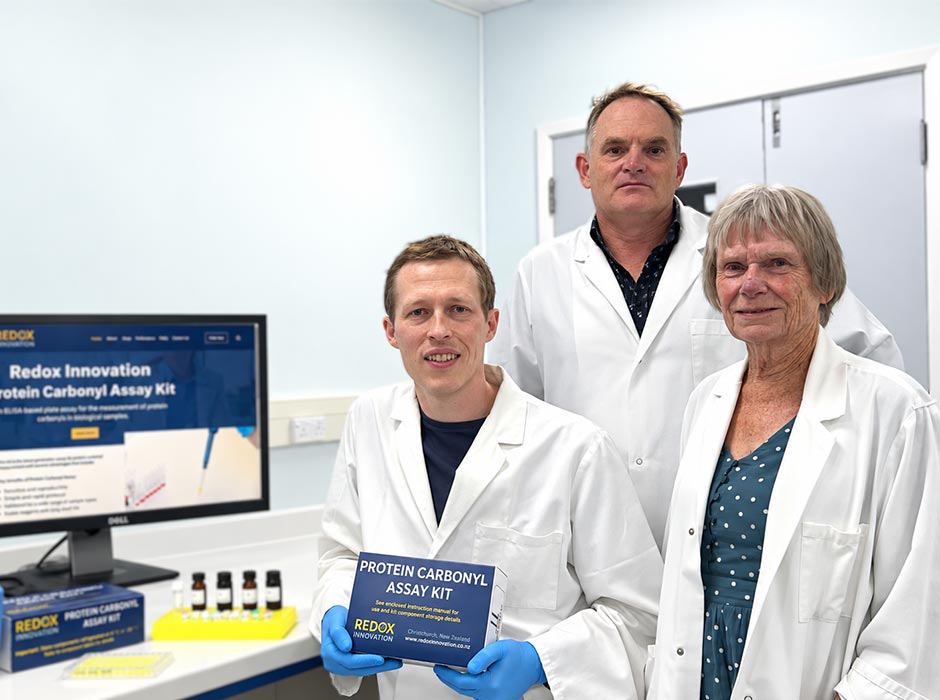
From left, Research Fellow Nick Magon (holding the protein carbonyl assay kit), Professor Mark Hampton and Professor Christine Winterbourn. Mark, Christine and Professor Tony Kettle were the inaugural winners of the 2007 Proof of Concept.
~ Kōrero by Sandra French, Adviser, Internal Communications