

Former OUSA President Helen Jamieson is proud to have introduced House and Garden week to Otago.
Digital artist Helen Jamieson shares some of the good, the bad and the funny moments from her time as the 1991 Otago University Students’ Association (OUSA) President.
Otago alumna Helen Jamieson was born and grew up in Dunedin, graduating with a Bachelor of Arts majoring in English in 1992. She is currently based in Munich, Germany, where she works internationally as a digital artist, writer and theatre practitioner.
Her artistic work includes cyberformance (live online performance), digital installations, playwriting and performance collaborations addressing social and environmental themes such as disposability, waste, the impact of technology on humans and the environment, and feminist topics.
She is active in open-source communities and advocates for awareness around digital sovereignty and alternatives to proprietary platforms. On her most recent visit home she helped to organise ‘System Change’, a community event about open-source software and the Linux operating system, at the South Dunedin Library.
Q&A with Helen Jamieson
What are you proud of in your term at OUSA?
Helen says her time in student politics coincided with the introduction of tertiary tuition fees and the start of the move away from compulsory student association membership.
“I'm really proud of the campaigning that we did against the fees and other issues – we had thousands marching in the streets as well as many more creative actions.”
Particularly memorable is the ‘Starving Scarfy Shantytown’, which protested the long delay in paying out student allowances (in 1990).
“We didn't get any money until the end of April, and many students were struggling to pay their rent, so we invited people to build a shack on the union lawn to draw attention to the problem.
“Mine was made out of big cardboard boxes, one student brought all of the furniture from his bedroom and arranged it on the lawn, and there were lots of other creative shacks as well.
“Unfortunately, it poured with rain during the night and some of us ended up sleeping on the floor of the OUSA offices after our shacks disintegrated in the rain. Former Prime Minister David Lange came the next day to award prizes, and we got national TV coverage of the protest.”
She says other memorable protest actions include a mass wedding, highlighting the illogical rules that gave married students a larger allowance than unmarried students, a cheque burning ceremony, and students abseiling down the Hocken Building (now Richardson) with giant anti-fees banners.
“I'm really proud of the House and Garden Week, which I initiated in 1990 after the Easter Tourney riot and increasing incidents of poor student behaviour in the community.
“At that time there were still many non-student residents in North Dunedin, and my family had lived in Dundas Street when I was a child, so I was personally motivated to encourage students to engage positively in the local community and build neighbourly relationships.”
Competition entries were invited in categories such as best student neighbour, best non-student neighbour, best letterbox, best bedroom, best flat and so on, with generous prizes donated by local businesses and landlords.
“During the week we toured the entries with guest judges and gave out the prizes. The whole event attracted great media coverage, including national TV and was held again in 1991 and 1992.
“I think there may have been versions of it over the years since. It was successful in terms of highlighting the positives and shifting the media focus away from the anti-social behaviour of a small number of students.
“I was the first president to have a computer in the presidential office, and to type my own letters. And of course, I'm proud that Mrs Rennie (Bridget Rennie served as OUSA Secretary from 1976-94), Shaun Scott and I made the brilliant decision to employ Donna Jones (who has worked for OUSA for 35 years).”
What did you learn from OUSA and use in your life?
“Being on the OUSA exec was a huge learning experience that I continue to draw on in all kinds of ways in my life.
“I learned a lot about how organisations work, and in particular teamwork – how to bring a disparate group of young and inexperienced people into a functioning executive.”
She says people sometimes end up on the student executive without any real understanding of what they've got themselves into, so it can be “a bit like herding cats”. The advice of those who've been around for longer can be very helpful!
“I honed my media release writing skills and learned how to work with journalists to ensure student issues and opinions were kept in the forefront of public discussion.
“I discovered that if I wrote a good text and faxed it out, I would get to the journalists before they came to us and sometimes see it printed word for word.
“I was able to foster good relationships with local reporters such as John Gibb and Lynn Freeman, and during the year I was president I was in the ODT (Otago Daily Times) nearly every week. I gained a lot of confidence in speaking publicly as well as skills in working with the media.
“I had a computer in my office, but no internet or email on that computer (it was 1991). Next door at Radio One they already had the internet, and they were getting online news feeds and emails from independent sources.
“I remember news updates coming out of East Timor (this was during the lengthy genocide committed by the Indonesian government) and realising the importance of being able to source accurate information from people on the ground in real time, rather than waiting for the curated mainstream news media.”
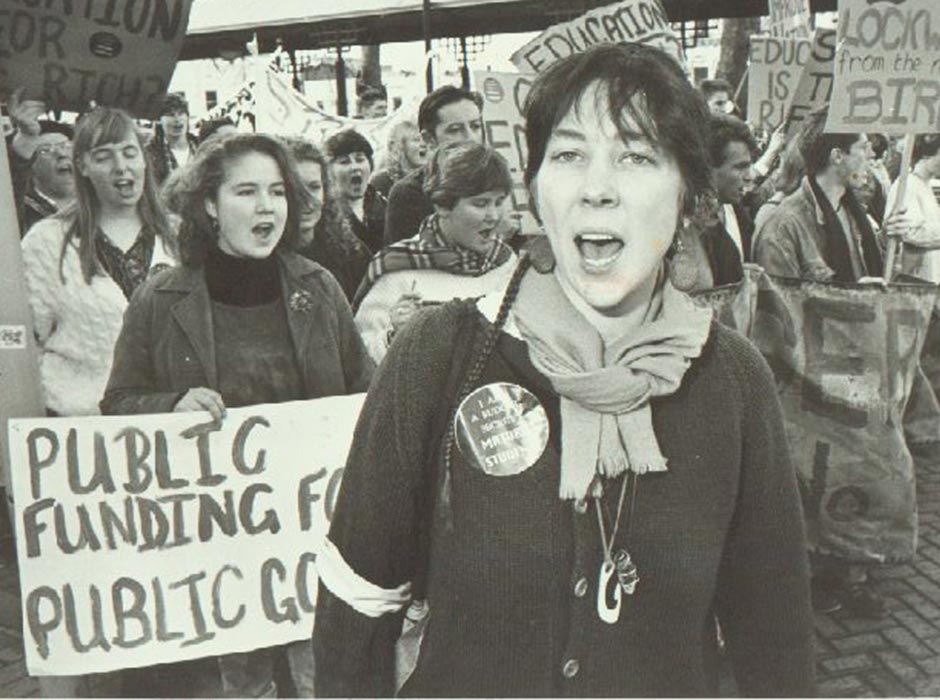
Then OUSA President Helen Jamieson leading a protest against student loans in the Octagon in 1991.
She says while the early internet was already offering the possibility for solidarity with political causes around the world, she learned a hard lesson on the University Council that she could not rely on solidarity from the University and its staff.
“I watched in disbelief as individuals who had privately expressed to me their support for students and our campaign against tuition fees, turned around and voted against us.
“This institutional acceptance of the neoliberal user-pays principle meant prioritising bums on seats over academic research and has led to many ‘unprofitable’ departments disappearing, as well as massive student debt and graduates heading overseas.
“We had campaigned so hard and had massive support from the general public as well as the student body, it was really disappointing that in the end the universities chose not to stick by us. That taught me not to be too naive!”
Would you like to share any memories?
“I have many funny and affectionate memories associated with the legendary Mrs Rennie. She had a fantastic dry sense of humour and could be ‘beyond blunt’.
“There were many times during exec meetings when she averted certain disaster by interrupting with ‘I'm not supposed to say anything, but ...’ then bringing up some historical information that we had no idea about, yet was highly relevant to the decision we were about to make.
“She was also incredibly caring; there was a time when I had got very stressed and wasn't eating properly, so Mrs Rennie would bring me a plate of lunch from the cafeteria, close my office door, and stand in front of my desk with her arms folded watching me sternly until she decided that I had eaten enough.
“In 1989 I was on the Women's Rights Collective and one of our projects was the Dunedin Women's Festival. The programme featured an exhibition, magazine, craft market, performances and other events including a ‘Death by Chocolate’ evening.”
“We massively underestimated how popular this would be, particularly with first-year girls from the hostels, and how much easier the $5 entry was for them than to bring a chocolate dessert."
She says entry to this was $5 or a chocolate contribution.
“We massively underestimated how popular this would be, particularly with first-year girls from the hostels, and how much easier the $5 entry was for them than to bring a chocolate dessert.
“We had to keep running out to nearby dairies to buy more chocolate desserts, ice-cream, blocks of chocolate and so on to feed these insatiable hordes of chocolate-hungry young women. After everyone finally left, we had to vacuum ground-up chocolate out of the carpet before we collapsed with exhaustion and relief that it was over!”
Helen says RNZ’s Colin Peacock was the Critic editor the year she was president.
“We enjoyed a bit of witty sparring back and forth in our regular columns. I'd have to dig out my bound copies of every issue of Critic for the year 1991 (do presidents still receive that, I wonder?) to remember what in particular we sparred about, but it was fun and sometimes got very convoluted and silly. These days I enjoy listening to Colin on Mediawatch.”
Any regrets or things you wished your team had achieved?
“We didn't succeed in stopping the introduction of tertiary tuition fees, even though all of our arguments about the negative effects of student debt have been proved correct.
“But we knew that it was an almost impossible task. I remember then-Education Minister Lockwood Smith rejecting the economic research that NZUSA (New Zealand Union of Students’ Associations) had commissioned with the argument that we didn't have the support of our members and then dismissing the huge marches on the grounds that we didn't have researched arguments.
“Unfortunately, we are again suffering from politicians that aren't interested in listening.”
Alumni & Friends
If you are a former student, staff member, friend or supporter of the University of Otago, we warmly welcome you as a member of our alumni community.
More alumni news