
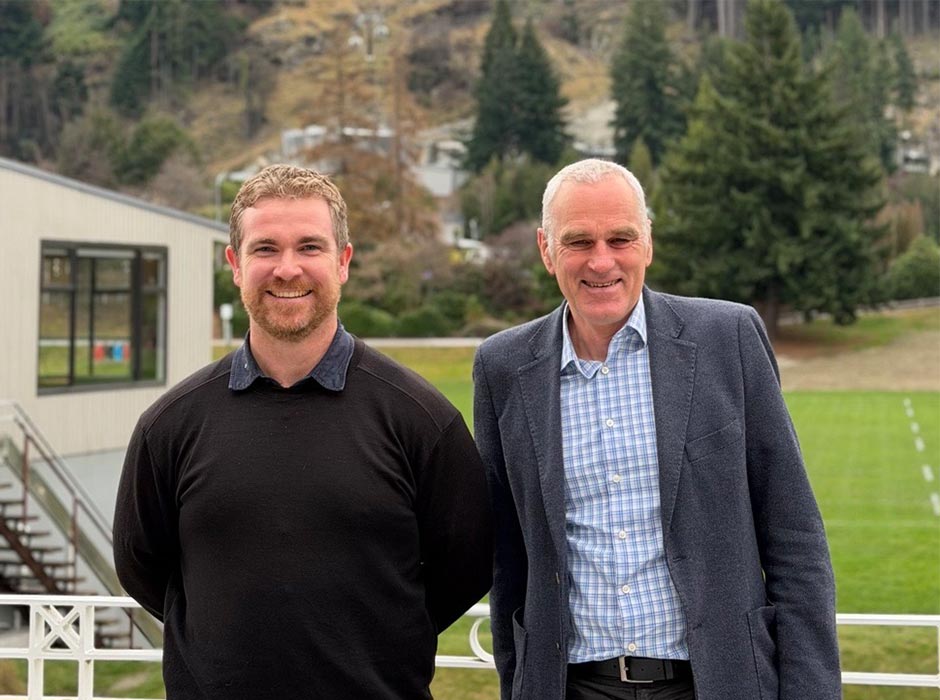
James Mulcahy (left) and Peter Harris, pictured near their Queenstown Lakes District Council offices, smiling bravely in the face of their region’s economic challenges.
When a region that’s undergoing rapid growth and unique economic and environmental pressures offers itself up to a university business school as a ‘living lab’, the town-and-gown synergy of it all is quite irresistible.
That’s how it seemed to staff at the Otago Business School (OBS) when the Queenstown Lakes District Council (QLDC) proffered its region’s knotty issues to the keen minds of its postgraduate students.
The two men leading the charge on developing this symbiotic relationship are QLDC’s Economic Futures Manager Peter Harris and Senior Economic Development Adviser James Mulcahy.
Having previously worked as Otago Polytechnic’s Innovation Facilitator, Peter knows a thing or two about nurturing and leveraging keen minds within the tertiary sector. He could see the benefits of engaging postgraduates to tackle local economic issues that council staff often feel swamped by.
“I thought we could try and plug into the people who have the time to think a bit more deeply and look a bit more widely than we have time to do,” Peter says.
The collaboration was initially trialled as a paid consultancy, with two OBS postgraduates selected to carry out research. Kate Ellmers, then completing a Master of Sustainable Business, was commissioned in 2024 by QLDC (in partnership with Startup Queenstown Lakes) to identify how to measure the impact of startup support organisations.
The following year they contracted Syed Zulqernain Hussain, a PhD candidate in Economics, to research tourism productivity in New Zealand with the aim of providing insights that could support more sustainable and high-value tourism strategies for the region.
It was a win-win situation. The students’ work was well received and has informed subsequent work within QLDC, and the postgraduates got paid to stretch their research legs and pitch their findings to a non-academic audience.
“It was quite different from presenting at the University, where you can assume a certain level of technical familiarity,” says Syed.
“It pushed me to think carefully about how to communicate key insights in a way that was accessible, interesting and directly useful for decision-making.
“The sense of real-world impact was the attractive aspect for me. Knowing that the analysis could potentially influence local policy and planning decisions made the work particularly meaningful and motivating.”
“These experiences provide exceptional work-integrated learning opportunities, allowing students to apply their knowledge to genuine business challenges while contributing fresh thinking and insights." – Pro-Vice-Chancellor of Commerce Maree Thyne
Similarly, Kate found the opportunity to have some tangible impact beyond her student desk hugely compelling.
“It’s a very appealing opportunity for students, who can provide enormous value but often lack connections or inroads in the workplace,” Kate says.
The experience also exposed her to the priorities and concerns of local government and provided a bridge between academia and industry.
“I think every major operator in the Otago region should be supporting this.”
Having tested the collaborative waters via Kate and Syed, QLDC has recently formalised its involvement with OBS. They’re now working with staff to embed some of their research questions into student courses.
“We saw an opportunity to frame Queenstown Lakes as a ‘living lab’ for research conducted in partnership with the Otago Business School”, James says.
“Given the growing relationship between the University and our district, and the fact that the Otago Tourism Policy School is hosted here, we thought we could pitch a series of place-based questions that addressed real district challenges, particularly around tourism productivity, resilience, and destination management.”
Pro-Vice-Chancellor of Commerce Maree Thyne was more than happy to be their lab partner.
“We’re thrilled to see our Master of Business students collaborating with QLDC on real-world projects,” Maree says.
“These experiences provide exceptional work-integrated learning opportunities, allowing students to apply their knowledge to genuine business challenges while contributing fresh thinking and insights. It’s a powerful example of the value of industry partnerships and aligns strongly with our strategic commitment to growing our presence and impact in Queenstown.”
If that postgraduate research power prevails, a few Queenstown problems shared, might well be a few Queenstown problems halved.
– Kōrero by Claire Finlayson, Communications Adviser (Otago Business School)
Postgraduate study in Business
Our postgraduate programmes include diplomas, masters degrees (both research and taught), and PhD degrees. Each offers you the opportunity to gain advanced qualifications in your chosen business field, whether you hold a bachelor's degree or a wealth of industry experience.
Study Business at Otago