
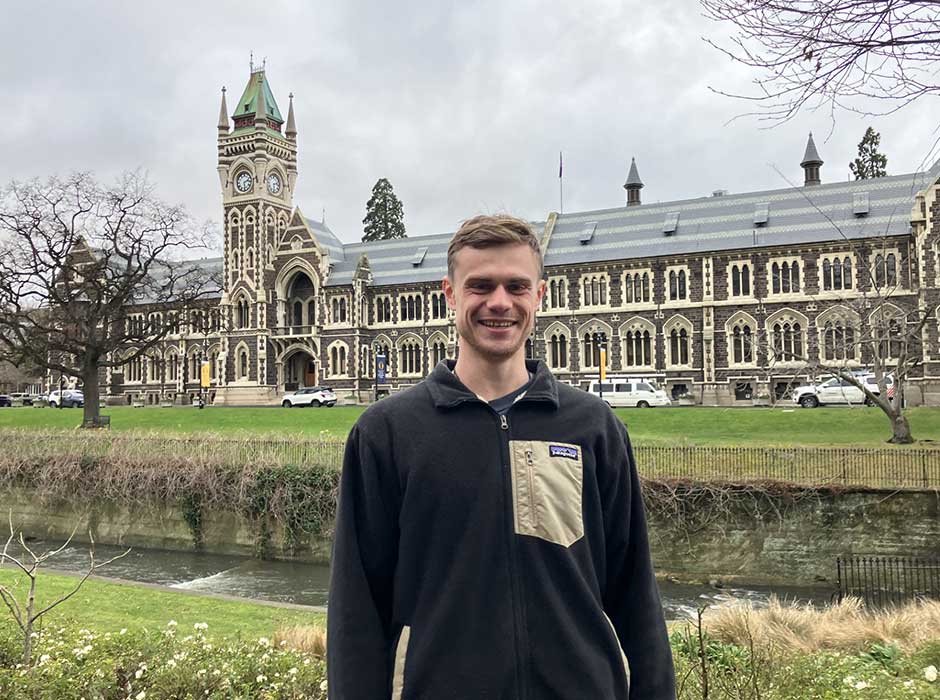
Zoology and Genetics tauira Ben Rooney just wants to “be a part of something cool”. PHOTO: Claire Grant
A two-week research placement is giving tauira Māori the chance to investigate scientific questions of interest to them alongside leading researchers.
Taking place at the University of Otago – Ōtākou Whakaihu Waka, the Rau programme provides second and third-year tauira with hands-on experience in laboratory research. During the mid-semester break, the Faculty of Biomedical Sciences – Te Kaupeka Mātai Rokoā-Koiorā (BMS) paired tauira with researchers working in their area of interest.
Associate Dean Māori for BMS Dr Nathan Kenny (Ngāi Tahu, Te Ātiawa) says the programme is designed to help students better understand research as a career.
“Research careers are a difficult thing to understand compared to being a doctor or a lawyer,” he says. “The most useful thing to do is to get into a lab and see what it’s like.”
Over two weeks, tauira shadow academic staff, postgraduate students and postdoctoral researchers, observe experiments and, in some cases, complete small research projects of their own.
“Most of the time they’ll be observing, seeing whether they like both the science that the lab is doing, but also the lab environment.”
The programme also provides a pathway towards the University’s summer studentship opportunities, which support students to undertake research projects over 10 weeks during the summer break.
For Zoology and Genetics tauira Ben Rooney (Te Arawa), the placement is another step towards a career in research. Originally from Auckland, Ben completed a degree in Building Science and worked in commercial construction before deciding to change direction.
“I’d always been really passionate about animals and science and the environment. The work that I was doing was completely the opposite of that.”
After leaving his job and travelling overseas, Ben volunteered alongside researchers and found himself drawn to the work.
“I thought, this seems way cool, why don’t I do this?”
He moved to Dunedin at the beginning of last year to study Zoology and recently added Genetics as a minor after discovering a fascination with the subject.
“I just want to be a part of something cool.
“One of the coolest parts of the genetics paper I took was them teaching you how they discovered certain things, and I find the thinking processes people go through really interesting. I want to be a part of that space.”
During the Rau placement, Ben is working alongside Senior Lecturer in Anatomy Dr Alana Alexander (Te Hikutū: Ngāpuhi) and Dr Sebastian Alvarez-Costes, a research fellow in Dr Alexander’s lab, investigating the genetics behind wax esters – fatty acids found in whales and dolphins.
The project was inspired by conversations between Dr Alexander and environmental tohunga Dr Ramari Oliphant Stewart, MNZM (Ngāti Awa, Te Whānau-ā-Apanui, Ngāti Rongomaiwahine, Ngāti Mahuta), whose mātauraka has revitalised customary recovery practices from whale and dolphin strandings.
“I had a kōrero with her and she said there are some species that our tūpuna would not use for consumption for gastrointestinal difficulty reasons,” Dr Alexander says.
The research aims to better understand the variation across particular genes responsible for producing wax esters in different cetacean species. The findings could help researchers better understand why some cetacean species produce higher levels of these compounds than others.
“These waxes seem to be really important, specifically for deep-diving species. They might have a role in regulating the trade-off between buoyancy and thermoregulation.”
Dr Alexander says the project demonstrates how mātauraka Māori can inspire new scientific questions.
The programme has also given Ben an opportunity to deepen his connection with Māori culture.
“It’s something I wasn’t exposed to much growing up, but I would really like more exposure, which was another reason for doing this programme.
“I really love being invited into that space. I really appreciate how much the University embraces it.”
-Kōrero by Ani Ngawhika, Kaitohutohu Pāpāho Māori
Faculty of Biomedical Sciences
Our Faculty of Biomedical Sciences is delivering science that is transforming our world. Our work is vital to healthcare professions, our productive sector, and to our unique flora and fauna. Together our staff and students are shaping our futures for Aotearoa, the Pacific, and beyond.
View