
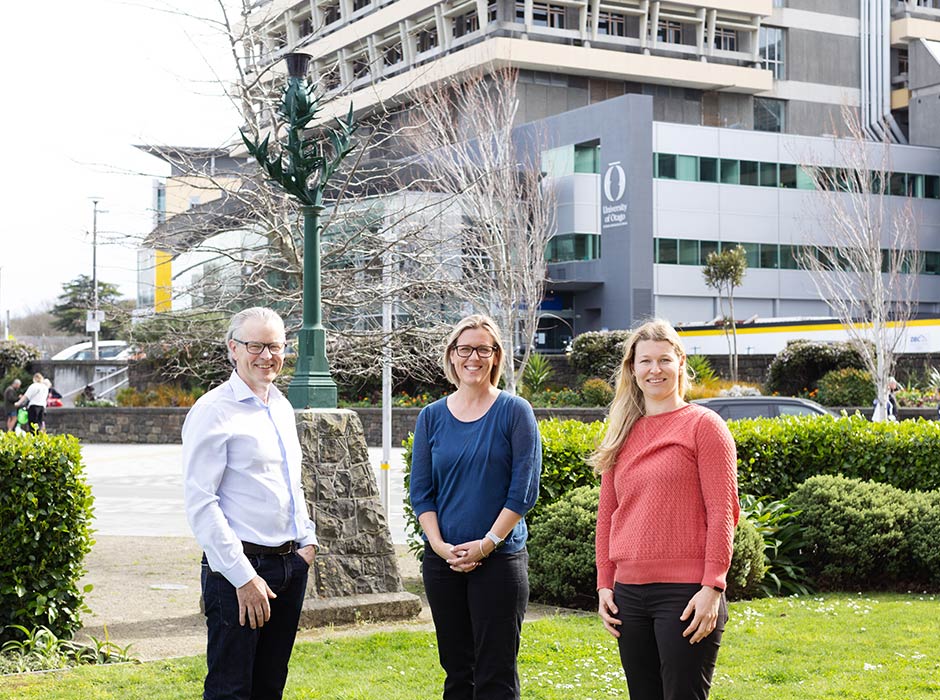
Professor Tony Walls (left), Dr Amy Scott-Thomas (centre) and Katharina Wolf of the University’s Christchurch campus have developed a urine test to allow rapid screening for the Kingella Kingae bacteria – the leading cause of septic arthritis and osteomyelitis in young children.
An Otago trial using microbial DNA could transform how a painful and hard-to-diagnose bone and joint infection in children is detected.
Kingella kingae is a bacterium commonly carried harmlessly in the throats of young children, but it can sometimes cause serious illness.
It is the leading cause of septic arthritis and osteomyelitis in otherwise healthy children aged six months to four years.
Most cases of Kingella respond well to antibiotics, says University of Otago Paediatrics Professor Tony Walls (Medicine – Christchurch). But, diagnosing it can be tricky because it is hard to grow in the lab.
“Most children present with only subtle symptoms such as struggling to walk or sit, crying during nappy changes and presenting with only mild fever, therefore clinical suspicion of this infection needs to be high in this age group,” Tony says.
“Laboratory findings often come back normal or only slightly abnormal, so for definitive diagnosis we need to carry out invasive molecular blood, fluid, bone and joint tissue sampling tests, which require putting the child through a minor surgical procedure to extract the samples. They sometimes take several days to deliver results.”
The new trial, led by Senior Research Fellow Dr Amy Scott-Thomas along with Professor Stephen Chambers, aims to significantly speed up diagnosis, using a urine sample.
“The bacterium in these infections is what we call ‘fastidious’, which means it’s difficult to culture from biopsies taken from sterile sites,” Amy says.
“We’ve set out to develop an assay which will allow us to easily detect the bacterial DNA from urine, gaining a definitive response in a timelier way while, at the same time, eliminating pain, discomfort and the need for surgery.”
Amy and colleagues were inspired by results from a paper published in 2021, reporting the use of a hybridisation assay to detect Mycobacterium tuberculosis DNA in patient urine.
They decided to initially modify this assay for the potential detection of Legionella bacteria in the urine of patients suffering from Legionnaires’ disease.
The Kingella kingae trial will work in a similar way.
“If patients have a high load of bacteria, causing an infection, its likely DNA fragments will be released into the patient’s blood and urine. By testing a child’s urine using a hybridisation assay, it’s hoped we can detect Kingella kingae with some accuracy,” Amy explains.
“Our assay uses a probe which is sequence-specific to the microorganism of interest. This probe, which is attached to tiny magnetic beads, acts like Velcro for DNA and will only ‘grab’ a matching DNA sequence.
“Using a magnetic rack, we pull the beads (with the probe and DNA attached) to the side of the tube. The urine is then removed, leaving the bacterial DNA of interest.”
Scott-Thomas says this DNA is used in a quantitative PCR – a technique which amplifies DNA while measuring it as the reaction happens, allowing the team to see how much pathogen DNA is present in the sample.
They are also developing another non-invasive test using CRISPR-Cas technology.
Funded by Te Niwha and Cure Kids, the trial is recruiting 60 Canterbury children; 20 with confirmed Kingella bone and joint infections; 20 with no infection but who carry Kingella in their mouths; and 20 healthy children who will act as a control group.
PhD candidate Katharina Wolf has helped develop and modify the assay with the aid of Honorary Research Fellow and Canterbury Health Laboratories Scientific Officer Trevor Anderson. She will liaise directly with Walls to meet with the families of children signed up to the trial, collect the samples and process them for future use.
Gathering the samples will present challenges – but the research team is working on a solution.
“While a ‘clean catch’ urine sample is ideal, it’s not always possible with small children, nor is the use of urine collection bags,” Katharina says.
“We’ll be testing several absorbent materials which can be placed easily inside a nappy and allow us to collect as much urine as possible while preserving the vital Kingella DNA within.”
The team is motivated by the prospect of being able to deliver a non-invasive test for this pathogen, while removing pain and discomfort for the child.
“I have a daughter who is petrified of needles, so I understand the need for less intrusive diagnostic tests,” Amy says.
“Several members of our research team have spent time in hospital with their own children, so if we can painlessly improve the experience for other young patients, then that’s a win.”
Korero by Lorelei Mason
This story first appeared in He Kitenga 2025 – Impacts. He Kitenga is the University of Otago’s flagship research publication, which showcases the University’s cutting-edge research and explores how it is making a difference to the lives of New Zealanders.