
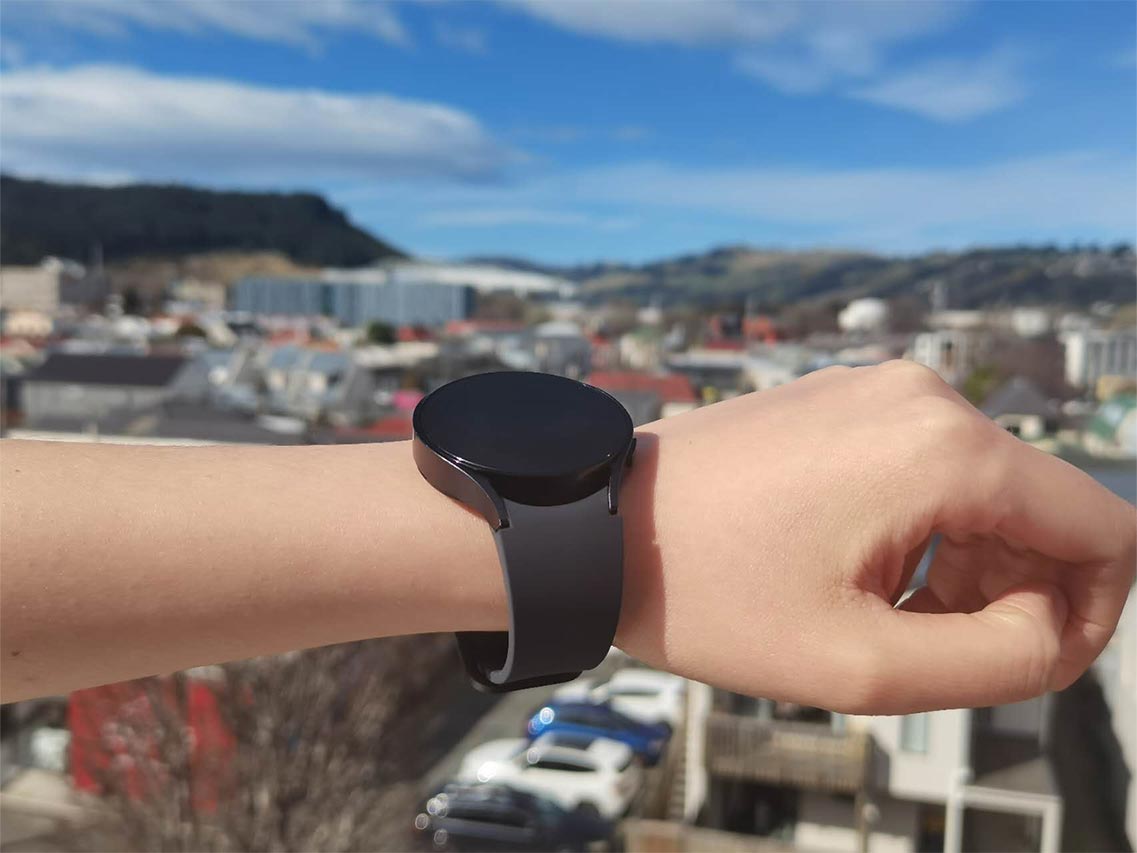
A new study by the University of Otago shows location tracking in smartwatches can be much more precise.
University of Otago – Ōtākou Whakaihu Waka researchers have developed algorithms that improve the precision of location tracking in smartwatches, a world-first development.

Associate Professor Robert Odolinski
Led by Associate Professor Robert Odolinski, a Visiting Researcher with Google from Otago’s School of Surveying, the research team demonstrated that a smartwatch determined its location with centimetre-level precision over four hours with a stationary setup.
This was done in collaboration with Google's Android Context group and Chinese Academy of Sciences.
This was achieved by using the Google GnssLogger app and combining precise signals from several global navigation satellite systems.
Results have just been published in the scientific journal GPS Solutions.
Associate Professor Odolinski says for decades, achieving centimetre-level positioning has required industries such as surveying, construction, and engineering to invest in expensive GPS equipment.
“While the use of the so-called carrier-phase signals has long been known to improve the positioning performance, the specialised antenna and receivers needed for this have traditionally come at a cost far beyond the reach of many who would benefit from the technology.”
GPS was introduced in a wearable watch in 1999, but hardware and power consumption limitations prevented it from tracking the carrier-phase signals needed for high-precision results.
Recent advances in smartwatches now make this possible.
“This is just the beginning of what wearable high-precision positioning can potentially achieve.”
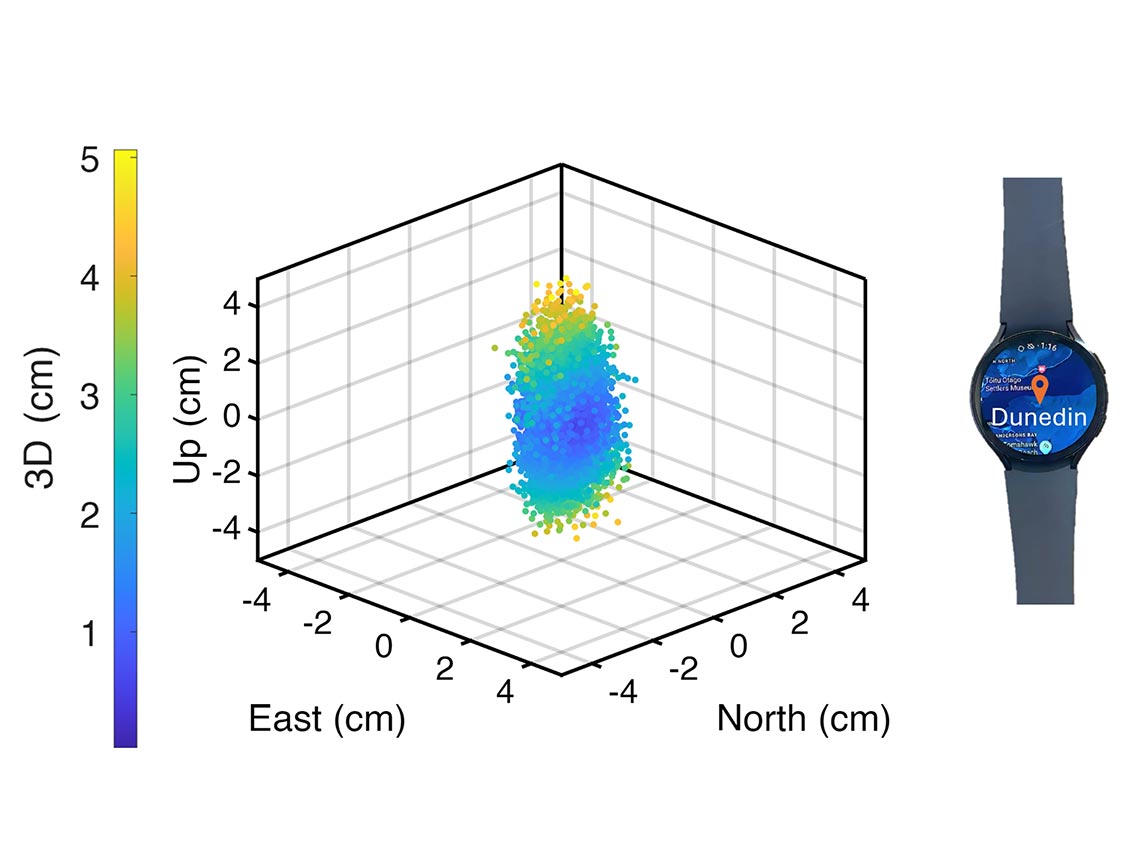
Precise centimetre-level positioning on a smartwatch during 4 hours of data in Dunedin, New Zealand. The dots show the repeatability of one second of data in comparison to precise benchmark coordinates. The repeatability of the positioning is about 8 cm, i.e. at most twice as large as the smartwatch diameter of 4 cm (displayed to scale).
Publication details
Phyo C Thu, Robert Odolinski, Yong Chien Zheng, Baocheng Zhang, Hongzhou Yang, Sean Barbeau, Mohammed Khider, Greg Leonard
GPS Solutions
School of Surveying
Surveyors and spatial scientists measure, model and analyse the world
Find out more