
Two University of Otago – Ōtākou Whakaihu Waka researchers, at either end of their careers, have received Royal Society Te Apārangi awards for their work.
Professor Cliff Abraham, of the Department of Psychology, received the prestigious Rutherford Medal, for breakthrough advances in understanding the neural mechanisms of memory and for providing inspirational leadership for the neuroscience community.
While Helena Abolins-Thompson (Ngāti Toa Rangatira, Ngāi Tahu, Rangitāne o Tamaki nui a rua), PhD candidate in the Department of Surgery and Critical Care, Wellington, received the Te Kōpūnui Māori Research Award, for demonstrating how Indigenous worldviews and community collaboration can enhance molecular biology studies, ensuring ethical, culturally responsive, and equitable representation in scientific data.
The awards were presented at a Royal Society Research Honours event in Wellington last night.
Vice-Chancellor Grant Robertson is thrilled their achievements have been recognised at a national level.
“Cliff is an internationally renowned neuroscientist who has made significant contributions to the field throughout his career; Helena may be at the start of hers but is already helping make meaningful changes in Māori health outcomes.
“They are both excellent examples of the world-leading researchers we have at Ōtākou Whakaihu Waka and I’m proud of them both.”
Rutherford Medal – Professor Cliff Abraham, Department of Psychology
The Rutherford Medal includes prize money of $100,000 and is awarded annually for research with national significance and international recognition.
Professor Abraham says it is a “tremendous honour” to receive the award.
“To be selected to join the ranks of the amazing previous recipients is truly humbling.”
He believes the success of his career has hinged on not just his own hard work and dedication, but that of those around him.
After completing his PhD at the University of Florida, he moved to Aotearoa New Zealand and found “wonderful colleagues, research staff and students” at Otago, across the motu, and internationally.
“The passion and drive of my students in particular has been inspirational and critical to our research gains and has helped keep me feeling young! Furthermore, I am grateful to the University and the Department of Psychology which have provided support and encouragement for my research career here,” he says.
Together, he and his colleagues have made fundamental discoveries into the capacity of the brain for plasticity that enables and guides memory formation, including a novel form of plasticity termed ‘metaplasticity’.
“We have also gained important insights into the molecular mechanisms of plasticity and metaplasticity, and an understanding of how these processes are impaired in various neurological disorders.
“These studies have led to more recent experiments testing new therapeutic approaches for treating neurological disorders such as Alzheimer’s disease, a line of work that that has been another highlight of my research career,” Professor Abraham says.
Funding support from government agencies such as the Health Research Council and the Marsden Fund, as well as publicly supported organisations such as the Neurological Foundation of New Zealand and the Otago Medical Research Foundation has been vital to the research.
Professor Abraham is also particularly pleased he has been able to help lead efforts to uplift neuroscience through increased collaborations, not only at Otago with the establishment of the Brain Health Research Centre, but across Aotearoa with other like-minded leaders, including through the Brain Research New Zealand Centre of Research Excellence.
In the future, he hopes his team’s work on therapies for dementias, which are showing significant promise so far, will continue to thrive and then lead to actual use in the clinic sometime in the not-too-distant future.
Professor Abraham pays special tribute to his wife, Philippa Youard, and the rest of his family, whose “incredibly important love and support” has sustained him in his mahi.
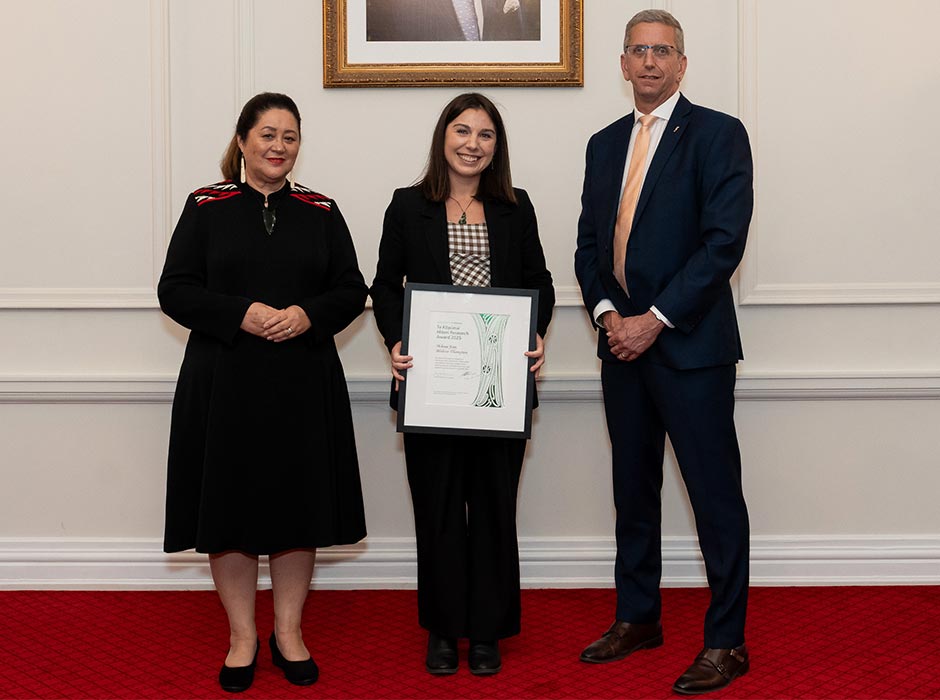
Helena Abolins-Thompson (Ngāti Toa Rangatira, Ngāi Tahu, Rangitāne o Tamaki nui a rua), pictured with Governor-General The Rt Hon Dame Cindy Kiro and Chair of the Royal Society Te Apārangi Academy Distinguished Professor Geoff Chase, received the Te Kōpūnui Māori Research Award. Photo: Royal Society Te Apārangi and Rebecca McMillan
Te Kōpūnui Māori Research Award - Helena Abolins-Thompson (Ngāti Toa Rangatira, Kāi Tahu, Rangitāne o Tamaki nui a rua), PhD candidate in the Department of Surgery and Critical Care, Wellington
Recognises early-career Māori researchers who demonstrate excellence and innovation in their work, in line with the dynamism that underpins both Te Ao Māori and Mātauranga Māori. It includes prize money of $2,500.
Ms Abolins-Thompson is both thankful to receive recognition for her research, and hopeful for what it will mean for whānau Māori.
“I am extremely grateful and humbled to have received this award. This project has been a feat of immense professional but also personal growth, so to be recognised in this manner by the Royal Society means a lot,” she says.
“I wouldn’t be in this position without the people who have helped me along the way, from the wonderful group of wāhine who have mentored and guided me, to my wider community – overall I feel extremely appreciative.”
In her research, she has been using precision medicine, genomics, and kaupapa Māori science to help rethink understanding and delivery of Māori health.
Her most recent study focused on cancer and cardiovascular diseases in Māori women in which she developed culturally informed practices to obtain samples of human tissues from these wāhine Māori.
She created 3D models of tumour organoids from some samples, to enable screening of potential therapies for cancers; RNA from cells in other samples was sequenced, using advanced next-generation techniques, to aid development of personalised medicines for Māori women that target the relevant genes.
One of the aims of the research was to highlight how standard healthcare practices can be adapted to be culturally appropriate through use of tikanga. Ms Abolins-Thompson is redefining translational research with and for Indigenous communities and connecting to Indigenous research networks around the world.
She was drawn to the area because of the opportunity to achieve better outcomes for people living with cancer but says her career path came down to meeting the right people at the right time.
“The opportunity to work with my community and to grow as a young Māori researcher alongside learning many new technical skills was a no brainer, it’s been such a privilege.”
She hopes her work will help achieve equitable cancer outcomes for everyone in Aotearoa, but especially whānau Māori.
“I’d love to keep contributing to this kaupapa and keep the momentum going, there’s an incredible bunch of Māori scholars coming through now, so I think it’s a really exciting time to be a researcher in this space, and to make some small but continuous changes for the better.”