
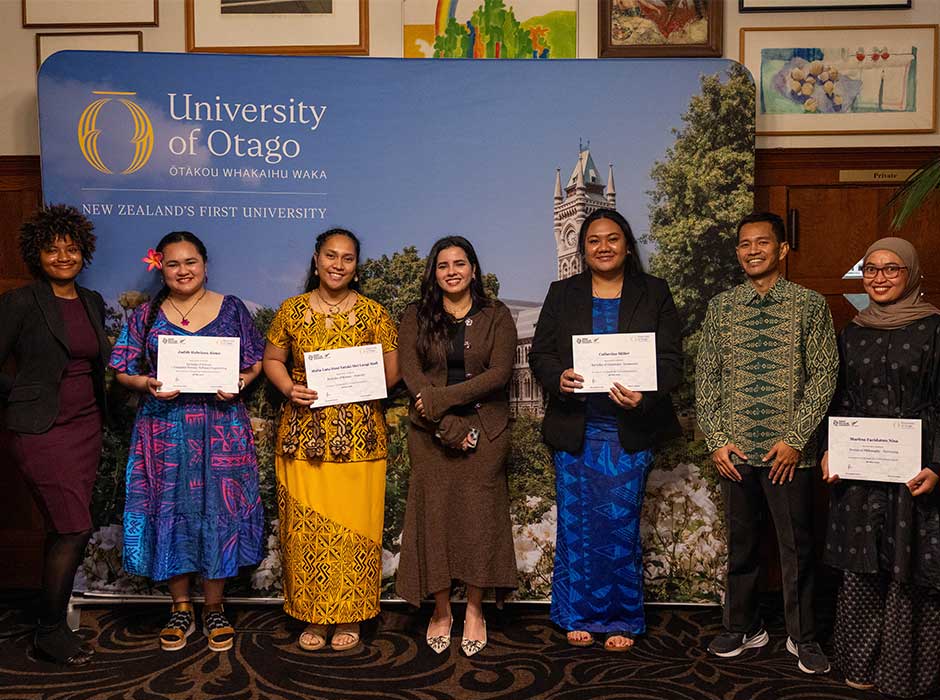
Celebrating at the recent Manaaki Scholars event are, from left, Nikita Danvill, (Jamacia), Judith Ainuu (Samoa), Latu Mafi (Tonga), Tala Alswaeer (Jordan), Catherine Miller (Samoa), Awang Hariyanto (Indonesia) and Maritsa Nisa (Indonesia).
Manaaki Scholars Latu Mafi and Maritsa Nisa spoke with communications adviser Koren Allpress about their time at Ōtakou Whakaihu Waka. They, along with several other scholars, were celebrated at a Manaaki Scholars event on 29 May.
From an “awkward” start to having a jampacked schedule – saying yes has resulted in Manaaki Scholar Latu Mafi making the most of every opportunity that has come her way during her time at Otago.
Latu, an Anatomy tauira, arrived in Dunedin from Tonga in 2023 at the start of Semester 2. For most Pacific tauira who arrive in Dunedin it’s not very common to not know anyone, she says.
“There’s always an aunt or an uncle somewhere, or a cousin who can sort of show you the ropes.
“All my siblings, my cousins, they're in Auckland, and most of my core family that I grew up with are in Tonga.
“I came to Dunedin with no family and virtually no friends… I was just this one person who came in the middle of the year, not knowing anyone.”
Initially it was difficult, she says.
“My solution to this was just ‘don’t say no’ to invitations unless I had school. If the reason I said no was because I was scared, that wasn’t a good enough reason.
“I really tried to participate in things, and soon enough, within a few weeks I was very comfortable at St Margaret’s College, and I made some really good friends.”
Her mid-year start – which was the result of circumstances beyond her control – also presented a challenge, as her degree is designed for Semester 1 starts, she says.
“The second semester start meant I was kind of twiddling my thumbs over what papers to take because I wasn't eligible for any of my prerequisite papers.
“And this was something I hadn't foreseen as someone straight from high school, and from the Islands. I felt like I was kind of, I wouldn't say thrown into the deep, but I was going in kind of blind.”
Latu was able to overcome this challenge with help from University course and career advisors. Making use of the papers available during Summer School also helped alleviate her “awkward start” and ultimately helped her finish her degree at the end of an academic year.
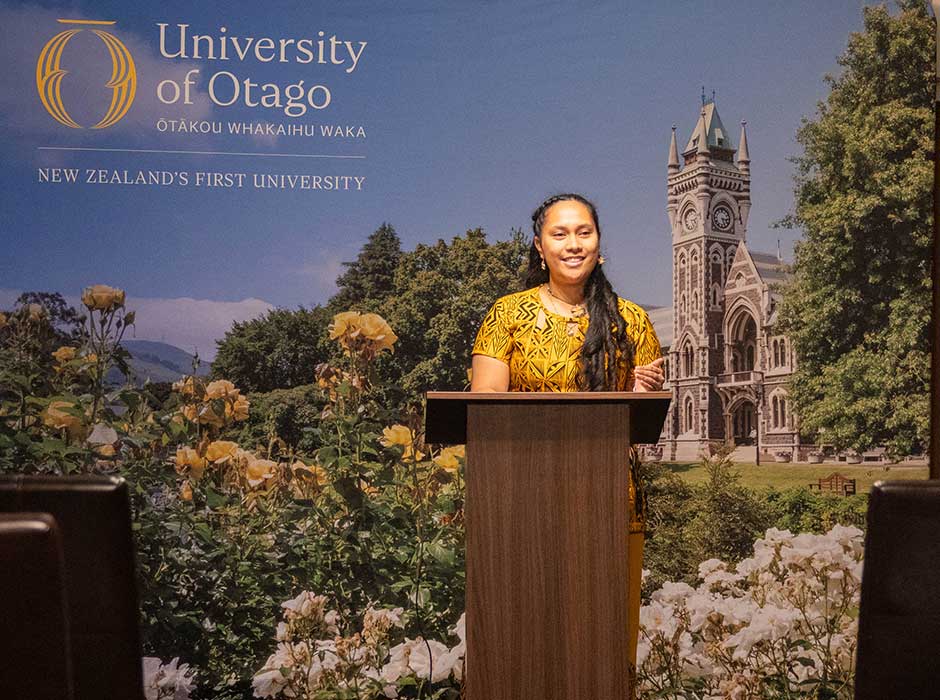
Manaaki Scholar Latu Mafi speaking during the recent event.
Another quirk to starting in the middle of the year meant Latu had three summers in between her academic years, instead of the usual two.
“In that third summer, instead of going home and enjoying my holiday, I took up a role as a research assistant in the ENHANCE lab for 10 weeks.
“I found that to be really fun and I learnt a lot of skills. Even though it wasn’t contributing points to my overall degree structure, it definitely contributed to my growth as a scientist.
While her goal is to get into Medical School, she’s been open to studying something other than Medicine and her summer research assistant role gave her an insight into the “world of research”, she says.
“I chose Anatomy because I actually want to get into Med School one day. But I was also just fascinated with the human body design, and why things are the way they are.”
In 2025 Latu volunteered to coordinate the Pacific dance item for St Margaret’s for the Inter-College Cultural Competition.
“That included choreographing a Tongan dance, and making space for the other Pacifika cultural identities at St Margaret’s, allowing them to teach me and the rest of the group.”
Pulling together outfits that were “as authentic as possible” proved to be more challenging than she anticipated as there were not many Pacific materials available in Dunedin, she says.
“I ended up having to have things sent from Auckland. It was a little bit stressful, more than I thought it would be, but I learned a lot from that role.”
Latu started out as a Peer Assisted Study Session (PASS) facilitator in 2025, before becoming a mentor in 2026, which is a role she’s very fond of.
“Normally mentoring is a full-year position, whereas I finish in the middle of the year, so they made an extra place for me because they wanted me to join their team.”
Latu has also helped welcome international students and lead an orientation for newly arrived Manaaki Scholars, which she says was “quite fulfilling”. She has also mentored tauira at St Margaret’s and tutors Chemistry at Disability Information and Support.
Outside of University, Latu co-leads a prayer group.
“The youth leaders of this small group said they needed someone who was sort of younger and proactive, so they asked me if I wanted the role.”
She has also loved singing as part of St Joseph’s Cathedral Choir.
“It takes me out of student-ville and gets me involved with families, nurses, scientists, people who are already in the throes of life.
“It’s been a great experience to know what it’s like outside of school.”
Latu says her parents both studied at Otago in the 1980s as “one of the few Pacific graduates at the time”, which was one of the reasons she chose Otago.
“The other reason being that it has such a superior sciences programme.”
Latu says it would be hard to identify one specific moment as a highlight of her time in Dunedin. Something that she has continually enjoyed is the beauty of the South Island.
“I’ve gone on some trips with friends and family to Queenstown, Lake Tekapo, and Christchurch. I’ve really explored what I could of the South Island, as well as the local hotspots of Dunedin.
“The community I’ve found has really made the ordinary days feel very fun.”
Through the highs and lows of Surveying
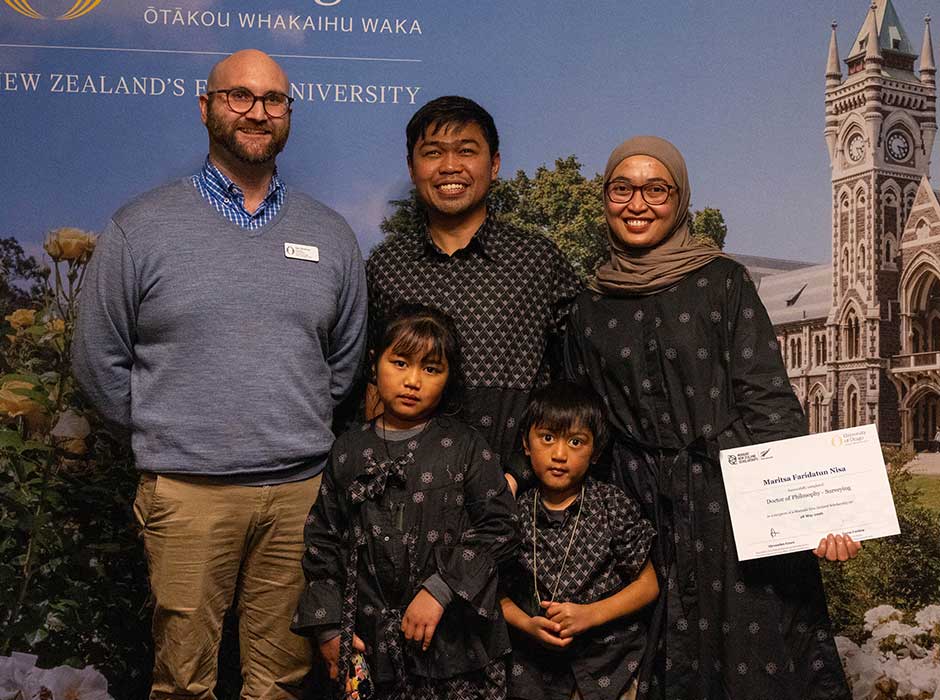
Manaaki Scholar Maritsa Nisa, far right, with her husband and their two children, and International Student Adviser Sam Mehrtens on the left.
As many Otago tauira can attest, studying far away from home can be challenging. Manaaki Scholar Maritsa Nisa knows this all too well, having come to Otago from Indonesia with her husband and two young children in tow.
Maritsa arrived in Dunedin in February 2023 to start her PhD at the School of Surveying. Her research looked at vertical land motion rate – the rate at which land rises or sinks each year – and the sea-level rise around the coastline of Indonesia.
Instead of relying on the estimated global sea-level rise, which she says is not uniform across the world, she used existing technology combined with sensors to calculate a more precise sea level rate to specific pieces of coast.
“In Indonesia we have more than 17,000 islands, and around 60 per cent of our population is on the coast.
“At the same time, my country is really prone to disaster, specifically prone to tectonic activity – numerous earthquakes happen which are one of the triggers for land subsidence or uplift."
Another trigger is sediment compaction and excessive groundwater extraction, both of which occur in some cities on the North Coast of Java island which is where Maritsa's husband is from.
Maritsa hopes her research will provide people with a clearer idea of what to expect in the future, and how to plan for it.
Subsidence is a topic that has held Maritsa’s interest since her undergraduate degree. At completion of her Masters Degree, where she continued her research in subsidence, she worked for a period of time as a lecturer before gaining the Manaaki Scholarship. She then started searching online for a suitable supervisor.
“One of Otago’s supervisors really, really matched with my interest and also has expertise in my field – Paul Denys.”
Throughout her PhD Maritsa found herself struggling at times, and her supervisors and colleagues were understanding and supportive.
“I can share my thoughts and I can share with them what I’ve been feeling.”
She was encouraged to rest until she felt ready to get back into her research.
“It’s ok to feel low. It’s also okay to step back for a moment and just stop what you’re doing.”
It’s also important to know your limits and seek help if you need it, she says.
Maritsa’s kids were aged one and three when they arrived. She loves that her kids are able to speak English throughout the day at daycare and school, and their teachers encourage them to speak their “mother language” at home to maintain a connection to their culture.
“It’s very nice for us.”
One of the things she and her family had to adjust to when they arrived was the weather.
“I come from a tropical country, we only have two seasons, and here we experienced four seasons and the extreme cold in Dunedin.”
Maritsa will return to her role as a lecturer at the Gadjah Mada University, Yogyakarta when she and her family leave Aotearoa New Zealand.
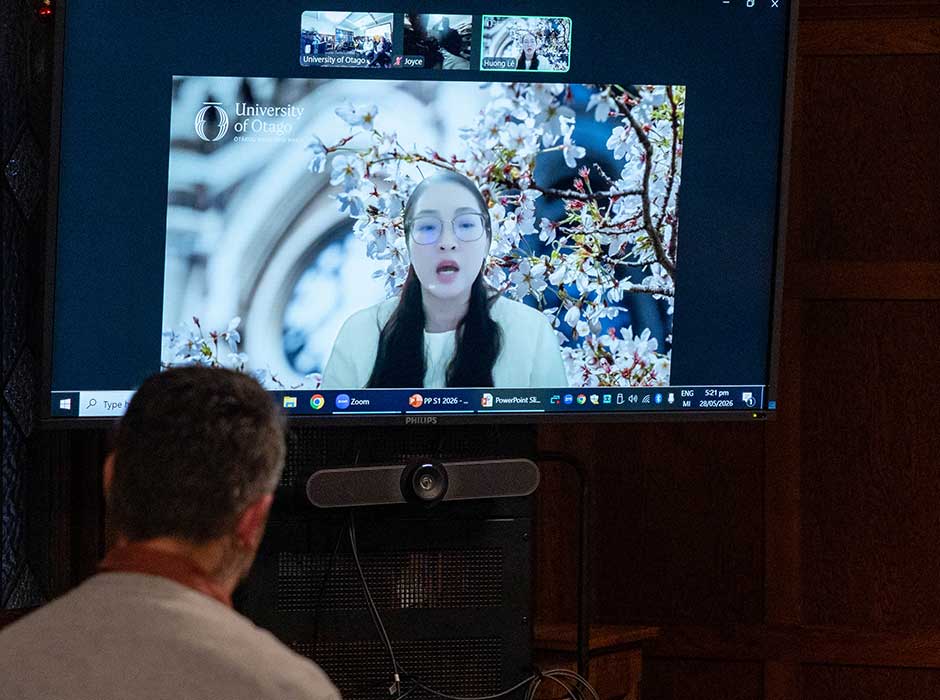
Manaaki Scholar Hương Lê (Vietnam) was unable to attend the event in person, but gave a speech over Zoom.
Previous Manaaki Scholar stories:
'A roller coaster in the best way'
The Manaaki New Zealand Scholarships provide opportunities for international students to study in Aotearoa New Zealand. The scholarships are offered to eligible citizens from developing countries and can be used for undergraduate or postgraduate study at universities or institutes of technology within Aotearoa.
Manaaki NZ Scholarships at University of Otago
The New Zealand Government offers full scholarships to eligible citizens from selected countries to study at New Zealand universities, including the University of Otago. These scholarships cover full-time undergraduate and postgraduate study at New Zealand universities. They include expenses such as tuition fees, return airfares, insurance, basic living costs, and set-up costs in New Zealand.
View